How a Telehealth App Moves You From Acne Photos to a Valid Prescription
Licensed clinicians review photos and medical history to issue valid acne prescriptions remotely.
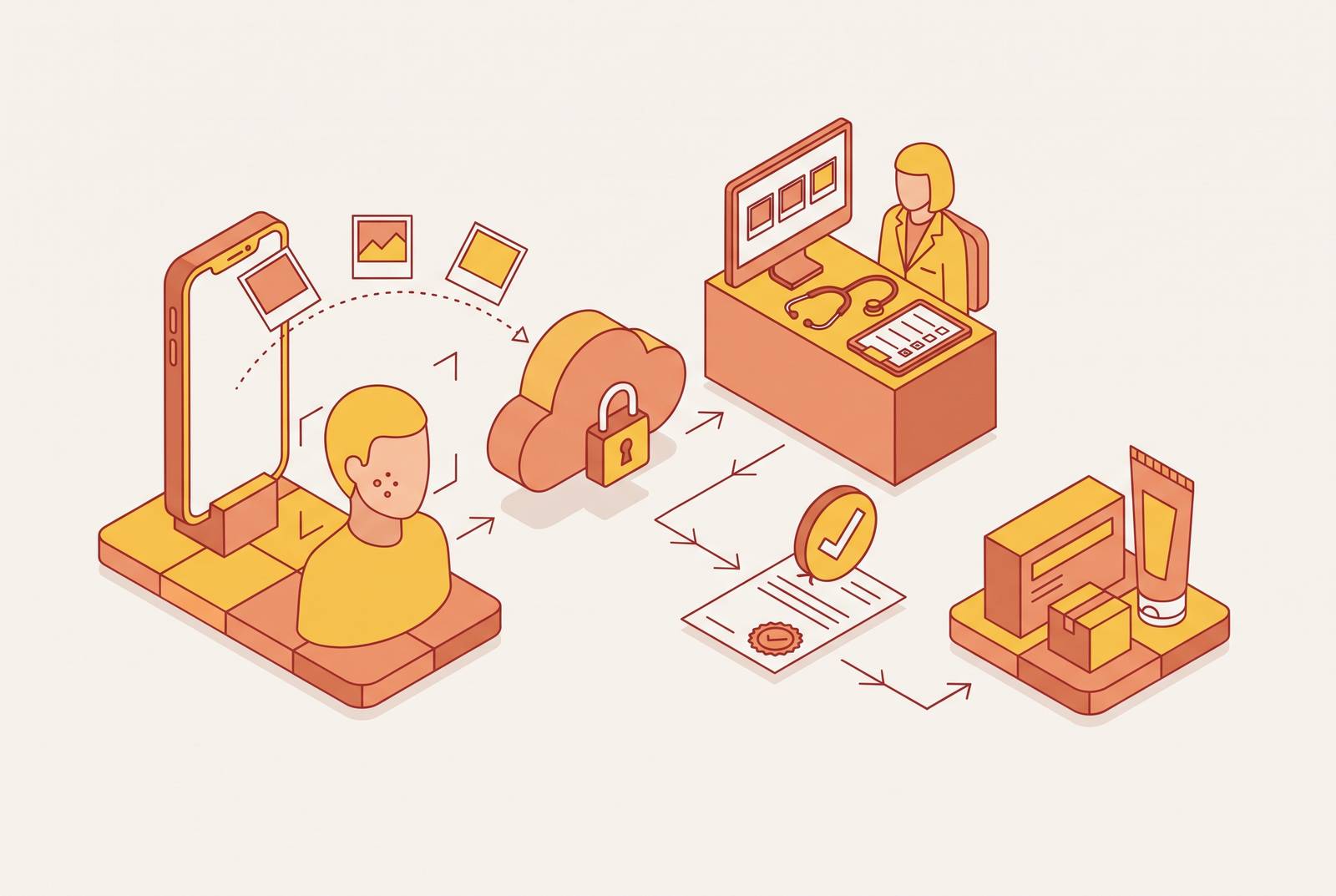
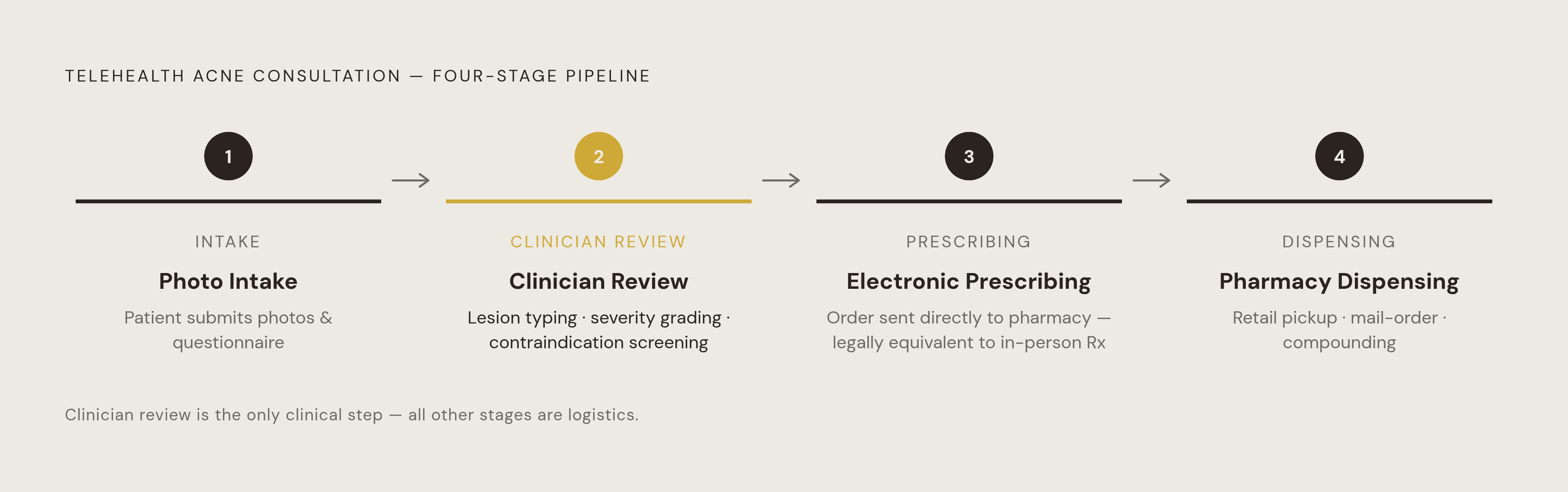
You can get prescription acne treatment online through a telehealth app when a licensed clinician decides that remote care is right for you. The process has four steps, which are photo intake, clinician review, electronic prescribing, and pharmacy dispensing. A valid prescription requires a clinical assessment, even when a patient has uploaded photos or asked for a particular medication.
Why acne is structurally suited to asynchronous telehealth, while most conditions are not
Acne puts much of its diagnostic information in view. Comedones, papules, pustules, and nodules can be assessed in well-lit photographs, while a written history supplies information about hormones, medications, products, and past treatment. Routine acne assessment does not generally depend on palpation or a biopsy to identify lesion types and grade severity. That makes photos unusually useful clinical evidence. Conditions that depend on texture, touch, or live back-and-forth are less suited to an image-based encounter.
This fit explains the use of store-and-forward teledermatology. The patient submits images and questionnaire answers, and the clinician reviews them later without requiring a shared appointment slot. The exchange is asynchronous, but it is still a consultation. It removes the scheduling friction of arranging an in-person appointment, and the review queue has no no-shows. Live video and hybrid care still have a role when a case is ambiguous or complicated.
The University of Pittsburgh Medical Center rosacea retrospective describes this same consumer-to-physician model. Patients sent images and questionnaire answers through a portal, and teledermatologists used the same portal to send back a diagnosis, treatment plan, and advice on follow-up. The protocol also provided a way out. When images or patient information were insufficient, clinicians recommended an in-person appointment.
Step one: what the photo intake actually asks of the patient, and why each element matters clinically
The submission is the clinical encounter. Without an in-person examination, the photos and questionnaire form the record the clinician has to assess. The pictures show what the skin looks like, while the history helps explain the presentation and which treatments may be suitable. Those inputs do different jobs. A clear image cannot disclose a medication interaction, and a detailed history cannot compensate for skin that is impossible to see.
The questionnaire therefore asks about current medications, birth control status, known allergies, skincare products, prior acne treatments, and relevant hormonal or medical history. What has already been tried helps the clinician judge the next treatment tier. Current medications and allergies inform the safety assessment. Hormonal history can also change the treatment choice. Specific descriptions of whiteheads, papules, or nodules help when lighting or an angle leaves the image ambiguous.
Patients need to take as much care with their photos as with their written answers. Studies that compare images sent by patients with those sent by clinicians generally find that patient photos vary more in quality, though most are still clear enough to assess. For patients, the practical guidance is straightforward. Natural daylight, a steady hand, and multiple angles, including close-up and wider views, give the reviewer useful visual information. Images of currently clear skin also provide a baseline and show which areas are unaffected.
A complete submission helps review proceed remotely. Missing information can hold up the paperwork. As the rosacea protocol illustrates, it can leave the clinician without enough evidence to make a remote diagnosis.
Step two: what a licensed clinician actually does during the review, and how a treatment decision gets made
The licensed clinician turns the intake packet into a treatment decision. That means identifying lesion types, grading severity, screening for contraindications, and deciding which treatment tier fits the presentation. Pregnancy and potential drug interactions are part of that screening. The review is not simply a product match. A comedonal presentation, inflammatory acne, and cystic acne can call for different decisions even when patients describe them all as breakouts.
Who performs the review varies by platform. It may be a board-certified dermatologist, primary care physician, nurse practitioner, or physician assistant working under a collaborative agreement. That distinction affects prescribing scope and the complexity that can be handled remotely.
The treatment logic follows four biological targets. Acne involves keratinous plugs in sebaceous ducts, excess sebum production, bacterial colonization by Cutibacterium acnes, and inflammation within the follicle. Topical retinoids such as tretinoin and adapalene bind to retinoic acid receptors, reduce keratinocyte proliferation, and treat both comedonal and inflammatory acne. Benzoyl peroxide acts against Cutibacterium acnes and has anti-comedonal properties, making adapalene combined with benzoyl peroxide an established, well-tolerated first-line combination.
A hormonal component can point toward another option. The FDA has approved four oral contraceptive pills for acne vulgaris, which work by reducing androgen-mediated sebum production. The JAAD Guidelines of Care for Acne Vulgaris describe these options for women who also desire oral contraception. This is where acne care and contraceptive prescribing overlap.
Isotretinoin involves iPLEDGE enrollment, lab work, and pregnancy testing, even when certified providers manage care through telehealth. Remote management does not remove those obligations. The clinician must distinguish a treatment that fits the ordinary asynchronous pathway from one that requires additional monitoring.
Step three: can you get an acne prescription through a telehealth app, and where does AI fit?
An electronic prescription sends the clinician’s medication order straight to the pharmacy the patient chooses. There is no paper slip to transfer. A telehealth prescription is legally equivalent to one issued in person when the applicable requirements are met. The electronic format changes how the order travels while preserving the requirement for a valid prescribing decision.
State law governs who may prescribe and under what conditions. The American Academy of Dermatology advises platforms to establish appropriate clinician licensure in the state where the patient receives virtual services, in accordance with state laws. Its standards allow exceptions for store-and-forward consultations where state law allows cross-state care. Location is therefore a prescribing input, too. The platform must match the patient with a clinician authorized to provide that care.
The law also calls for a record of informed consent, prescribing that meets each state’s rules, clear escalation pathways, and controlled prescribing protocols for higher-risk medications. These conditions work with the clinical review. Most platforms also send a written treatment plan. That plan explains what was prescribed, how to use it, expected side effects, and when to follow up, giving the prescription the context needed for daily use.
AI can assist without becoming the prescriber. Many platforms use it to flag lesion patterns, suggest severity grades, or pre-screen intake information before a clinician confirms, adjusts, or overrides the result. A licensed clinician still reviews each prescription before it is issued in most services. Software that helps a clinician make a decision differs from software that is allowed to decide what to prescribe.
A Utah pilot tests that second possibility with clear safeguards in place. Initially, a physician approves every prescription for a cohort of patients. The next stage allows autonomous prescriptions with daily physician review, followed by a stage in which a physician reviews a sample weekly. The system is limited to a short list of physician-approved topical treatments and predefined pathways, with cases outside those limits handed to a doctor.
That pilot is an exception to ordinary app-based care. Shah and Agarwal’s 2026 Cureus study found overall accuracy of 22% when testing consumer AI apps on the Stanford Diverse Dermatology Images database, with poor performance across skin tones. The finding is limited to consumer apps. It nevertheless reinforces why an AI-generated image assessment should not be confused with an accountable clinical decision.
Step four: how pharmacy fulfillment works, and what options exist between a local pharmacy and home delivery
After prescribing, the next choice is where to fill the order. Retail pharmacies widely stock standard generics such as tretinoin, clindamycin, and doxycycline, often with low-cost options through discount programs. The prescription travels directly from the platform to the chosen pharmacy. This route separates the consultation from dispensing.
Some platforms also support compounding pharmacies, which combine multiple active ingredients into one formulation. That can suit a prescribed combination regimen when a patient wants one product. Home delivery is also available when platforms work with mail-order or specialty pharmacies. Availability depends on the service being used. The Utah pilot, for example, offers home delivery or pharmacy pickup after prescribing.
The written plan connects these dispensing choices to treatment. It should explain the application method, expected timeline, and when follow-up or escalation is needed. Topical retinoids have a well-documented adjustment period involving initial irritation and dryness, which can lead patients to stop before treatment has time to work. Receiving the medication is only the beginning. Because response takes weeks to months to observe, built-in follow-up gives patients a route back to the clinician rather than leaving the next step entirely to their initiative.
How evidence from real asynchronous dermatology programs supports the pipeline's clinical soundness
The UPMC non-scarring alopecia retrospective assessed 321 cases from 2022–2023 and found that a definitive diagnosis was made remotely in the strong majority. Only a small fraction required in-person follow-up. The cases included androgenetic alopecia, alopecia areata, telogen effluvium, and traction alopecia. Patients outside Pittsburgh also used the service.
The rosacea retrospective compared asynchronous care with in-person visits across hundreds of cases. Teledermatology patients were more likely to present with new-onset rosacea, suggesting the channel was reaching people who might not otherwise seek care. This is evidence about access as well as assessment. It also demonstrates a practical clinical exchange in which images and history lead to a diagnosis, plan, and follow-up advice.
A 2022 study adds evidence directly about acne. It found that GAGS severity scores fell by a large amount in patients who received care through teledermatology. The studies looked at different conditions and measured different outcomes. Together, they support the clinical usefulness of remote dermatology for selected presentations, without proving that every remote service or every case will match in-person care.
The limits are part of that evidence. The rosacea protocol explicitly directed patients toward in-person assessment when the available information could not support a remote decision. Higher-risk treatment also retains its monitoring requirements, as isotretinoin illustrates. A sound pipeline needs both a way to proceed and a reason to stop.
What patients can do at each step to get the most out of a telehealth acne consult
Treat intake as a medical conversation. Answer the questionnaire specifically, including previous treatments, what failed and why, current products, medications, and relevant hormonal history. Do not rush past the treatment history. An in-person clinician can prompt for gaps in real time, while an asynchronous reviewer begins with what has been submitted.
For the photos, use natural daylight and a steady hand, with close-up and wider views from multiple angles. Include unaffected skin as well as breakouts so the clinician can compare areas. After review, use the platform’s secure messaging to clarify the plan. A response is an opening for questions. The useful goal is to understand why the medication was chosen and what its use will involve.
Before you pick up the prescription or have it delivered, read the treatment plan. Pay attention to application instructions, the expected adjustment period, and when to return or escalate concerns. At follow-up, take periodic photos with the same lighting and angle as the initial submission so the clinician has a comparable baseline. Consistency makes those later images more useful. The patient’s role is not to diagnose acne, but to provide clear evidence and stay engaged as the clinician assesses the response.