Benzoyl Peroxide Concentrations and Resistance Prevention
Benzoyl peroxide's broad-strike mechanism prevents bacteria from evolving resistance.
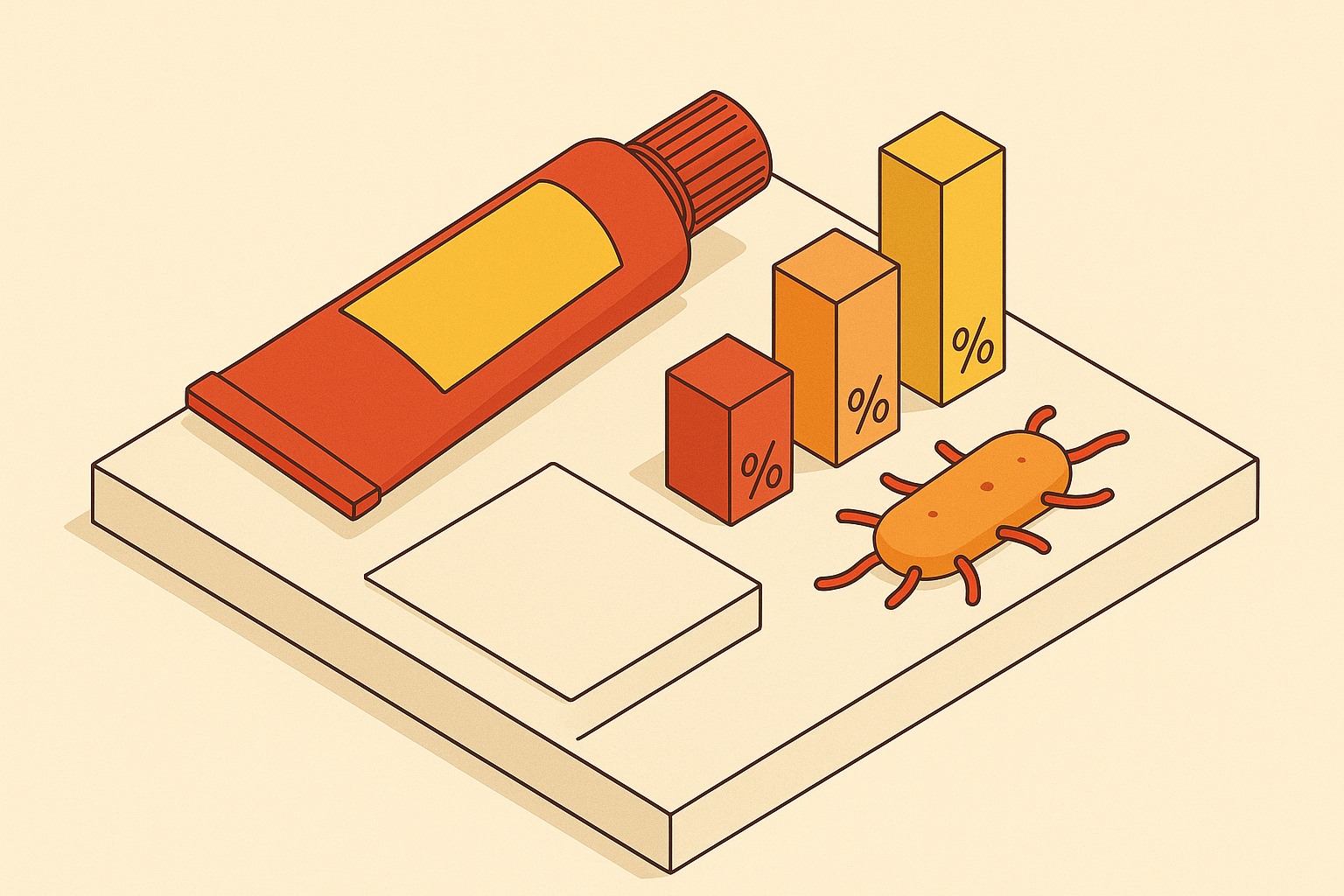
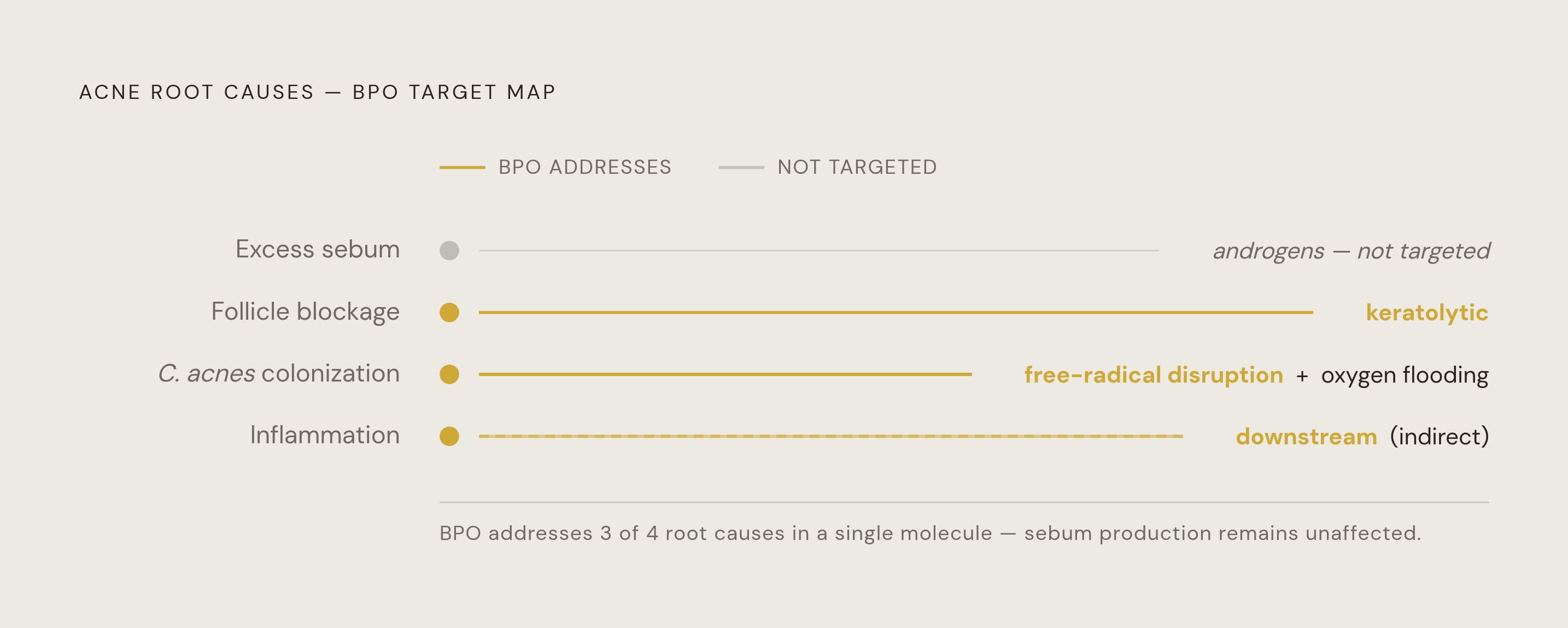
Benzoyl peroxide earns its place in acne treatment by doing more than one job at once. Acne develops through four overlapping problems: too much sebum from oil glands (driven largely by androgens), a buildup of keratin that clogs the follicle, colonization by the bacterium Cutibacterium acnes, and inflammation that follows. Most acne treatments pick one of these four and go after it. BPO goes after three.
The antimicrobial action starts with a simple chemical event. The peroxide bond in the BPO molecule splits apart and forms what are called benzoyloxy free radicals. These radicals don't target one specific protein or structure on the bacterium. They interact with bacterial proteins broadly, disrupting function wherever they land, and that disruption kills C. acnes. There's a second effect working alongside it: BPO pushes oxygen into the pore. C. acnes is anaerobic and needs a low-oxygen environment to survive. Flood that environment with oxygen and the bacterium loses the conditions it depends on.
The third pathway BPO addresses is hyperkeratinization, the buildup of keratin (a structural protein in skin) that clogs follicles and forms comedones, the small plugs that turn into both blackheads and inflamed pimples. BPO has keratolytic properties that break down that keratin buildup and help dead skin cells shed normally. Fewer clogged follicles means fewer comedones, and fewer comedones means fewer lesions downstream.
Put those three actions together: BPO works on bacteria, oxygen availability, and follicle blockage at the same time, all from one molecule. The way those free radicals kill bacteria, without aiming at a single target, turns out to matter for a reason that goes well beyond simple efficacy.
Why BPO cannot generate bacterial resistance
Antibiotics work by binding to one specific target on or inside a bacterium. Many acne antibiotics, for instance, bind to a ribosomal subunit (the 23S rRNA component of the 50S subunit) and block protein synthesis there. That precision is the antibiotic's strength, and it's also its weakness. A bacterium only needs one mutation at or near that binding site to survive the drug. Once that mutant survives and reproduces, resistance has taken hold in the population.
BPO doesn't give C. acnes a single site to mutate around. The benzoyloxy radicals it produces attack bacterial proteins broadly and without a fixed target, so there's no single mutation that could protect the bacterium from them. Adaptive resistance requires a specific vulnerability to adapt away from. BPO's mechanism doesn't offer one. Resistance to BPO, by this logic, is biologically ruled out by how the mechanism works.
This isn't a theory sitting untested in a lab. BPO has been in widespread clinical use for decades, and in that time, there's no documented case of BPO-resistant C. acnes emerging anywhere. The mechanism predicts no resistance, and the clinical record backs that prediction up.
That property, a treatment bacteria simply cannot evolve around, sounds almost academic until it's placed next to what's actually happening with the antibiotics acne treatment has relied on for decades.
The antibiotic resistance problem in acne treatment is now measurable and worsening
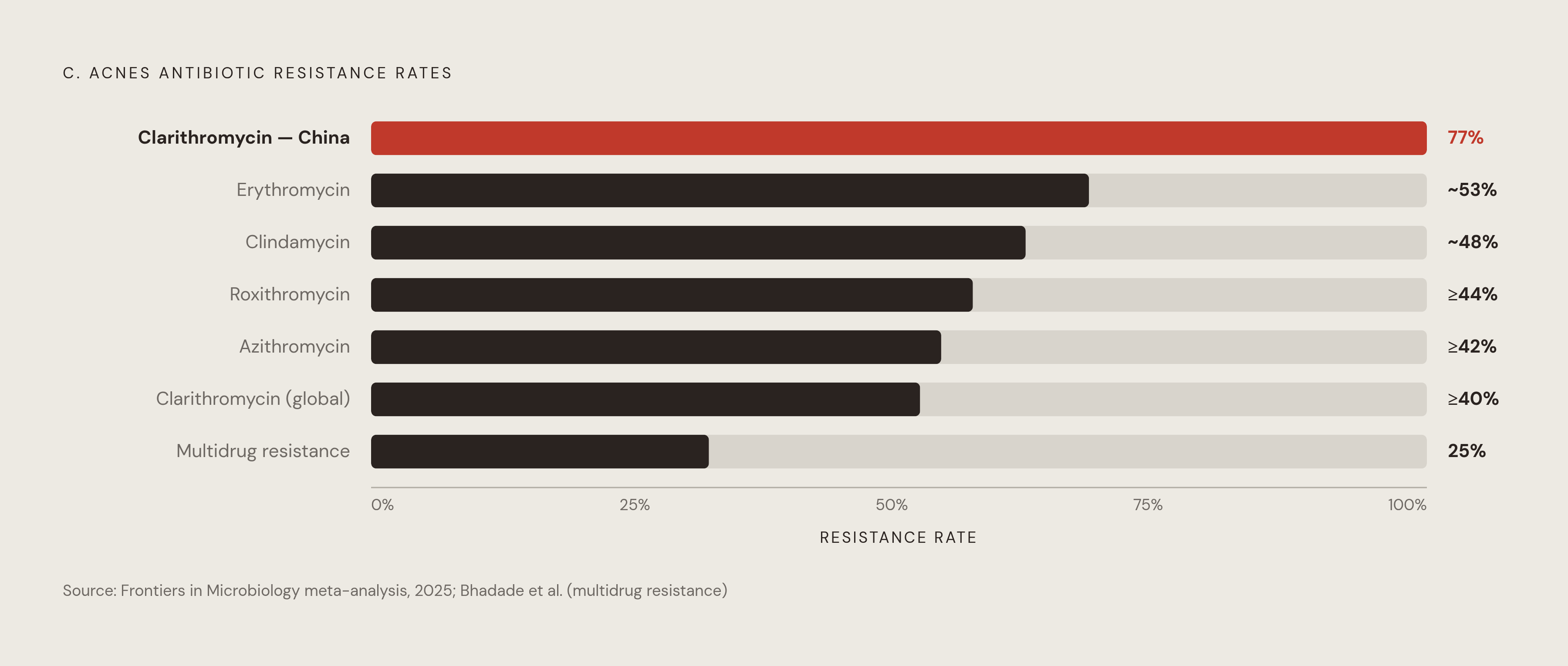
Antibiotic resistance in C. acnes isn't a distant worry anymore. It appears in lab data at rates that should concern anyone relying on antibiotics alone to treat acne. A 2025 systematic review and meta-analysis published in Frontiers in Microbiology found that looked at thousands of bacterial isolates and found resistance to macrolide antibiotics, including roxithromycin, clarithromycin, and azithromycin, near or above forty percent. Resistance to levofloxacin, erythromycin, and clindamycin wasn't just high. It was rising over time in a way the researchers could measure statistically.
Some regions show how bad this can get when antibiotic use goes unchecked. In China, clarithromycin resistance in C. acnes isolates reached approximately 77%, and the researchers behind that finding attributed it directly to overuse of antibiotics in acne treatment. A single number like that reframes the conversation: this isn't a hypothetical risk on the horizon, it's a treatment class losing its grip in real populations.
Multidrug resistance compounds the problem further. A study in the Journal of Family Medicine and Primary Care (Bhadade et al.) found that a quarter of the isolates tested showed resistance to two or more antibiotic classes at once. A bacterium resistant to one drug class is a problem. A bacterium resistant to several at the same time narrows the options a clinician has left to reach for.
What's driving this? Prolonged courses of antibiotics, prescribing that doesn't always match clinical need closely, and easy access to over-the-counter antibiotic formulations all play a part. None of those factors are going away on their own, and that is why a treatment that cannot be undermined by resistance, like BPO, functions less as a nice-to-have alongside antibiotics and more as a requirement.
How BPO protects the effectiveness of antibiotics used together
Dermatology guidelines don't frame this as a choice between BPO or antibiotics. The standard is BPO with antibiotics, because antibiotics alone drive the resistance described above. BPO doesn't just treat acne alongside an antibiotic. It actively works against the conditions that let resistant bacteria take hold.
The 2024 AAD Guidelines for Clinical Management of Acne Vulgaris reflect this directly. They include a good practice statement recommending multimodal therapy, meaning multiple mechanisms of action combined rather than relied on individually, alongside separate strong recommendations for topical benzoyl peroxide, retinoids, and antibiotics (including fixed-dose combinations of these). Combining antibiotic therapy with BPO lowers the rate at which resistance develops and improves treatment results at the same time. Those two outcomes aren't separate wins stacked on top of each other; they're the same mechanism showing up in two different measurements.
Topical clindamycin illustrates what happens without that protection. C. acnes has already developed resistance to clindamycin used alone, and current guidelines call for switching treatments if a patient doesn't respond within four to eight weeks. That's a documented failure window, not a worst-case scenario. Even in severe acne cases that call for oral antibiotics, BPO still belongs in the regimen, specifically because it suppresses the emergence of resistant strains while the antibiotic does its work.
The data on combination therapy backs this up in practice, not just in guidelines. A systematic review of eight randomized controlled trials examining adapalene combined with BPO found reductions in acne lesions ranging from roughly a quarter to more than two-thirds, with the 2024 review reporting results up to 70.2%. Side effects varied but stayed mild and resolved over time, and the combination was judged safe and effective overall. BPO's role in these regimens is established on both counts: it protects the antibiotic's effectiveness and it adds real, measurable results of its own.
Once BPO's role in treatment is settled, a more practical question follows close behind: how much of it does a patient actually need?
Why higher BPO concentrations do not deliver better outcomes
A common assumption trips people up here: stronger must mean better. With BPO, the clinical evidence doesn't support that assumption. Low, mid, and high concentrations perform similarly against acne lesions, while higher concentrations bring more irritation without adding benefit in return.
The January 2026 Texas HHSC Therapeutic Class Review states that concentrations higher than 2.5% are associated with more skin irritation and may not add any increased benefit. Head-to-head randomized controlled trials back this up. Lower concentrations of BPO reduce inflammatory lesions about as well as higher concentrations do, with a lot less irritation along the way. The highest formulations on the market produce results similar to mid-range concentrations, but with markedly higher rates of redness, dryness, and contact dermatitis.
Age matters here too. The 2025 Frontiers in Pediatrics review by Czyz, Yang, and Jafarian points to minimal irritation at low concentrations as a key reason BPO works well in younger populations, where sensitive skin is common and tolerance for aggressive treatment is lower.
What does this mean for someone standing in front of a shelf of products? Start with a low concentration, once daily. If that's tolerated well, move to twice daily before reaching for a higher concentration. Concentration should be the last lever pulled, not the first.
Why does this matter so much in practice? Because irritation doesn't just cause discomfort. It causes people to quit. A patient who develops severe dryness and redness from a high-concentration product is far more likely to stop using BPO altogether than one who sticks with a lower concentration that their skin tolerates. A treatment that's abandoned delivers zero benefit, no matter how strong the formula was on paper. Continuing consistently at a lower concentration beats quitting a stronger one. Once concentration is settled, the product's form, gel, cream, or wash, turns out to carry its own weight in how much of that active ingredient actually reaches the follicle.
Why the formulation and delivery vehicle can matter as much as the label concentration
Two products listing different concentrations on their labels can deliver very different amounts of active drug to the follicle, depending entirely on how they're formulated. The number on the front of the bottle tells only part of the story.
A leave-on, low-concentration gel can deliver more active BPO to the follicle than a wash-off product labeled at 10%. A cleanser spends maybe a minute or two on the skin before it's rinsed away, cutting short the time BPO has to penetrate the follicle. A gel stays on the skin and keeps working. The higher number on a wash-off label doesn't guarantee a higher delivered dose; label strength and effective strength can diverge, so a product isn't necessarily working harder just because it says so.
Matching the vehicle to skin type matters as much as picking a concentration. Gels tend to suit oilier skin well. Creams and lotions are better tolerated on dry or sensitive skin, where a gel might be too drying. Washes work well for body acne, where leave-on products risk irritating larger areas of skin for longer than needed.
For people with sensitive or dry skin, a non-comedogenic moisturizer applied after BPO has dried can help maintain a consistent routine without needing to cut back on dose just to manage dryness. Reading the concentration on a label is necessary. It's not sufficient on its own to know how a product will actually perform on a given patient's skin, and that same formulation question, how a product behaves under different conditions, shows up again in a very different context: how BPO holds up in storage.
The benzene finding and correctly stored BPO
A real safety question arose around BPO in 2024, and it deserves a direct answer. The concern centers on temperature and storage conditions, not on BPO itself when stored and used as directed, and the cancer risk tied to correctly stored products remains low.
The independent lab Valisure ran tests in March 2024 and found that benzene, a known human carcinogen, can form in BPO products. The important detail is how it forms: not through outside contamination, but through degradation of the BPO molecule itself under specific conditions. The FDA followed up by testing a large number of BPO-containing products on the market. The vast majority showed no detectable benzene. Six products exceeded the agency's daily intake limit of 2 ppm, some only under heat stress testing conditions and others as sold on shelves, and those six were voluntarily recalled at the retail level in March 2025. Even accounting for extended daily use of the affected products, the FDA found the risk of developing cancer from the benzene levels detected remains low.
The 2025 Frontiers in Pediatrics review by Czyz, Yang, and Jafarian looked at what happened after the initial alarm and reported that subsequent investigations have not demonstrated an increased risk of hematologic malignancies. The cancer signal that the initial testing raised concern about hasn't shown up in the retrospective data that followed.
Temperature is the variable driving almost all of this. A study in the Journal of Cosmetic Dermatology (Ho, Ho, and Duh) tested BPO products packaged in tubes and in dispensed ointment boxes, held at room temperature (about 25°C) and at high temperatures (40°C to 70°C) over six weeks. Benzene concentrations climbed sharply with heat in both packaging types, and tubes held at high temperature produced dramatically more benzene than ointment boxes at the same temperature. At room temperature, benzene stayed far lower across both packaging formats.
Formulation offers a path forward too. A study in JAMA Dermatology found that antioxidants such as BHT, when built into a formulation, significantly lowered benzene levels, giving manufacturers a concrete tool to reduce this risk at the source.
For a patient using BPO today, the guidance that follows from all this is straightforward: refrigerate BPO products where possible to slow degradation, and never leave them in a hot car or in direct sunlight. UV light and high heat both speed up benzene formation. Open-surface dispensed formats appear to accumulate less benzene than sealed tubes under high-temperature conditions. None of this requires abandoning BPO. It requires treating it the way any chemically active product deserves to be treated: kept cool, kept out of the sun, and used as directed.
Putting the framework into practice, choosing a concentration, building a routine, and knowing when to get clinical guidance
A patient who understands how BPO works, what the concentration evidence actually shows, and how storage affects the product has what's needed to use it well, and to recognize the point where a clinician's input becomes necessary.
For mild to moderate acne on normal or oily skin, a leave-on, low-concentration gel applied once daily is a reasonable starting point. If that's tolerated, moving to twice daily makes more sense than jumping to a higher concentration.
For mild to moderate acne on dry or sensitive skin, a low-concentration cream or lotion once daily, followed by a non-comedogenic moisturizer, gives the skin a chance to adjust. Increasing frequency before increasing concentration applies here just as it does for oilier skin types.
For body acne or acne on oilier areas like the back and chest, a 5% wash used once daily, left on for one to two minutes before rinsing, limits irritation while still delivering active drug to the area.
For severe or persistent acne, BPO alone is unlikely to be enough. Combination with a topical retinoid, or with an antibiotic alongside BPO, is the clinical standard at that point, and that's a decision that calls for a clinician's involvement.
What should a patient expect along the way? Improvement with BPO tends to build gradually rather than arrive overnight, and irritation in the first few weeks often settles as skin adjusts. A routine that starts conservative, respects storage guidance, and escalates by frequency before concentration gives BPO the best chance to do the three-pathway job it's built for, without the setbacks that come from pushing too hard, too fast.
Sources
- Created Date: 11/13/2024 Acne Agents, Topical Revised Date: 10/16/2025
- Benzoyl peroxide in the treatment of acne
- Differences in Benzene Concentration Across Packaging Types During Normal Use of Benzoyl Peroxide Products
- Safety and Efficacy of Fixed-Dose Combination of Adapalene and Benzoyl Peroxide in Acne Vulgaris Treatment: A Systematic Review of Clinical Trials
- Benzoyl Peroxide: Enhancing Antibiotic Efficacy in Acne Management
- Benzoyl peroxide: Uses, Interactions, Mechanism of Action