Tretinoin vs Retinol: Why the OTC Version Works Differently
Tretinoin is already active retinoic acid while retinol must convert first.
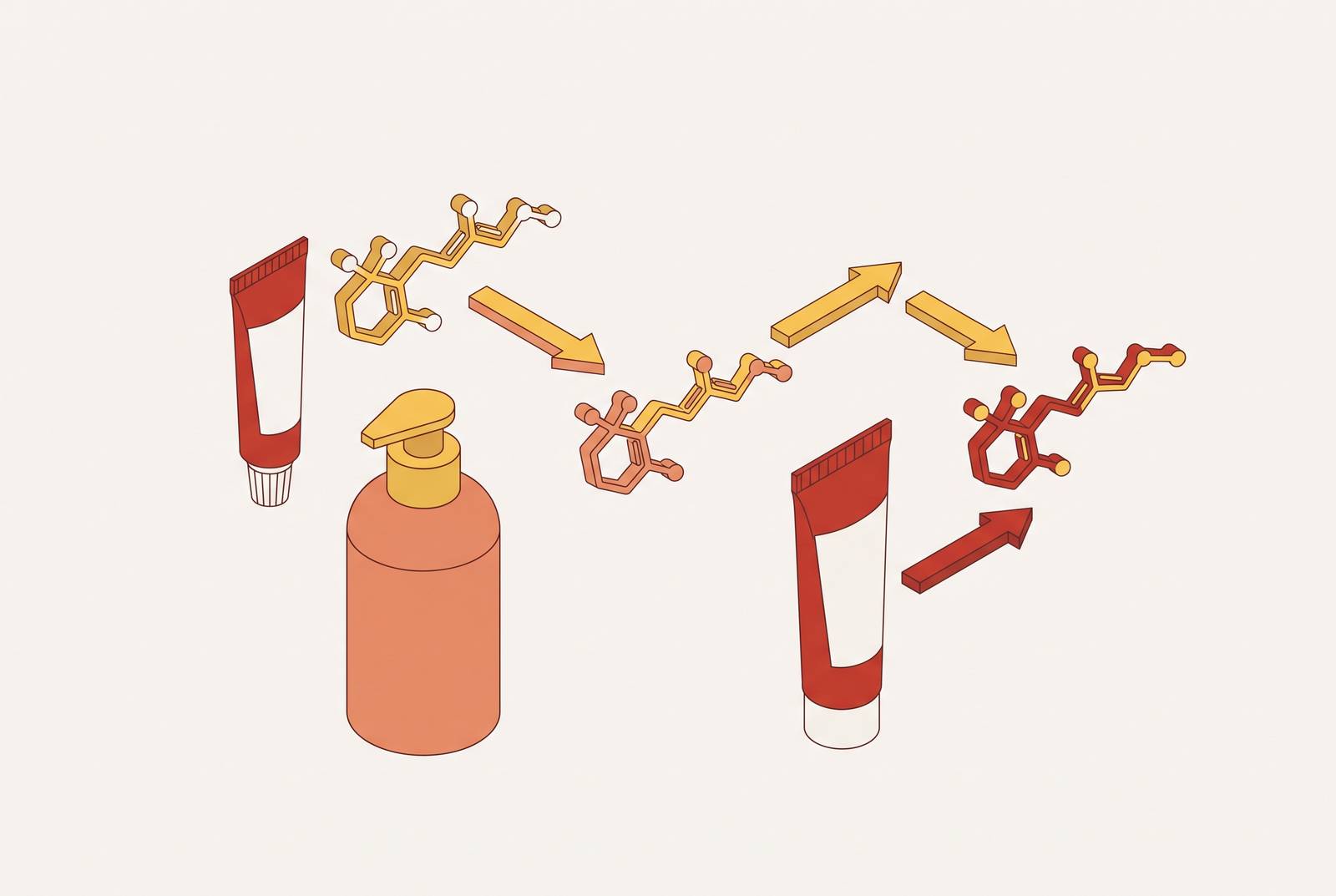
Retinol and tretinoin get lumped together constantly, same aisle, same marketing language, same before-and-after photos. But they don't work the same way, and the reason comes down to one biochemical fact: tretinoin is already retinoic acid, the form your skin cells actually respond to. Retinol isn't. It's a precursor that has to get converted before it does anything at all.
That distinction, active versus precursor, is the whole story. It's not about concentration, not about "clean" versus "medical grade," not about which brand formulated it better. It's about whether the molecule your skin needs is present the moment you apply it, or whether your skin has to go build it first. Everything else, speed of results, how strong the reaction feels, why one needs a prescription and the other doesn't, traces back to that single fork in the road.
The two-step conversion that makes retinol milder by design
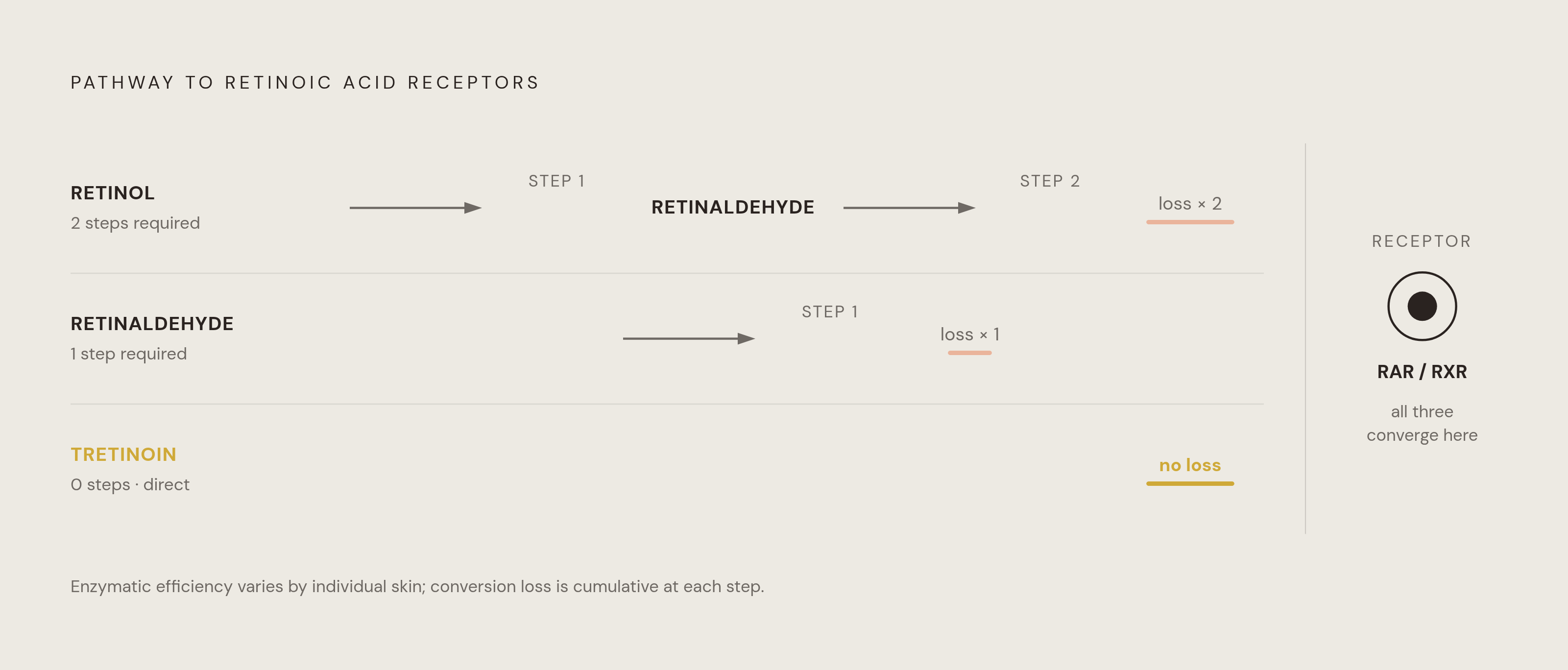
Here's the pathway retinol has to travel: retinol converts to retinaldehyde, and retinaldehyde converts to retinoic acid. Two separate enzymatic steps, both happening inside the skin, after you've already applied the product.
Neither step is perfectly efficient. Some retinol never makes it to retinaldehyde. Some retinaldehyde never makes it to retinoic acid. So whatever amount of retinol goes on your face, less of it arrives as active retinoic acid at the receptor sites that matter. Retinaldehyde (also sold as retinal) is in between, needing only that second step, which is why it's often positioned as the middle ground on the retinoid spectrum: faster than retinol, gentler than tretinoin.
Tretinoin skips the conversion. It's already retinoic acid when it goes on the skin, so the full applied dose is available immediately for cellular interaction. No lag, no loss, no waiting on enzymes to finish their job.
Both compounds, once converted or once applied in tretinoin's case, act on the same receptors: retinoic acid receptors (RARs) and retinoid X receptors (RXRs). These regulate gene transcription, which sounds abstract until you translate what it actually triggers, collagen synthesis goes up, matrix metalloproteinase (MMP) activity that breaks down collagen gets suppressed, and skin cells proliferate and differentiate at a faster clip. Same receptors, same downstream machinery. What differs is how much signal arrives and how fast.
The conversion delay isn't a design flaw. It functions as a built-in time-release mechanism, and for skin that would revolt against a full dose of active retinoic acid on day one, that slower drip is often the reason retinol is usable at all.
What the potency gap looks like in practice, and what the clinical evidence actually says
The number that gets repeated everywhere is that tretinoin is roughly 20 times more potent than retinol. It's a useful shorthand, but treat it as an estimate people cite rather than a figure with precise clinical backing. What's better grounded is the actual trial data on each compound.
Tretinoin has the deeper evidence base, and it's not close. A 2025 systematic review and meta-analysis covering 8 trials and 1,361 patients (ages ranging roughly 29 to 76, follow-up periods from 16 weeks out to 2 years) found topical tretinoin significantly improved both fine wrinkles and coarse wrinkles compared to vehicle. A separate 2025 review of 25 studies found tretinoin consistently effective across clinical and histological measures of photoaging, and superior to retinol, glycolic acid, and antioxidants on most outcomes measured. Longer term, a 2-year placebo-controlled trial of 0.05% tretinoin in 204 subjects showed improvements in wrinkling as early as 1 month, sustained out to 24 months, applied just once daily.
Some of the histological changes appear within 15 days. One high-strength study found compaction of the stratum corneum and increased epidermal thickness after just 15 days.
This detail complicates the assumption that stronger tretinoin always means stronger results: after 48 weeks, both 0.1% and 0.025% tretinoin produced statistically similar epidermal thickening (30% versus 28%, against an 11% decrease for vehicle) and similar increases in vascularity (100% versus 89%, against a 9% decrease for vehicle). The gap between a "strong" prescription strength and a mild one is smaller than most people assume.
Retinol's evidence, while thinner, is more encouraging than its reputation as "tretinoin's weak cousin" suggests. Vehicle-controlled data across 6 studies (352 women, age 30 and up, mild to moderate photodamage) found 0.1% retinol significantly improved crow's feet, facial wrinkles, uneven tone, brown spots, and overall photoaging. Improvements in fine lines and radiance appeared by week 2, with hyperpigmentation and wrinkle improvement significant by week 4. Tolerability was notably good, only 3 subjects experienced peeling and 1 experienced redness, all mild to moderate and resolved by week 8.
One head-to-head study even found retinol's clinical outcomes for photoaging didn't differ meaningfully from tretinoin's. That's a real finding, though direct comparisons like it remain rare, so it's not grounds for assuming parity across the board.
Where the evidence clearly favors tretinoin: acne. A leading dermatology body's guidelines strongly recommend prescription topical retinoids based on systematic review, and cosmetic retinol simply doesn't have an equivalent evidence base there. A 2025 network meta-analysis in Scientific Reports, spanning 23 randomized controlled trials and 3,905 participants, found isotretinoin, retinol, and tretinoin all improved fine wrinkles significantly, with isotretinoin ranked highest for efficacy, but tretinoin showing the most favorable safety profile among the group.
One more thing retinoids of any strength cannot fix: deep, pitted atrophic acne scars. Those are structural damage, not a cell-turnover problem, so no topical retinoid rebuilds that tissue. That's a job for fractional lasers, microneedling, subcision, or fillers, a different category of treatment.
Why the conversion gap also explains the side-effect profile
More retinoic acid arriving faster means more cellular disruption, and more disruption means a more visible reaction on your face. Retinol's conversion delay works as a buffer against that. Tretinoin, with no delay, hits harder and faster, for better and worse.
The "purging" phase people associate with tretinoin comes from accelerated cell turnover. Normal skin cycles through roughly every 28 days; tretinoin compresses that to somewhere around 14 to 21 days. That speed pushes underlying comedones to the surface faster than they'd otherwise emerge, so skin often looks temporarily worse in the first 2 to 6 weeks before it improves. It's a known, expected phase, not a sign the product is wrong for you.
Photosensitivity is another consequence of that same immediacy. Tretinoin is understood to raise UV sensitivity by up to 50%, which makes broad-spectrum SPF 30+ non-negotiable, even for a quick walk to the mailbox. Retinol carries the same photosensitivity risk in principle, just less acutely, since less active compound is present at any given moment.
None of this makes retinol the "better" option by default. It makes it the appropriate option for skin that can't tolerate an immediate, undiluted signal. Sensitive skin, rosacea-prone skin, skin new to retinoids entirely, these are contexts where the slower ramp is a feature, not a consolation prize.
Serious reactions are uncommon but real. Allergic responses, facial swelling, severe burning, or contact dermatitis occur in fewer than 5% of patients using tretinoin, and any of those warrant stopping use right away. Tretinoin also carries a hard line retinol doesn't: it's not considered safe during pregnancy or while nursing, due to potential fetal risk. And layering matters early on, combining tretinoin with benzoyl peroxide, salicylic acid, or vitamin C early in treatment can cause chemical burns. Other actives need to wait until the skin has adjusted.
How to manage tretinoin's adjustment period without abandoning it
Every piece of titration advice for tretinoin comes back to the same idea: slow the exposure down until the skin catches up. You're not changing the biology, just pacing it.
A common starting protocol looks like this: 0.025% concentration, applied every third night for two weeks, then stepped up to every other night. That pacing meaningfully cuts the risk of severe irritation compared to jumping straight to nightly use. Some dermatologists also recommend the "retinoid sandwich," moisturizer first, then tretinoin, then another layer of moisturizer on top. That buffer can reduce irritation by around 40% while still letting the drug do its job, it just slows absorption slightly rather than blocking it.
Retinol's ladder looks different because the concentrations sold over the counter (typically 0.05% to 1%) already carry a wider margin of safety. A standard approach starts with twice-weekly use and builds gradually toward nightly application as the skin adjusts.
Is a stronger retinol always the smarter buy? Not if irritation stops you from using it consistently. A 1% retinol that causes enough redness and flaking to keep it in the medicine cabinet three weeks out of four delivers less cumulative benefit than a 0.3% formula applied reliably every night. Adherence is part of the efficacy equation, not separate from it.
Sun protection isn't optional during any of this. Given the photosensitivity increase tied to retinoid use generally, it's a clinical requirement, not a nice-to-have.
What should you expect along the way? Initial dryness and flaking, sometimes called the retinization period, typically occurs in weeks 1 through 4 and is considered normal. Purging, especially with tretinoin, typically occurs within the first 2 to 6 weeks before resolving. Neither means the product isn't working. It usually means it is.
Who is best served by retinol, who needs tretinoin, and what determines the line
Go back to the conversion pathway, because that's really the deciding question: does your skin concern, sensitivity, and timeline justify going straight to active retinoic acid, or does it make more sense to work through the slower conversion process first?
Retinol tends to be the smarter starting point when skin is new to retinoids altogether, since building tolerance gradually is the clinically sound approach. It also fits mild concerns well, early fine lines, slightly uneven texture, preventive use in someone's twenties or thirties who isn't chasing aggressive correction. Sensitive skin, or skin with conditions that would flare under full-strength retinoic acid, generally does better easing in. And around the eyes specifically, retinol or retinaldehyde are generally the better-tolerated choice for that area given the delicacy of the skin around the eyes.
Tretinoin becomes the clinically appropriate call in a different set of situations. Acne is the clearest one, AAD guidelines support prescription topical retinoids here, and retinol doesn't have comparable evidence behind it for that purpose. Moderate to severe photoaging is another, both the 25-study review and the meta-analysis referenced earlier show tretinoin outperforming retinol across most measured outcomes in that population. If speed matters, whether for clinical reasons or personal timeline, and the skin can be titrated through the adjustment period safely, tretinoin is built for that. And for melasma or post-inflammatory hyperpigmentation, tretinoin has randomized controlled trial and prospective study support that retinol simply doesn't match at this point.
The prescription requirement itself is arguably part of what makes tretinoin valuable, not just a hurdle to clear. It comes packaged with dosing suited to your specific skin, some form of monitoring, and guidance on managing the rough first weeks, rather than just a stronger molecule handed over with no oversight.
And carry forward that concentration nuance from earlier: choosing 0.025% versus 0.1% tretinoin changes tolerability more than it changes the histological outcome. Since histological outcomes at 48 weeks looked similar across both strengths, starting low and actually tolerating the routine produces results comparable to chasing the highest available dose.
The real cost comparison between OTC retinol and prescription tretinoin
Assuming OTC retinol is the cheaper, more accessible option doesn't hold up once you look at the actual pricing. A 2025 study in the Journal of Cosmetic Dermatology examined retinol products across 9 retailers, CVS, Neiman Marcus, Nordstrom, Sephora, Ulta Beauty, Walgreens, Walmart, and other major retailers, with data collected between October 20 and December 21, 2023, in Pennsylvania and New Jersey. The finding: price had no correlation with how much retinol was actually in the product. You could be paying a premium for a bottle with less active ingredient than a cheaper one sitting two shelves over.
Compare that to generic prescription tretinoin, where a $15 tube can outperform a $20-plus OTC retinol on acne, fine lines, and skin texture, backed by a stronger evidence base, adjustable dosing, and clinician oversight built into the process. At the pharmacy, most insurance plans cover generic tretinoin at a modest out-of-pocket range per tube, and even paying out of pocket, the cost often lands comparable to, or below, a mid-range retinol serum.
So the barrier to tretinoin was never really price. It's the prescription requirement itself, an access problem more than a cost or efficacy one. Which raises the obvious next question: how do you actually get that prescription without eating weeks of wait time and a few hundred dollars in consultation fees?
How telehealth has changed access to tretinoin prescriptions
Getting a tretinoin prescription used to mean booking a dermatologist visit, and that typically carried a hefty price tag with a wait that could stretch for weeks depending on the practice.
Telehealth changed the shape of that process. Most platforms now run on an asynchronous, or store-and-forward, model: upload clear photos of the skin concern, fill out a detailed medical history (current medications, allergies, anything tried before), and a licensed provider reviews it and issues an electronic prescription, usually within 24 to 48 hours. That prescription gets sent straight to the pharmacy of your choice.
Virtual consultations built around tretinoin now often run at a fraction of the cost with a licensed provider, a sharp drop from the price range of an in-person dermatologist visit. That's not a replacement for an ongoing clinical relationship, and it isn't meant to be, but for the acne and photoaging indications where tretinoin already has its strongest evidence behind it, it's a reasonable and increasingly common first step.
A few platforms illustrate how varied this landscape has become. Several telehealth platforms offer online tretinoin options at competitive monthly prices. Some platforms take a more tailored approach, with providers selecting the strength and vehicle based on individual skin and history with a response within 24 hours, or higher-tier visits with faster turnaround times.
The mechanism hasn't changed, retinol still needs converting, tretinoin still arrives active. What's changed is how fast someone can get the prescription that puts the active form in their hands.
Sources
- Tretinoin vs Prescription Retinol Your 2025 Pick
- Tretinoin for Photodamaged Facial Skin: Systematic Review and Meta-Analysis of Randomized Controlled Trials - PMC
- Comparative efficacy of topical interventions for facial photoaging: a network meta-analysis | Scientific Reports
- 6 Common and Serious Side Effects of Tretinoin
- doctronic.ai
- doctronic.ai
- ktvz.com