Skincare Products That Cause Acne Breakouts
These products clog pores and trigger breakouts you won't connect to them.
Some skincare products don't just fail to stop breakouts. They cause them. The clinical term is acne cosmetica, a documented condition. It's a documented condition, first described by Kligman and his colleagues back in 1972, referring specifically to acne triggered or worsened by cosmetic products themselves.
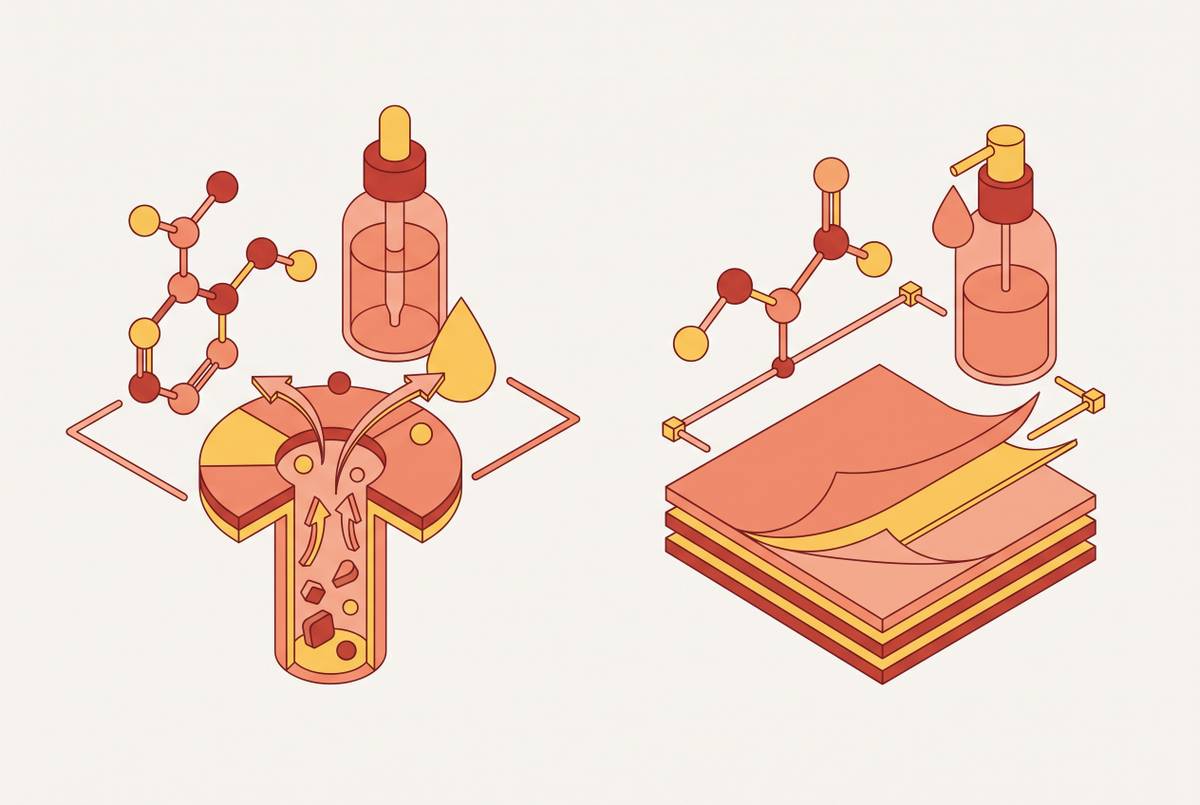
The mechanism happens at the level of the pore. Comedogenic ingredients get trapped inside hair follicles along with oil and dead skin cells, and that trapped material becomes food for bacteria, setting off the inflammatory chain reaction that produces blackheads, whiteheads, and the deeper, angrier lesions people associate with breakouts. That inflammatory piece matters. Niacinamide calms inflammation and supports barrier function without clogging pores, directly counteracting two of the mechanisms by which acne cosmetica develops.
What makes this especially tricky to catch is who it shows up in. Regular teenage acne tends to follow a predictable pattern tied to hormones and development. Acne cosmetica instead shows up unpredictably, unmoored from any developmental stage. It appears in adults who've never dealt with serious breakouts before, so few people, including the person experiencing it, connect it back to a product sitting on their bathroom shelf.
Recent clinical evidence backs this up in a controlled setting. A 2025 case-control study out of Sun Yat-sen Memorial Hospital found that specific product categories, facial cleansers, foundation, and powders, were each independently linked to acne risk.
Acne cosmetica can take up to six months to show up after a product enters someone's routine, which makes it genuinely hard to diagnose without knowledge of the ingredient. By then, the obvious suspects, a new serum, a new sunscreen, get blamed, while the actual trigger sits untouched in the same spot it's occupied for half a year.
Why the "non-comedogenic" label can't be trusted
The words "non-comedogenic" printed on a bottle feel like a promise. They aren't one. A peer-reviewed clinical review in JAAD Reviews, covering literature from 1972 through 2025, found that brands can slap "noncomedogenic" onto a label with no requirement to prove it, because no standardized test or regulatory body actually governs that claim. Anyone can write it. Nobody has to check it.
Comedogenicity got measured using a flawed method from the start. The original assay used rabbit ears to grade how pore-clogging an ingredient might be, and that method produced results that didn't hold up consistently when applied to actual human skin. A rating built on a flawed test carries that flaw forward into every label that cites it.
A second layer of trouble comes from how comedogenicity testing typically looks at single, isolated ingredients, not the finished product someone actually puts on their face. That misses combination effects. Ceteareth-20 and cetearyl alcohol, for instance, don't register as comedogenic on their own, but combined, which happens constantly in standard moisturizer formulas, they become a pore-clogging pair. Testing each ingredient in isolation simply can't catch that.
None of this gets solved by shopping "clean" or "natural" instead. Ingredient origin tells you nothing about how that ingredient behaves once it's sitting in a pore. A highly refined mineral oil with a low comedogenic rating can actually be gentler on acne-prone skin than an unrefined natural oil carrying a high one. Marketing language about purity and nature has no bearing on pore behavior, so it should not stand in for safety.
None of this means labels are lying on purpose or that the whole system is rigged against consumers, but the label alone isn't enough information to act on. The real fix is reading past the front-of-bottle claims and into the ingredient list itself, which is where the next section picks up.
Ingredient categories most likely to cause breakouts
Knowing categories of problem ingredients, and understanding the mechanism behind each one, holds up better over time than memorizing one static list of names. Products change their formulas. The underlying categories don't.
Comedogenic oils and heavy emollients sit at the top of the list. Coconut oil and isopropyl myristate are among the most well-documented pore-clogging ingredients out there. Coconut oil in particular is high in lauric acid and rich enough to seal bacteria inside the pore despite its reputation as a gentle, natural ingredient. Other confirmed offenders in this same family include cocoa butter, lanolin (found often in moisturizers and lip balms), palm oil, isopropyl palmitate, laureth-4, and unrefined mineral oil. Isopropyl myristate and its relatives, isopropyl isostearate and myristyl lactate, deserve a specific mention because they turn up in some acne medications, including certain tretinoin formulations. That's a reminder that ingredient literacy matters even when the product on the label is marketed as a treatment. On the safer end, lighter oils like jojoba oil and argan oil more closely mirror the skin's own sebum, making them generally better tolerated by acne-prone skin.
Silicones are next. Dimethicone and similar silicone polymers lock in moisture, which sounds beneficial, but they can also trap debris and bacteria underneath that seal if they aren't cleansed off thoroughly. The risk isn't inherent to silicone as a category. Silicone traps debris and bacteria when a dimethicone-heavy product sits on the skin overnight without being properly removed.
Drying alcohols and fragrance make up a third category, and this one trips people up because of a naming confusion. Drying alcohols, denatured alcohol, ethanol, isopropyl alcohol, strip away the skin's protective barrier. The skin responds by overproducing oil to compensate, which creates a rebound effect that often worsens congestion rather than fixing it. Fatty alcohols are a completely different animal. Cetyl alcohol and stearyl alcohol are emollients that are generally fine for acne-prone skin. Fragrance, both synthetic and so-called natural, carries its own risk through allergic contact dermatitis, with compounds like limonene and linalool as common triggers, producing redness, itching, or bumps that look a lot like acne while breaking down the same barrier that's supposed to keep bacteria out. Essential oils, peppermint, eucalyptus, citrus, belong in this same bucket. Their natural origin doesn't make them safe; it just makes them fragrant in a different way.
Sulfates show up constantly in cleansers and shampoos. Sodium lauryl sulfate and sodium laureth sulfate are foaming agents that strip natural oils from the skin and disrupt the barrier, which makes it easier for other irritants to get in. Gentler surfactants, coco glucoside among them, clean just as effectively without that same stripping effect.
Algae extract gets marketed heavily for hydration and anti-aging benefits, but it's high in iodides, which can trigger inflammation and pustules. It also penetrates deep into pores, which can speed up the formation of micro-comedones, the earliest, invisible stage of a clogged pore.
Physical exfoliants round out the list. Crushed walnut shells and apricot kernel scrubs create tiny tears in the skin, and those micro-tears trigger inflammation that can drag breakouts out longer instead of clearing them. Chemical exfoliants, salicylic acid, glycolic acid, lactic acid, do the same job of clearing dead skin without the physical damage.
Hair and makeup deserve their own mention since they're easy to overlook. Hair oils, gels, and pomades migrate off the scalp onto the forehead, temples, and cheeks, producing comedones and inflammatory bumps along the hairline, a pattern dermatologists refer to as pomade acne. Foundation and powders carry their own documented risk, with heavy powder formulas acting as a common vector for comedogenic pigments. D&C Red dyes, built from xanthenes, monoazoanilines, fluorans, and indigoids, are documented comedogenic colorants found especially in blushers.
Which product types carry the most risk in daily use
The 2025 Sun Yat-sen Memorial Hospital case-control study offers the clearest real-world picture of where the risk actually concentrates. Among acne patients in the study, 62% were using facial cleansers containing comedogenic ingredients, a rate significantly higher than the control group, and moisturizers with comedogenic ingredients appeared at a meaningfully elevated rate among acne cases as well.
That cleanser finding deserves a second look, because it cuts against a common assumption. Cleansers get rinsed off within seconds, so most people assume that whatever they're made of can't do much harm. The study's results say otherwise. After adjusting for age, occupation, parental history of acne, and diet, facial cleansers containing comedogenic ingredients, specifically anionic surfactants, still held up as an independent risk factor for acne. Contact time turned out to matter less than expected. Formulation mattered more.
Powders showed the same pattern. Even after the researchers controlled for those same background variables, powders remained a statistically significant independent risk factor. Moisturizers added another layer to the picture: the relationship was dose-dependent, so more frequent use tracked with higher risk. That points to something practical. How much product contact someone has matters just as much as what's actually in the product.
The study's ranking of risk by category, facial cleansers first, then powders, then foundation, gives a natural audit order for anyone trying to figure out what in their routine might be causing trouble. Start with whatever touches the face most often and gets used without a second thought, since that's usually the cleanser. Check the powder next.
That audit sequence matters because of the delayed-onset effect: a breakout showing up now might trace back six months, and the cleanser used every single day for those six months is a far more likely suspect than whatever got added to the routine last week.
Reading a product label to find the ingredients that matter
Reading the full ingredient list beats trusting any single marketing claim on the front of a bottle, whether that claim says "non-comedogenic," "natural," "clean," or "gentle." None of those words carry regulatory weight, but the ingredient list does.
Ingredients are listed roughly in order of concentration, so something near the top is present in a much larger amount than something buried near the bottom. A comedogenic oil sitting third or fourth on a long list is a real concern. That same oil appearing second-to-last is a lot less worth worrying about.
Knowing the difference between drying alcohols and fatty alcohols prevents one of the most common label-reading mistakes. Denatured alcohol, ethanol, and isopropyl alcohol strip the skin. Cetyl alcohol and stearyl alcohol are fatty alcohols that moisturize rather than dry out skin, and lumping them in with the first group means avoiding ingredients that were never the problem. The same logic applies to sulfates: SLS and SLES strip the skin's oils, while coco glucoside cleans just as well without that effect. Knowing the actual ingredient names lets someone avoid the ones that cause problems while keeping the ones that don't, something a category label can't do.
A few practical tools make this easier. Comedogenicity scales exist online for looking up unfamiliar ingredient names one at a time. Keeping a personal running list of ingredients that have caused a reaction in the past is more useful than any generic avoid-list someone else compiled, since skin reactions vary person to person.
| Instead of | Consider | |---|---| | SLS / SLES | Coco glucoside | | Coconut oil | Jojoba oil or argan oil | | Denatured alcohol / isopropyl alcohol | Cetyl alcohol or stearyl alcohol (for moisturizing, not cleansing) | | Physical scrubs (walnut shell, apricot kernel) | Salicylic, glycolic, or lactic acid |
Simpler formulas with fewer total ingredients make it much easier to trace a reaction back to its source when one shows up. Simpler formulas offer a diagnostic advantage because fewer variables means fewer suspects. Before committing to full-face use of anything new, patch testing on a small area first is the recommended starting point, especially for anyone already prone to breakouts.
Ingredients that actively support acne-prone skin, as a counterweight to the avoid list
An avoid-list only tells half the story. Knowing which ingredients actively support acne-prone skin gives label-reading a positive target for what to seek out.
| Ingredient | What it does | |---|---| | Salicylic acid | Oil-soluble beta hydroxy acid that penetrates into the pore itself to exfoliate from the inside, making it one of the most targeted over-the-counter options for clogged pores | | Niacinamide | Calms inflammation and supports the skin's barrier without clogging pores, directly working against two of the mechanisms behind acne cosmetica | | Hyaluronic acid | Hydrates the skin without the heaviness of occlusive emollients, giving acne-prone skin moisture without the comedogenic risk that heavier ingredients carry | | Zinc oxide | Soothes irritation and carries antimicrobial properties, and shows up in many non-comedogenic mineral sunscreens, which matters because daily sun protection isn't optional: unprotected sun exposure worsens inflammation and darkens post-acne marks | | Glycolic acid / lactic acid | Alpha hydroxy acids that speed up cell turnover, helping prevent the buildup of dead skin that leads to pore congestion |
When clinical treatment becomes necessary
Cutting comedogenic ingredients out of a routine can meaningfully reduce product-triggered breakouts, but it has limits. It can't touch acne driven by hormones, bacteria, or genetics, and persistent, cystic, or clearly hormonal acne calls for a clinical treatment plan rather than another round of label-reading.
The AAD's 2024 guidelines establish topical retinoids (adapalene, tretinoin), benzoyl peroxide, and topical or oral antibiotics as first-line therapy, treatments that require clinical evaluation to match to the right patient. Matching the right one of those to the right person isn't a guessing game done at home. It calls for clinical evaluation, since the same medication that clears one person's skin can irritate another's past the point of use.
Hormonal acne works through an entirely separate mechanism. Androgens bind to receptors on the sebaceous glands and drive excess sebum production directly, and no amount of ingredient substitution touches that pathway at its root. Product changes address what goes onto the skin, while hormonal and bacterial drivers operate from inside the body, and telehealth dermatology care, built around clinician oversight and treatment plans matched to the individual, exists for the cases where hormonal and bacterial drivers are at work.
Sources
- A Case-Control Study Exploring the Association Between Cosmetic Use and Acne Risk: Implications for Prevention and Clinical Practice - PMC
- Comedogenicity in cosmeceuticals: A review of clinical relevance, regulatory gaps, and future directions - ScienceDirect
- CLINICAL REVIEW Comedogenicity in cosmeceuticals: