Hyaluronic Acid Molecular Weight and Skin Penetration
Smaller hyaluronic acid molecules penetrate skin while larger ones hydrate the surface.
Hyaluronic Acid Molecular Weight and Skin Penetration.
Hyaluronic acid's identity and purpose in skin
Size is the whole story here, and most people never get told that. A large HA molecule sits on top of skin and holds water there. A small one gets inside and talks to cells. A PubMed search in January 2024 for articles on low-molecular-weight hyaluronic acid published between 2003 and 2023 yielded 864 results https://www.emjreviews.com/dermatology/article/update-on-low-molecular-weight-hyaluronic-acid-in-dermatology-a-scoping-review-j030124/.
Skin's extracellular matrix is built from collagen, elastic fibers, proteoglycans, and GAGs, and hyaluronic acid is one of the core pieces of that scaffold. HA is itself a glycosaminoglycan, a large linear polysaccharide found throughout the body but concentrated heavily in that matrix. Its usefulness comes from one blunt physical property: it grabs water and does not let go, binding up to 1,000 times its own volume in the stuff https://pmc.ncbi.nlm.nih.gov/articles/PMC4602392/. That is the entire reason it exists in skin. It pulls water in from the dermis below and the air above, then holds it in the outer layer, the stratum corneum. No other molecule in skin does this job at this scale, so when a product claims to hydrate, HA is usually the mechanism actually doing the pulling.
Difficulty of crossing the stratum corneum for topical ingredients
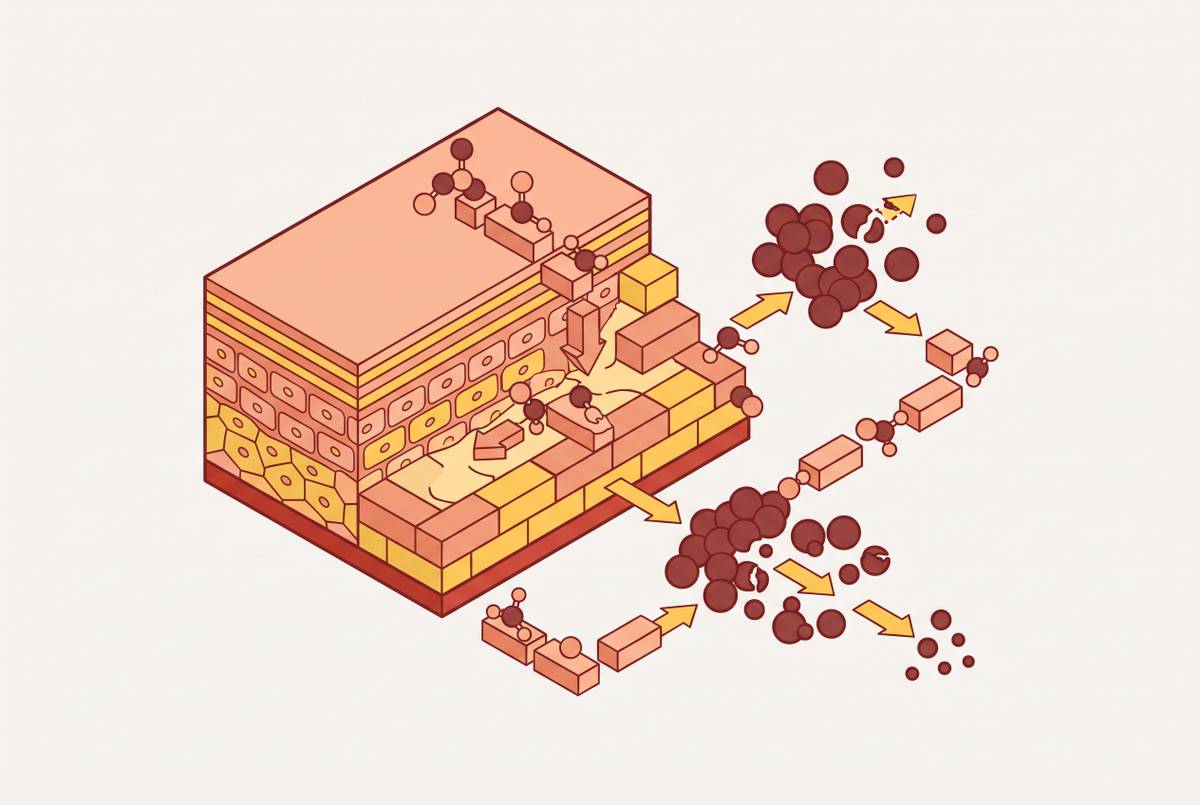
Skin is not sitting there waiting for ingredients to soak in. The stratum corneum is a barrier by design, built from flattened dead cells called corneocytes packed together with layers of lipids, saturated fatty acids, cholesterol, ceramides, that fill every gap between them. Dermatologists describe it as bricks and mortar, and the phrase holds up under scrutiny: corneocytes are the bricks, lipids are the mortar, and together they are built specifically to keep things out.
That is where molecular weight matters most, carrying the whole story rather than serving as a technical footnote. Weight, in this context, is really a stand-in for size: a molecule small enough slips through the mortar, while a larger one gets stopped cold. Native hyaluronic acid, in its natural biological state, runs somewhere between 1,000 and 4,000 kilodaltons https://www.laladaisy.com/hyaluronic-acid-molecular-weight/. At that size, it cannot cross the stratum corneum on its own, and that is not a formulation failure or a cheap product cutting corners. It is a structural fact about how skin is built. The barrier is doing what it evolved to do, and no amount of clever marketing changes that math.
High-molecular-weight HA's function and clinical usefulness at the skin surface
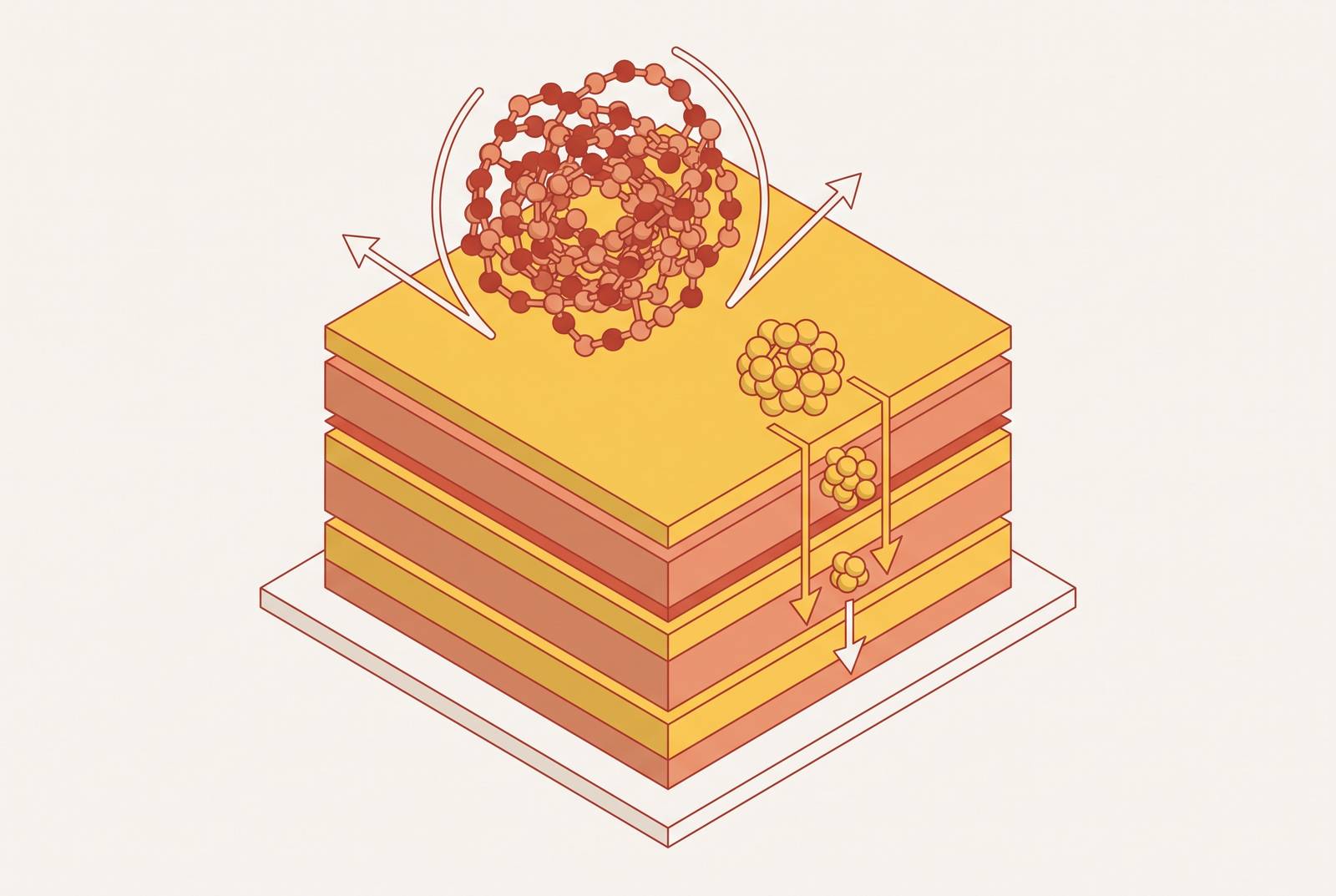
Giant HA molecules cannot get past the stratum corneum. Does that make them useless? Not even close, and this is where a lot of skincare criticism gets it backwards. High-molecular-weight HA, sometimes formulated as large as 2 million kilodaltons in cosmetic products, stays in the upper epidermis and on the surface, unable to reach deeper layers https://pmc.ncbi.nlm.nih.gov/articles/PMC4602392/. Staying on the surface is the point, not a limitation to apologize for.
At the surface, that HA forms a film that binds water molecules and locks them against skin. A serum with high-MW HA can make skin look plumper within minutes of application. The same film cuts down on transepidermal water loss, the technical term for water evaporating out of skin into the air. By sitting on top and slowing that evaporation, the film preserves moisture already present rather than adding anything new. Bigger HA molecules also thicken a product and stabilize the film it leaves behind, which is a large part of why a well-made HA serum feels a certain way on skin and holds up over the course of a day. None of that requires the molecule to go anywhere near the dermis.
Effects of Low-Molecular-Weight HA in the Epidermis and Dermis
Everything changes once the molecule is small enough to get in. Below a certain threshold, HA stops behaving like a passive sponge and starts behaving like a signal, and treating it as just a fancier moisturizer at that point misses what is actually happening.
Once inside, LMW-HA fragments interact with cell-surface receptors, including CD44, RHAMM, TLR2/4, ICAM-1, and Layilin, which triggers biological signaling rather than simple physical hydration. That receptor activity is what separates low-molecular-weight HA from an ordinary moisturizer. Gene expression research backs it up: LMW-HA affects how keratinocytes differentiate and how they build the tight junction complexes between cells, structures marked by proteins like ZO-1 and claudin-1. Those markers happen to be exactly the ones that decline in aged and sun-damaged skin, which is a strong hint that this fragment is doing repair work, not just topping off a water reservoir.
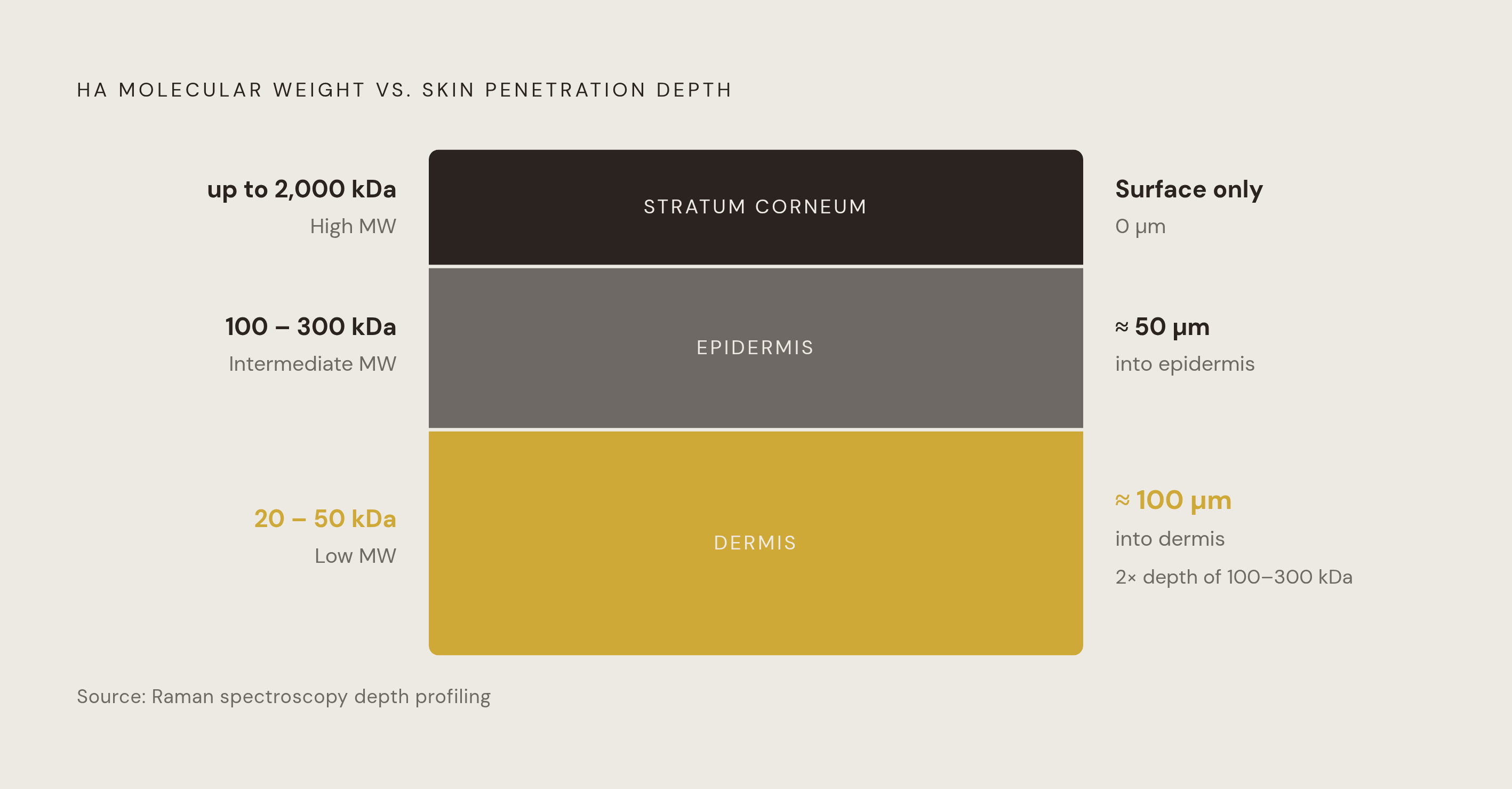
The depth difference by weight class is not subtle. LMW-HA, starting around 50 kDa, reaches the epidermis and, at lower weights, the dermis. Cutting the molecular weight by less than a quarter doubles the depth, a strange kind of leverage for one variable to have. According to Raman spectroscopy data from the Essendoubi et al. study, intermediate-MW HA (100–300 kDa) reaches approximately 50 µm, while low-MW HA (20–50 kDa) reaches approximately 100 µm.
Sodium hyaluronate versus hyaluronic acid on a label
If you flip over almost any HA serum, the ingredient list probably reads "sodium hyaluronate," not "hyaluronic acid." Sodium hyaluronate is the sodium salt of HA, made by neutralizing the acid with sodium hydroxide. It is more water-soluble, holds up better through formulation and manufacturing, and tends to run slightly smaller than HA at an equivalent weight range. Pure hyaluronic acid, in comparison, is finicky: less stable, prone to breaking down under heat or pH shifts, and hard to keep consistent on a shelf over months. That instability is the actual reason sodium hyaluronate shows up in the overwhelming majority of commercial formulas, not some marketing preference for one name over the other.
Neither name tells a buyer anything about depth of action. The molecular weight, the one number that actually decides whether an ingredient is on the surface or reaches the dermis, is almost never printed on the packaging. A shopper comparing two serums side by side, one labeled hyaluronic acid and one labeled sodium hyaluronate, is comparing two names that both obscure the only variable that matters https://www.emjreviews.com/dermatology/article/update-on-low-molecular-weight-hyaluronic-acid-in-dermatology-a-scoping-review-j030124/.
Multi-Weight and Broad-Spectrum Formulations in Applied HA Science
That is not a hypothetical. These blended formulations already exist, and the research behind them is starting to explain why they work better than single-weight products.
In a 24-hour reconstructed human epidermis assay, HA20 showed greater apparent permeation detectable by ELISA at all time points compared to high-molecular-weight HA alone. That result matters beyond the one molecule tested, because it shows penetration enhancement is not limited to tiny fragments. Even mid-sized, macromolecular HA can be pushed deeper with the right formulation strategy.
A separate technique called vectorization pairs high-molecular-weight HA with bentonite clay. The logic follows that if HMW and LMW HA do different things at different depths, a formulation containing both (or a continuous range) could deliver complementary benefits at once. The HA20 study examined a broad-MW HA complex with a weight-average MW of 188 kDa and a range spanning 10–1,000 kDa. The study also demonstrated anti-glycation, UVA-mitochondrial protection, and barrier-gene transcriptomic effects (KRT37, COL7A1, ACER2, SPRR1A). MALDI-MSI research on crosslinked HA as a penetration enhancer showed that crosslinked HA can boost topical delivery of a medium-molecular-weight HA species (~200–400 kDa) into skin, demonstrating that penetration-enhancing effects extend to macromolecules as well as small molecules.
Molecular weight in injectable HA treatments and combining weights
Injectables sidestep the difficulty of penetrating the skin barrier entirely. Dermal fillers and biorevitalizers place HA directly into the dermis, so the stratum corneum barrier that governs everything about topical products simply does not apply. Molecular weight still shapes what happens once the HA is sitting in tissue, though, and formulators working on injectables run into a version of the same tradeoff seen topically, just approached from the other side of the barrier.
The rheology, meaning how the gel flows and behaves under pressure, is one of the mechanism advantages of HCCs. Lab studies on these complexes have shown improved vitality in fibroblasts, keratinocytes, and adipocytes, along with a boost in collagen and elastin production.
Profhilo is the commercially studied example most often cited here. Clinical studies show that hybrid cooperative complex formulations improve superficial skin hydration lasting up to 6 months https://www.ncbi.nlm.nih.gov/pmc/articles/PMC12844948/. The lesson for injectables is the same one that appears in topical use: one weight alone leaves value on the table, and combining weights is where the research keeps landing. Hybrid Cooperative Complexes (HCCs) are formulations containing both LMW and HMW HA, held together by cooperative hydrogen bonds, developed to overcome shortcomings of traditional single-weight fillers. Cooperative hydrogen bonds extend durability and resistance to hyaluronidase-mediated degradation compared to HMW-HA alone. Profhilo® is a commercially studied formulation of HCCs, shown in studies to be superior to H-HA alone (and L-HA where applicable) in reducing hyaluronidase-mediated degradation, increasing elastin release, and increasing collagen amounts, contributing to improved skin elasticity.
Considerations for Choosing or Using a Hyaluronic Acid Product
Standing in front of a wall of serums, what actually separates one HA product from another? Not the name on the label. "Hyaluronic acid" and "sodium hyaluronate" both hide the one number that predicts what the product will actually do, and that number almost never makes it onto the packaging.
Check a few things instead. Does the label mention multiple molecular weights, or call out low versus high MW anywhere in the marketing copy? Is a concentration listed at all, and does it fall in the range most serums use, roughly 0.5% to 1.5% https://www.forbes.com/sites/forbes-personal-shopper/article/best-hyaluronic-acid-serum/? Is the product meant to go on damp skin? HA pulls water toward itself, so applying it to bone-dry skin in a low-humidity room risks the molecule pulling moisture out of deeper skin layers instead of from the air, which works against the entire reason to use it.
A topical serum, an injectable filler, and an oral HA supplement are not interchangeable versions of the same treatment, and treating them as such is where a lot of people waste money on the wrong product. A serum works at the surface and upper epidermis. An injectable reaches the dermis directly, bypassing the stratum corneum's barrier. Oral HA works through a different mechanism from either one. The right choice depends on what depth of skin someone is actually trying to reach, not which product happens to print "hyaluronic acid" in the largest font on the bottle. A January 2024 PubMed search for articles on low-molecular-weight hyaluronic acid published between 2003 and 2023 turned up 864 results https://www.emjreviews.com/dermatology/article/update-on-low-molecular-weight-hyaluronic-acid-in-dermatology-a-scoping-review-j030124/. Hyaluronic acid below a molecular weight of 100 kDa can penetrate the skin https://pubmed.ncbi.nlm.nih.gov/41463312/. Low-molecular-weight hyaluronic acid starts from 50 kDa https://pmc.ncbi.nlm.nih.gov/articles/PMC4602392/. HA20, a broad-molecular-weight hyaluronic acid complex, has a weight-average molecular weight of 188 kDa https://doi.org/10.3390/cosmetics13040179. HA20, a broad-molecular-weight hyaluronic acid complex, has a molecular weight range spanning 10–1,000 kDa https://doi.org/10.3390/cosmetics13040179. Type I collagen secretion in fibroblasts before treatment with 0.05% HA20 was at a baseline level of 535.20 pg/mL https://doi.org/10.3390/cosmetics13040179. Type I collagen secretion in fibroblasts increased to 585.47 pg/mL after treatment with 0.05% HA20 https://doi.org/10.3390/cosmetics13040179. Elastin secretion in fibroblasts before treatment with 0.05% HA20 was at a baseline level of 8.68 pg/mL https://doi.org/10.3390/cosmetics13040179. Elastin secretion in fibroblasts increased to 9.24 pg/mL after treatment with 0.05% HA20 https://doi.org/10.3390/cosmetics13040179. Crosslinked hyaluronic acid was demonstrated to enhance the topical delivery of a medium-molecular-weight hyaluronic acid species with a molecular weight range of 200–400 kDa https://pmc.ncbi.nlm.nih.gov/articles/PMC13448370/.
Sources
- High molecular weight hyaluronic acid vectorised with clay provides long‐term hydration and reduces skin brightness - De Tollenaere - 2024 - Skin Research and Technology - Wiley Online Library
- Penetration enhancement effects of topically applied crosslinked hyaluronic acid
- HA20, a Broad-Molecular-Weight Hyaluronic Acid Complex, Supports Transepidermal Bioavailability and Multi-Stress Barrier Protection in Human Skin Models
- Update on Low-Molecular Weight Hyaluronic Acid in Dermatology: A Scoping Review
- laladaisy.com
- Checking your browser - reCAPTCHA
- laladaisy.com
- researchgate.net