Sunscreen Active Ingredients for Acne-Prone and Sensitive Skin
Which sunscreen filters actually calm acne instead of feeding it.

Acne and sun exposure work against each other in ways most sunscreen labels never explain. Some active ingredients calm a breakout-prone face. Others quietly feed it. This piece breaks down what each filter actually does once it touches skin that's already inflamed, oily, or barrier-compromised, and how the FDA's 2026 update to its approved ingredient list changes which ones acne-prone shoppers can trust.
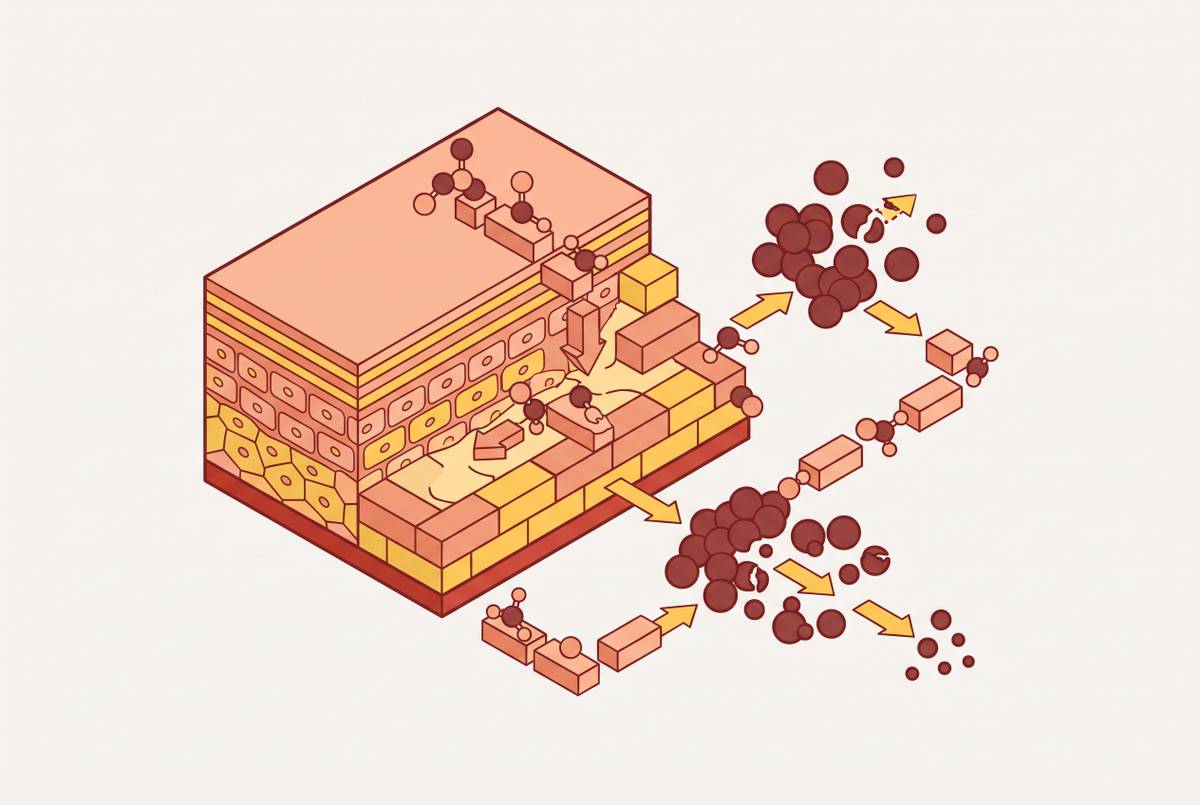
Acne vulgaris is a chronic inflammatory condition of the pilosebaceous unit, the hair follicle and oil gland combo that sits under nearly every pore on the face. Four things drive it together: bacterial imbalance, dead skin cells building up inside the follicle, too much sebum, and inflammation layered on top. Sebum itself isn't the problem. At normal levels it protects the skin. Only when it's overproduced does it start clogging follicles and feeding Cutibacterium acnes, the bacteria strain tied to breakouts.
There's a barrier piece to this too, and it gets less attention than it should. Acne patients tend to show lower ceramide levels than clear-skinned people, and ceramides are the lipids that hold the skin barrier together. Worse acne tracks with a weaker barrier, and a weaker barrier feeds hyperkeratinization, the same process that clogs follicles. Layer sensitive skin on top of that (research in Venereology and Leprology puts it at roughly half of women and closer to 40% of men) and a huge share of the population is putting sunscreen on skin fighting a battle on two fronts already.
Why skipping sunscreen is not a safe workaround for acne-prone skin
Some people with breakouts decide sunscreen is just one more product to pile onto inflamed skin, so they skip it. That logic runs backward. UV radiation worsens acne through three separate mechanisms: it generates reactive oxygen species inside skin cells, it ramps up sebum production, and it breaks down a barrier that's already struggling to hold itself together.
UV exposure also shapes what happens after a breakout heals. Post-inflammatory hyperpigmentation, the dark marks left behind, gets more pronounced and takes longer to fade on unprotected skin. Dr. Joshua Zeichner, director of cosmetic and clinical research in dermatology at Mount Sinai Hospital, points out that many acne medications, retinoids and Accutane among them, make skin more prone to sunburn. So the treatment meant to clear skin can leave it more exposed to the exact UV damage that makes acne worse.
How big is the gap between knowing this and acting on it? A cross-sectional survey in the Australasian Journal of Dermatology, looking at 51 skin-of-color patients dealing with acne-related PIH, found only 33.3% applied sunscreen daily, and nearly 40% applied it fewer than three times a week. That gap is wide enough to explain why dark marks sit on so many faces long after they should have faded.
How the FDA classifies sunscreen active ingredients today and what the 2026 update changes
The FDA sorts sunscreen actives using a standard called GRASE, short for Generally Recognized as Safe and Effective. Zinc oxide and titanium dioxide have held that status for years, cleared at concentrations up to 25%. As of 2026, bemotrizinol joins them, approved up to 6% concentration, the first new addition to this list since the late 1990s.
Twelve other active ingredients, including avobenzone, oxybenzone, octinoxate, octisalate, octocrylene, and homosalate, are in a different bucket: not GRASE, because the FDA says it needs more data before ruling either way. That doesn't mean they've been pulled from shelves. Manufacturers aren't required to remove them, and they stay legal to sell and buy.
That data gap matters, and it's not just a labeling technicality. The FDA's own absorption studies found that use of oxybenzone, homosalate, octisalate, octocrylene, avobenzone, or octinoxate has been found to push blood concentrations above 0.5 nanograms per milliliter, the threshold the agency uses to flag an ingredient for more safety research. Crossing that threshold means the ingredient gets absorbed readily enough that the FDA wants a closer look before calling it settled. It just means the ingredient gets absorbed readily enough that the FDA wants a closer look before calling it settled. Absorption and safety are two separate questions, and the next few sections take on the second one.
Zinc oxide: what it does at the pore level and why it leads the mineral category
Zinc oxide sits on top of skin rather than soaking into it. It works physically at the skin's surface rather than soaking in and converting radiation to heat the way chemical filters do. That distinction matters a lot for anyone whose skin responds to heat with more redness or more oil.
Zinc oxide also soaks up excess surface oil while it sits there. Dr. Ashley Magovern, a Medical Advisor at Dermstore, describes it as soothing, anti-inflammatory, and non-pore-clogging all at once, a combination that's hard to find packed into a single ingredient. For skin already dealing with a damaged barrier, that calming effect around active breakouts is essential. It's often the reason a sunscreen gets tolerated.
The clinical data backs this up, and this is where zinc oxide actually separates itself from titanium dioxide instead of just sharing the top shelf with it. A 2025 study in Clinical Dermatology found that acne patients using a zinc-based SPF 30 saw a 20% reduction in active lesions over 12 weeks. That's a meaningful drop for a product whose primary job is sun protection, not acne treatment. Nothing else in the mineral or chemical category has a comparable lesion-count result behind it, which is the real argument for putting zinc oxide first, not just tolerability on paper.
Titanium dioxide: narrower UV coverage, similar tolerability profile, useful in combination
Titanium dioxide works on the same physical principle as zinc oxide: it sits on the surface and reflects UV instead of absorbing into pores. Where it differs is coverage. Titanium dioxide protects mainly against UVB and the shorter UVA wavelengths, while zinc oxide reaches further across the UVA spectrum. The two often show up together in the same formula because each covers a range the other misses.
The FDA holds titanium dioxide to the same GRASE standard as zinc oxide, up to 25% concentration, with no systemic absorption flag against it. Tolerability runs about as gentle for sensitive and acne-prone skin, which is part of why it turns up across dermatologist-recommended picks in the sensitive-skin category: Blue Lizard Sensitive Face Mineral Sunscreen SPF 30+ (zinc oxide, fragrance-free), La Roche-Posay Anthelios Ultra-Light Fluid Mineral Sunscreen (titanium dioxide and zinc oxide together, fragrance-free, matte finish), and SkinCeuticals Physical Fusion UV Defense SPF 50 (also pairing the two). That pattern isn't a coincidence. Pairing the two minerals is close to the standard way to get genuine broad-spectrum coverage out of a mineral formula, since titanium dioxide alone leaves a gap in the UVA range that zinc oxide happens to close.
Chemical filters most likely to aggravate reactive skin versus those that carry the lightest risk
Every chemical filter works the same basic way: it absorbs UV radiation and converts that energy into heat, which then releases from the skin. That heat-conversion step is the starting point for why some of these filters bother reactive skin more than a mineral option would.
Oxybenzone sits at the top of the concern list for this audience, and for more than one reason. It crosses the FDA's 0.5 ng/mL absorption threshold after a single use. The European Commission's Scientific Committee on Consumer Safety reviewed it in 2021 over potential endocrine-disrupting properties, though the committee raised concerns about its safety profile. Concerns about possible reproductive harm have been raised in the scientific literature, and the FDA says what it says about most of this category: more data is needed. On top of the systemic questions, oxybenzone is also flagged as a low-prevalence allergen, capable of causing immediate irritation that can look a lot like an acne flare on skin that's already reactive. No single data point proves harm, but stack the absorption number, the SCCS review, and the allergen flag together and oxybenzone is the ingredient most dermatologists suggest skipping for acne-prone and sensitive skin.
Homosalate carries a similar profile. It isn't classified as GRASE, but it hasn't been affirmatively found unsafe either. The SCCS reviewed it in 2021 for the same kind of endocrine concerns raised about oxybenzone, and it also absorbs above the FDA's threshold.
Avobenzone, octinoxate, octocrylene, and octisalate are all in the same "additional data needed" bucket, and all cross the 0.5 ng/mL absorption line. Their heat-conversion mechanism can trigger inflammation and push sebum production up on skin that's already reactive. Even so, dermatologists generally rank these as a lighter risk than oxybenzone. For anyone who can't stand the texture of a mineral sunscreen, a lightweight, oil-free formula built around one of these filters is a reasonable middle ground.
Bemotrizinol: what the first new FDA-approved sunscreen active since the 1990s means for this skin type
Bemotrizinol, sold under names like Tinosorb S and Parsol Shield, cleared FDA approval in June 2026, the first new sunscreen active ingredient the agency has added since the late 1990s. An entire generation of sunscreen users has shopped from the same short list of chemical filters for nearly 30 years, the gap this approval closes. That's the size of the gap this approval closes.
The approval covers concentrations up to 6%, for adults and children as young as 6 months. The FDA's review credits three findings for its GRASE status: low skin absorption compared to older chemical filters, minimal irritation, and no evidence of reproductive harm in animal studies. It also does something none of the older single filters manage on their own: broad-spectrum UVA and UVB coverage from one ingredient, with no second filter needed to fill in the gaps. For acne-prone and sensitive skin specifically, low absorption paired with broad coverage is close to the ideal combination a chemical filter could offer. Whether it holds up over years of real-world use the way zinc oxide has is still an open question, and that's simply the price of being new.
Inactive ingredients that can undo a well-chosen active
A lot of otherwise smart sunscreen shopping falls apart over inactive ingredients. Active ingredients go through FDA review. The inactive ones, the oils, waxes, emollients, and surfactants that make up most of a sunscreen's actual volume, don't face anything close to that scrutiny. Yet they're frequently what triggers the breakout, even after someone spent real time researching the UV filter. Even the cleanest active ingredient on the market can be wrecked by a bad inactive blend.
A few culprits appear repeatedly on acne-prone skin. Mineral oil and soybean oil are both common comedogenic filler oils. Coconut oil, beeswax, lanolin, and cocoa butter get flagged by Dr. Jane Yoo, a board-certified dermatologist and Mohs surgeon, as emollient-rich and prone to occluding pores. Silicones and sodium lauryl sulfate draw the same warning from Dr. Patricia Wexler. Alcohol and essential oils are also commonly flagged as potential irritants on reactive skin, and can cause irritation even inside otherwise well-built mineral formulas.
On the other side of the ledger, certain inactive ingredients actually support the goal instead of working against it. Niacinamide, also known as vitamin B3, regulates oil production, calms inflammation, and can make enlarged pores look smaller. Studies have found it can meaningfully cut oil output and improve texture. A study in Dermatology and Therapy tested a broad-spectrum sunscreen containing niacinamide and sclareolide and found it reduced PIH pigmentation by up to 16 ΔITA° units and cut redness by as much as 87% compared to unprotected skin. That's a striking number for a product whose main job is sun protection, not pigment correction.
Hyaluronic acid hydrates without adding oil, which matters for barrier repair on skin that can't tolerate heavier moisturizers. Aloe vera, green tea extract, allantoin, and panthenol calm inflammation and support the barrier without adding pore-clogging weight. Silica, kaolin clay, and perlite soak up surface oil and cut shine, giving a mattifying finish without blocking anything underneath.
"Non-comedogenic" sounds like a guarantee. It isn't a regulated term, and it never was. It signals that a manufacturer tested the formula, or claims to have, and found it doesn't clog pores. Testing standards vary from brand to brand, so treat the label as a starting filter for narrowing down options, not proof a product will work on every face.
The dermatologist-established hierarchy for choosing a product
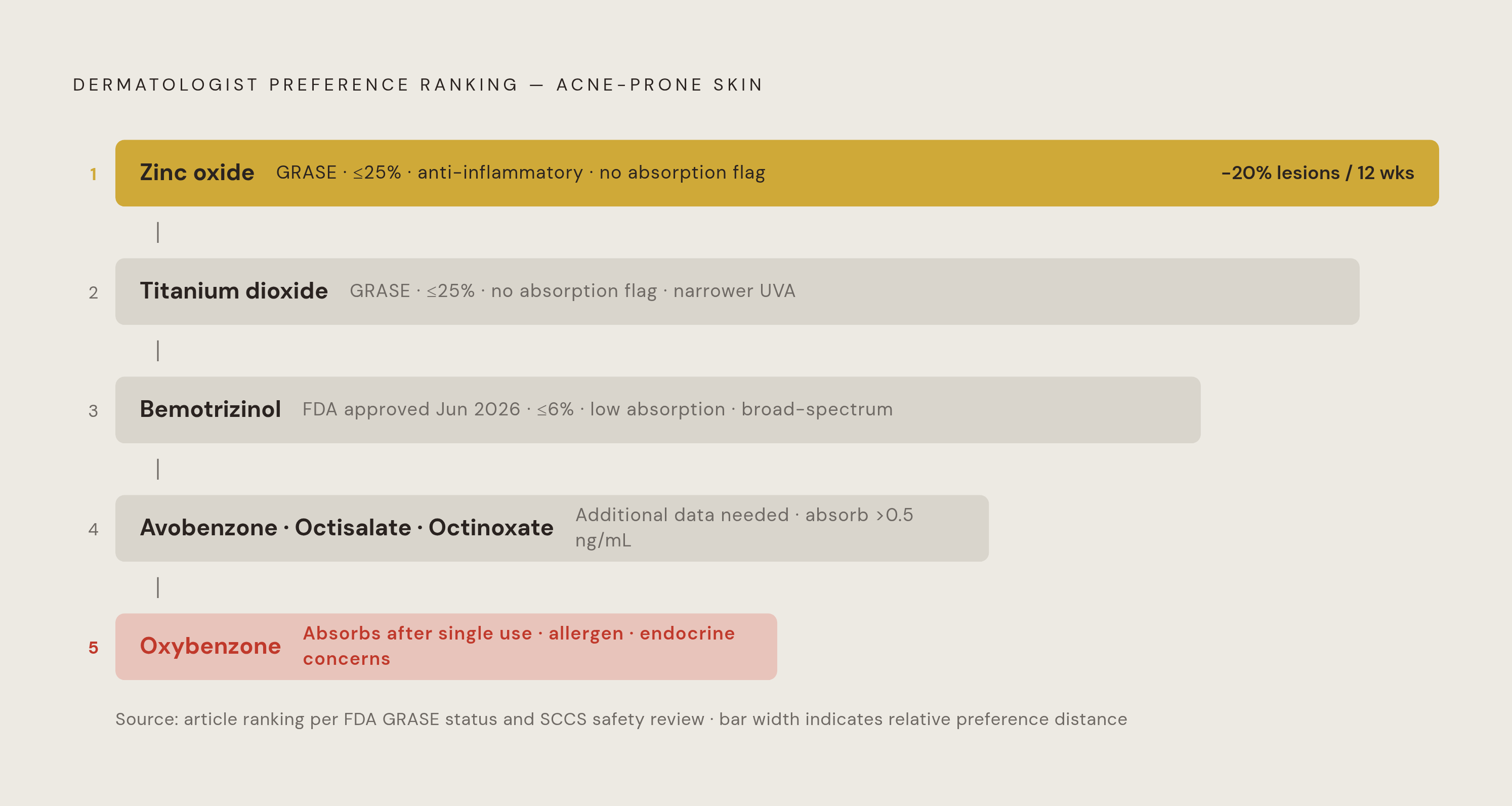
Dermatologists interviewed by NBC Select describe a clear order of preference, and it maps onto everything covered above: mineral filters first, chemical filters chosen carefully second, and inactive ingredients checked no matter which active wins out.
Start with zinc oxide, alone or paired with titanium dioxide, especially on skin that's actively breaking out or clearly barrier-compromised. That's the choice most dermatologists default to, and it earns the top spot honestly: it's the only option in this piece with a documented reduction in active lesions, not just a lack of irritation. If the mineral texture doesn't work on a given face, bemotrizinol is the newest option worth a look, given its low absorption and single-ingredient broad-spectrum coverage. If cost or availability rules that out, a lightweight formula built on avobenzone, octisalate, or octinoxate is a reasonable step down, so long as the skin tolerates it. Oxybenzone belongs at the bottom of the list for this skin type because it stacks more red flags than any other filter here and offers acne-prone skin nothing the others can't do more safely.
Whatever active makes the cut, run the ingredient list a second time for the inactives covered above. A sunscreen built on zinc oxide can still break someone out if it's loaded with coconut oil and fragrance. The active ingredient sets the ceiling for how well a sunscreen protects. Skin can tolerate wearing it every day because of the inactive ingredients sitting around that active, and daily wear is how sunscreen does its good.