Acne Vulgaris vs Fungal Acne Differences
Misdiagnosis turns acne antibiotics into fungal yeast fertilizer.
Picture a chest breakout that won't quit after three months of the antibiotic a doctor prescribed. This scenario mirrors a common pattern described by a nurse practitioner at a Doral, FL clinic, where patients treat fungal acne with antibiotics and benzoyl peroxide for months before learning those treatments cannot work, since pityrosporum folliculitis is a yeast infection of the hair follicles rather than bacterial acne, requiring a completely different approach. The face wash changed, the pillowcase changed, even the laundry detergent changed, and the bumps are still there, maybe worse. That frustration usually traces back to one root cause: acne vulgaris and fungal acne are two separate diseases that can look almost identical on skin, yet demand treatments that work against each other when mixed up. A peer-reviewed article in the Journal of Clinical and Aesthetic Dermatology describes fungal acne as a condition regularly mistaken for acne vulgaris, one that can drag on for years when treated with the wrong medications. That same article notes the condition may persist for years without complete resolution when treated with typical acne medications. What follows breaks down the cause, the appearance, and the triggers behind each condition, so the right treatment can follow the right diagnosis instead of a guess.
What happens inside the follicle in each condition
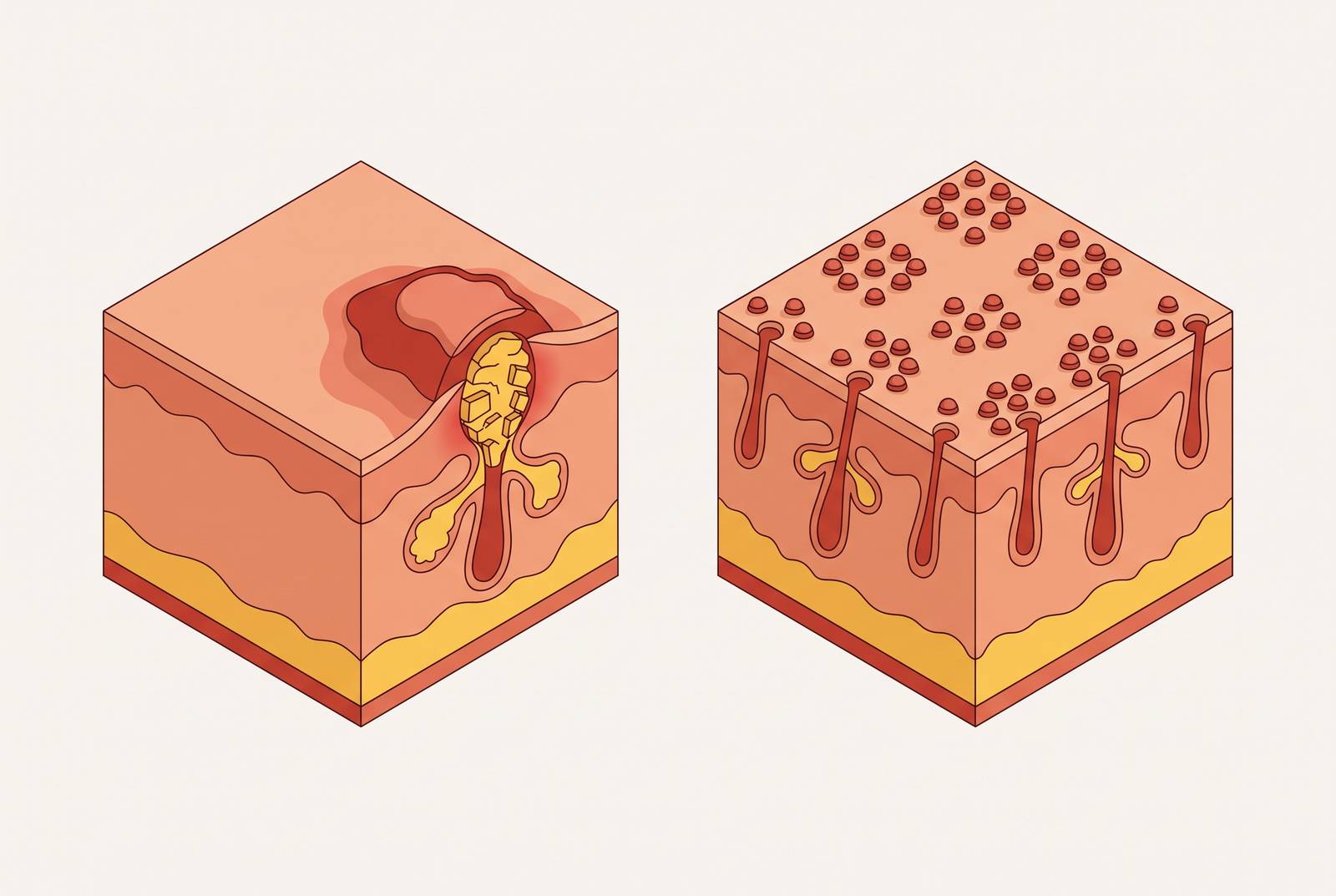
Both conditions start in the same place: the pilosebaceous unit, the hair follicle paired with its oil-producing gland. From there, the two diseases split completely, driven by different organisms working through different mechanisms. Acne vulgaris begins with androgen hormones ramping up oil production, skin cells shedding abnormally and clogging the pore, and bacteria multiplying inside that blockage, which together produce the microcomedone, the plugged follicle that turns into a pimple. Fungal acne, medically called Malassezia folliculitis (older texts call it Pityrosporum folliculitis, a naming leftover from when the yeast genus got reclassified), comes from an overgrowth of Malassezia yeast species, chiefly M. globosa, M. sympodialis, and M. restricta. Both terms, Malassezia folliculitis and pityrosporum folliculitis, describe the same infection of the pilosebaceous unit by these overgrown yeast species.
That yeast already lives on healthy skin. It feeds on fatty acids in sebum, and it stays in balance until something tips the scale, usually antibiotics wiping out the bacteria that normally keep it in check, combined with heat, sweat, occlusion, or heavy oils that give it more fuel. So one condition is bacterial and hormonally driven, the other is fungal and dependent on shifts in the skin's microbial balance. That single distinction is why every downstream decision, what the bumps look like, what triggers them, what clears them, traces back to which organism is actually responsible.
The hormonal angle deserves a beat of its own. When acne comes with hirsutism, irregular periods, or androgenic hair loss, an underlying condition like polycystic ovarian syndrome may be driving it, and that opens the door to hormonal treatment options such as combined oral contraceptives. None of that logic applies to fungal acne, because no yeast infection responds to a hormone regulator. Getting the diagnosis right makes the right systemic treatment available.
The four clinical signals that tell these conditions apart
Itch comes first, and it's the strongest tell of the four. Fungal acne itches, often more so with heat or sweat, while acne vulgaris tends to hurt or feel tender but rarely itches. Dermatologist Sandra Lee, MD, has said the most telling sign is what the breakout feels like, not what it looks like.
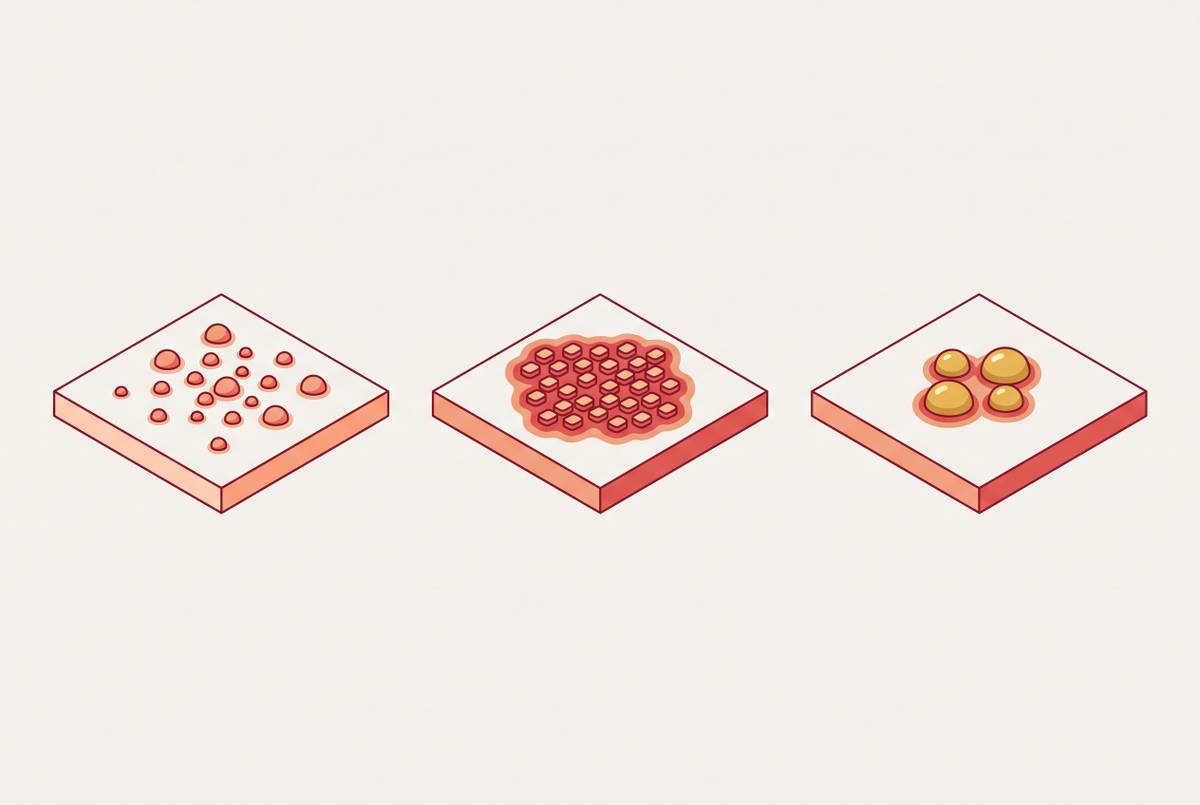
From there, look at the bumps themselves. Fungal acne tends toward a monomorphic pattern: small bumps, strikingly uniform in size, clustered tightly enough to resemble a rash more than a breakout. Acne vulgaris is polymorphic, a mix of blackheads, whiteheads, papules, pustules, sometimes cysts, all showing up at different stages at once, developing gradually and favoring the face and neck, especially the T-zone.
Third: check for comedones. True blackheads and whiteheads point toward acne vulgaris. Their absence, paired with that uniform bump pattern, points the other way. Fourth is timing and location. Fungal acne tends to erupt suddenly in clusters on the upper back, chest, shoulders, and forehead, the sweatier zones of the body, while acne vulgaris builds more slowly and settles into its familiar facial territory.
These two conditions can show up on the same person at the same time. A patient can have both, respond partially to one treatment, and be left more confused about why the skin never fully clears. That overlap is why the signals above function as a checklist, not a verdict, and why professional evaluation still matters even for someone who's memorized all four.
What Happens When the Wrong Treatment Is Applied
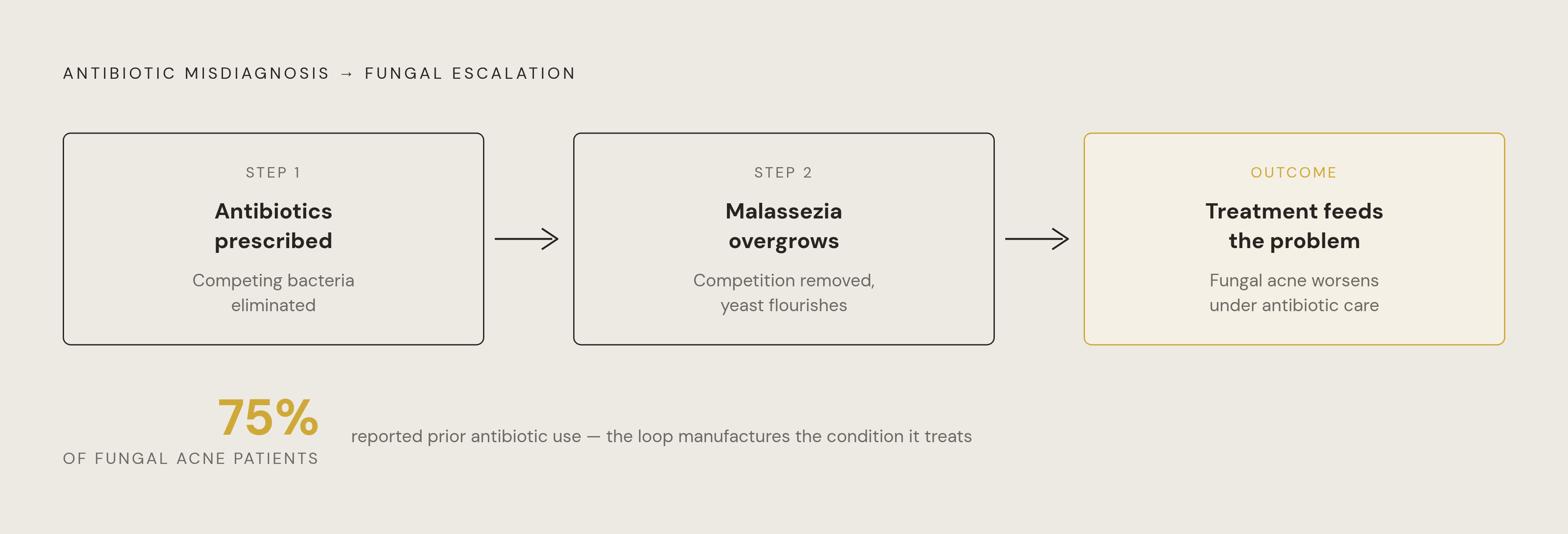
Misdiagnosis here doesn't just waste time. Applying the wrong treatment makes the actual problem worse, through a mechanism that's almost mechanical in its logic. Antibiotics prescribed for what looks like acne wipe out the bacteria that normally compete with Malassezia yeast for space and resources. Removing the competition gives the yeast more room to grow. The treatment feeds the exact thing it was meant to fix.
That's not a rare edge case. Among patients eventually diagnosed with fungal acne, 75% report prior antibiotic use in their history, a pattern that suggests misdiagnosis and antibiotic escalation may be manufacturing the very yeast overgrowth doctors then have to treat. And the cost isn't confined to the individual patient. A study in the Journal of Family Medicine and Primary Care documents rising resistance among Cutibacterium acnes, the bacterium behind true acne vulgaris, to commonly used antimicrobials, macrolide antibiotics especially, along with the emergence of multidrug-resistant strains. Widespread antibiotic use for what may often be misdiagnosed fungal acne adds to that resistance problem at a population level, which is part of why the study pushes for nonantibiotic first-line options like retinoids and benzoyl peroxide.
Running the failure in the other direction produces an outcome that is just as unproductive. Antifungal treatment applied to true acne vulgaris does nothing for it, since there's no yeast overgrowth to treat. Social media attention around fungal acne has driven more people to reach for antifungal products without a confirmed diagnosis, which risks leaving actual bacterial acne untreated while the patient waits for a yeast treatment to do a bacterial treatment's job.
The instinct when a treatment isn't working is to escalate, stronger actives, a new antibiotic, a full skincare teardown and rebuild. That instinct often backfires here. Escalation disrupts the skin barrier further and can shift conditions in ways that favor whichever organism is actually driving the breakout, deepening the exact problem the escalation was meant to solve.
The evidence-based treatment path for each condition
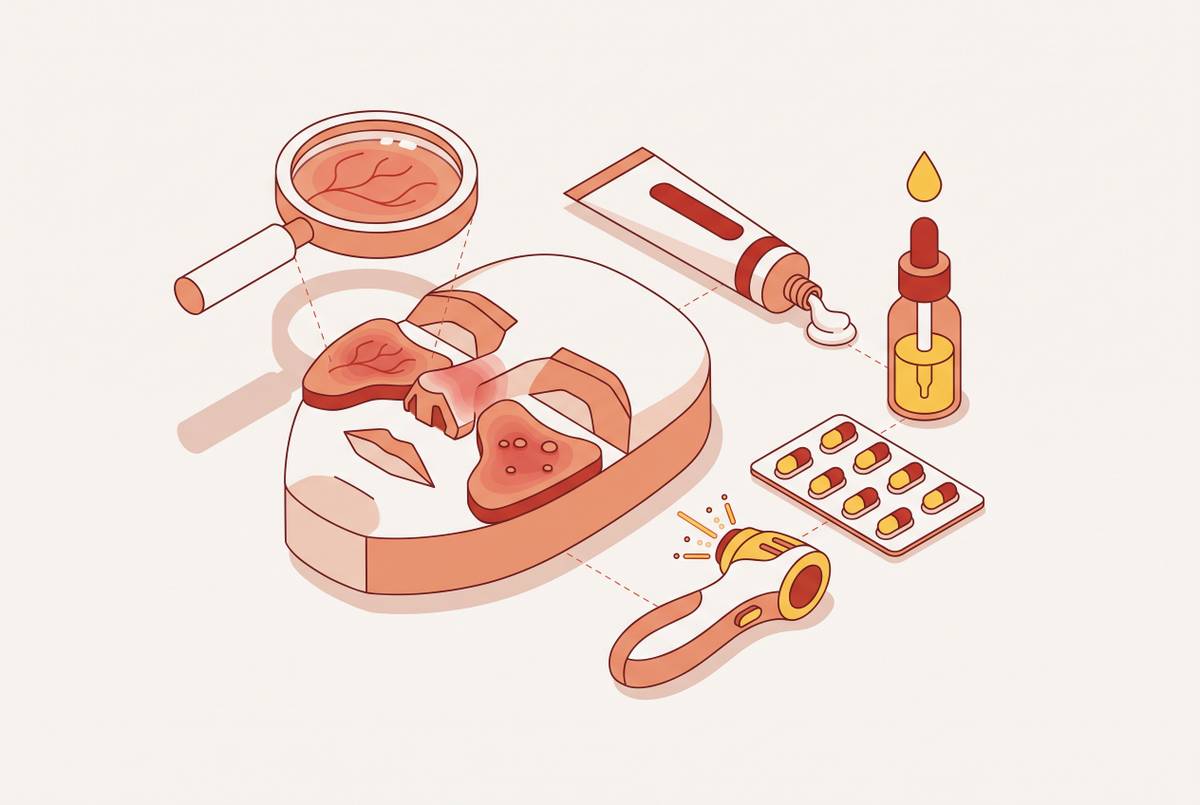
Different causes require categorically different first-line treatments, and knowing which condition is present determines which path applies. For acne vulgaris, mild cases typically start with a benzoyl peroxide wash, topical antibiotics (always paired with benzoyl peroxide to slow resistance), topical retinoids, azelaic acid, sulfacetamide products, or dapsone gel. Retinoids sit at the center of the acne vulgaris toolkit because they clear existing blockages, calm inflammation, fade discoloration left behind by old breakouts, and help maintain clear skin over time. Where hormones are driving the picture, combined oral contraceptives are a guideline-supported option, and an endocrine workup may be worthwhile for patients showing signs of hyperandrogenism.
Fungal acne runs on an entirely different track. Oral antifungals, fluconazole and itraconazole among them, are the most effective treatment according to Cleveland Clinic, often clearing the condition within two to four weeks. Topical antifungal creams like econazole and ketoconazole help too, along with shampoos containing selenium sulfide or zinc pyrithione used as a body wash rather than just a scalp treatment. Clearing the yeast is only half the job, though: recurrence is common without ongoing trigger management, so treatment doesn't end when the bumps disappear. Photodynamic therapy is being studied for cases that resist the standard options, though it remains an area under investigation rather than a first-line choice.
A 2026 review in the Journal of Drugs in Dermatology adds a layer of nuance here. Because both conditions share some underlying mechanisms, sebum production, lipase activity, inflammation, certain acne topicals like benzoyl peroxide and retinoids may offer some benefit in fungal acne too. That finding refines the treatment picture rather than upending it. It does not mean the two conditions are interchangeable, and it does not make antifungal treatment optional for someone with confirmed Malassezia folliculitis. Diagnosis still comes first, supported by dermoscopy, a potassium hydroxide preparation, Wood's lamp examination, or response to a trial of antifungal therapy, all of which go well beyond what a mirror or a photo can tell someone.
Skincare ingredients and daily habits that aggravate or prevent each condition
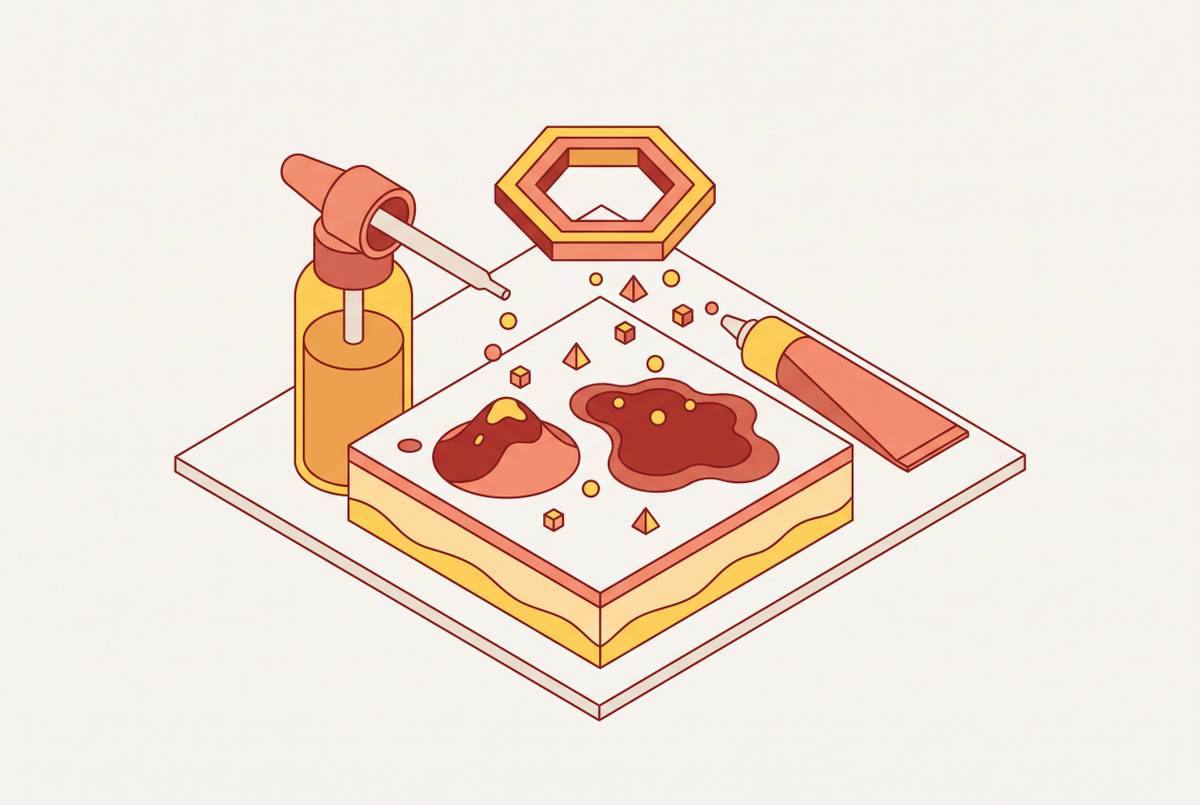
Before adding anything new to a routine, check what's already sitting on the bathroom shelf, since several everyday skincare ingredients act as direct fuel for Malassezia yeast. Fatty acids and esters with C11–C24 carbon chains feed the yeast directly, and so do oils high in oleic acid, olive, argan, and avocado oil among them. Fatty alcohol emollients, fermented yeast extracts like galactomyces, and certain polysorbate emulsifiers round out the list. These ingredients don't hide only in specialty treatments. They turn up in ordinary cleansers, moisturizers, sunscreens, and even hair products. A fungal acne flare can be getting fed by a shampoo that never touches the face.
On the other side of the ledger, antifungal actives like ketoconazole, zinc pyrithione, selenium sulfide, and sulfur are safe bets for fungal-prone skin, and non-lipid moisturizers, squalane, mineral oil, dimethicone, glycerin, hydrate without adding to the yeast's food supply. Acne vulgaris responds to a different set entirely: hypochlorous acid, azelaic acid, salicylic acid, niacinamide, benzoyl peroxide, and topical retinoids, each targeting a different piece of the bacterial acne process rather than starving a yeast population.
Behavior matters as much as product choice for fungal acne specifically. Heat and humidity, sweaty workouts followed by re-wearing damp gym clothes, heavy oil-based products, long courses of antibiotics or steroids, tight synthetic fabrics, and time spent in hot tubs or whirlpools all push conditions in the yeast's favor. Cleveland Clinic guidance recommends showering and changing clothes immediately after working out, and washing bathing suits and letting them dry between each use, to reduce fungal acne recurrence. Often the fastest way to make progress is reading the ingredient list on what's already being used and cutting the fuel source before adding anything else to the routine.
Limits of visual assessment for this distinction
The acne-versus-fungal-acne distinction is precisely the type of nuanced, multi-factor judgment that photo-based assessment, including AI-assisted tools, frequently cannot resolve alone, because the most reliable differentiating features are not fully visible in an image. Itch can't be photographed. Itch, antibiotic exposure history, lesion onset pattern, and climate context are the signals that most reliably separate the two conditions, none of which a photograph captures.
That doesn't make AI-assisted teledermatology useless. In 2026, these tools are commonly used to flag patterns, map out lesion characteristics, and organize a patient's information ahead of a physician's review, functioning as a triage layer rather than a replacement for one. What they can't do is weigh hormonal status, medication interactions, or coexisting skin conditions, factors that shift treatment selection substantially and that photo analysis routinely misses. For a condition pair this easy to mix up and this costly to get wrong, that gap is the reason clinical evaluation, not a snapshot, remains the standard of care.
Sources
- Fungal acne: Malassezia Folliculitis, Pityrosporum Folliculitis
- Fungal Acne vs Regular Acne (Pityrosporum Folliculitis): How to Tell the Difference
- Fungal Acne vs. Acne: How to Tell the Difference and Treat It Right – SLMD Skincare by Sandra Lee, M.D. - Dr. Pimple Popper
- Fungal Acne vs Regular Acne: Key Differences
- Malassezia Folliculitis: An Underdiagnosed Mimicker of Acneiform Eruptions - PMC
- Fungal Acne Safe Products: Ingredients to Avoid & Approved List - Sezia
- Malassezia Folliculitis Presentation, Diagnosis, and Treatment: A Review of "Fungal Acne" - JDDonline - Journal of Drugs in Dermatology
- Blog | Fungal Acne: A Mimic of Acne Vulgaris - Symptoms, Diagnosis, and Treatment