Yeast Infection Bumps vs Contact Dermatitis vs Herpes
Solid bumps, blisters, or angry rash each point to a different diagnosis and treatment.
What a yeast infection looks like on the skin
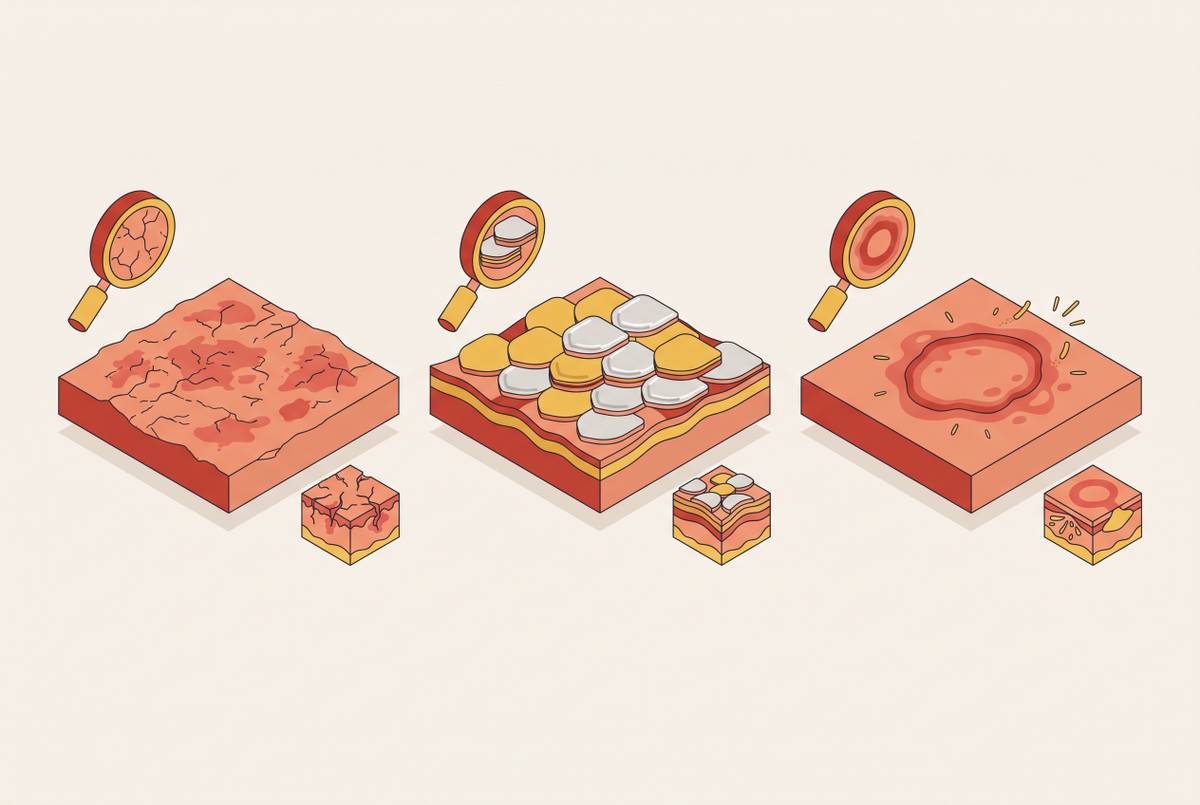
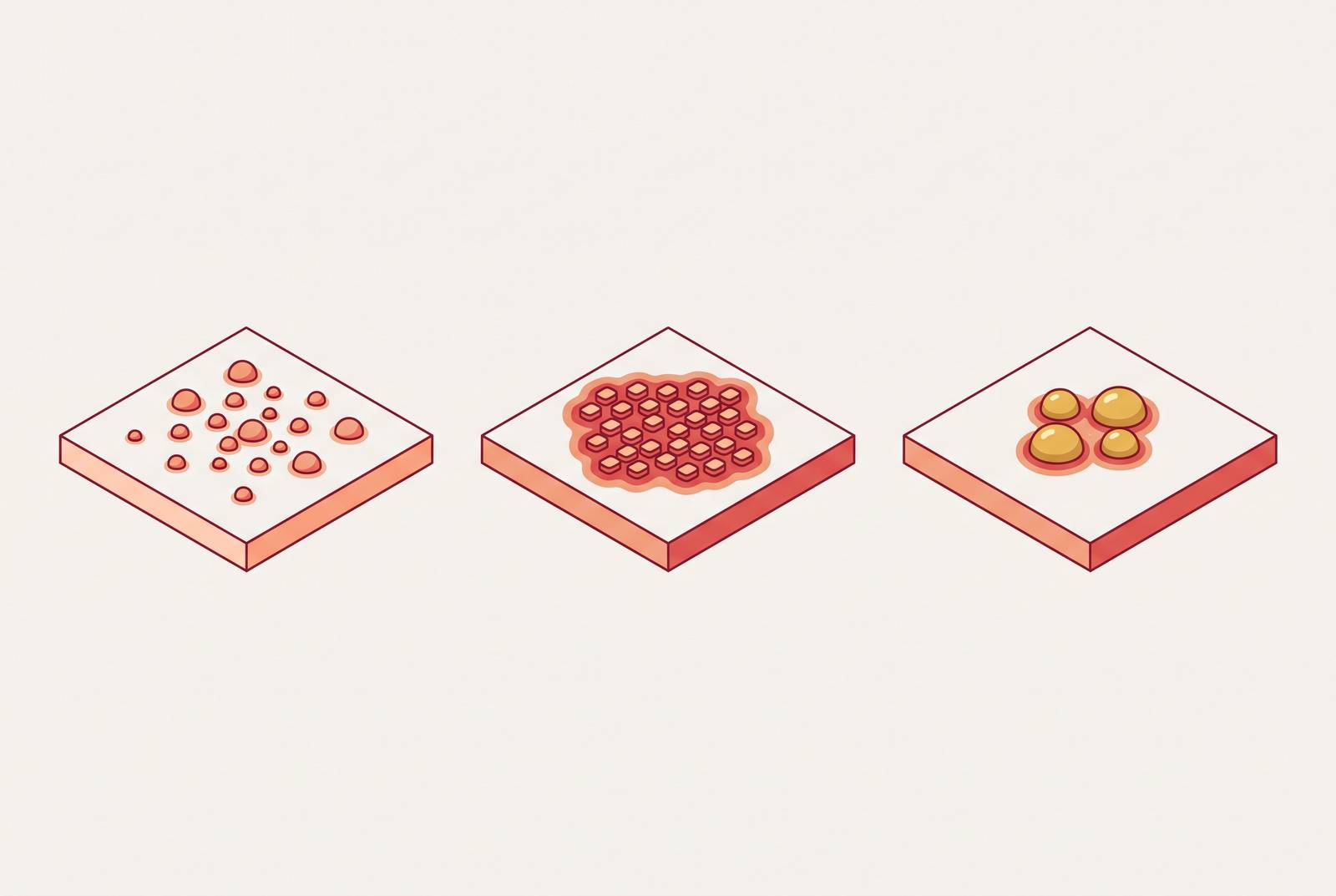
A red, shiny patch of skin with smaller bumps scattered around its edges is the classic presentation: an erythematous plaque with satellite papules or pustules at the periphery. Some of those satellite bumps are solid. Some may weep or break down when scratched or irritated.
Here's the detail that actually separates yeast from herpes: those satellite bumps are raised and solid, not blister-like. That's the opposite of the fluid-filled vesicle clusters that define a herpes outbreak. If scratching breaks the skin, shallow secondary sores can form, but that's a byproduct of irritation, not the primary lesion type, and a clinician who knows to look for that distinction won't confuse the two.
Not every case shows dramatic visible changes, either. Some patients describe minimal outward signs alongside a sensation best described as tiny paper cuts, sometimes with small fissures in the skin. So "doesn't look like much" is not the same as "not yeast."
Intense itching, often the first symptom, a thick white discharge with a cottage-cheese texture, burning during urination or sex, and redness or swelling that extends past the vaginal opening tend to travel with the bumps. Look for them around the vaginal opening, on the vulva, and in skin folds where moisture pools. WebMD puts lifetime incidence at roughly 75% for people assigned female at birth, and 45% of those who get one will get a second. Recurrence is common, in other words, but it doesn't cluster tightly in the same exact spot the way herpes does.
Why contact dermatitis is the most shape-shifting of the three
Contact dermatitis splits into two mechanisms. Irritant contact dermatitis (ICD) happens when a chemical damages the skin directly, on contact, no immune system required. Allergic contact dermatitis (ACD) is a delayed immune response to a specific allergen the body has decided to treat as a threat. A PMC review of vulvar dermatitis describes both as capable of ranging from mild, just redness and scaling, to severe, with edema, ulceration, and erosions.
The acute phase of ACD is where this gets genuinely hard to read. The skin can develop vesiculation, meaning actual fluid-filled blisters, and at that moment it can look almost identical to a herpes outbreak. Layer a secondary infection on top, which happens with either ICD or ACD, and now there's pustules, crusting, and fissuring stacked onto the picture. That combination is probably the hardest herpes look-alike in this entire comparison, and it's exactly the scenario where guessing instead of testing costs the most.
Timing is the clue that actually cuts through the confusion. Irritant reactions from something like a harsh soap appear within minutes to a few hours of contact. Allergic reactions, the kind triggered by latex, take up to 48 hours or more after re-exposure to appear. That delay is a signature nothing else on this list produces.
Distribution is the second clue. Contact dermatitis follows the shape of the exposure: wherever the product, pad, or fabric actually touched the skin, rather than clustering into one tight anatomical spot the way herpes does. The genital area is especially exposed to this problem. It stays moist, the skin there is thinner and more delicate than most other places on the body, and it's in constant contact with hygiene products, friction, and moisture buildup, all of which wear down the skin barrier. One prospective cohort study cited in PMC found that 81.4% of patients with vulvar itch had at least one positive contact allergen appear on patch testing. That's most of the people walking in the door with that complaint, not a rare edge case. That's most of the people walking in the door with that complaint.
The common triggers and allergens behind contact dermatitis that patients don't expect
Fragrances, preservatives, botanical extracts, topical medications, adhesives, dyes, and rubber or latex products top the list of allergens tied to vulvar contact dermatitis. Topical medications are the one people least expect, because topical medications including local anesthetics and corticosteroids rank among the commonly identified genital allergens.
That sets up a strange clinical trap. Corticosteroids are the standard first-line treatment for dermatitis, and they're also, in some patients, the thing causing it. Someone applying a steroid cream to calm a flare might be quietly feeding the exact allergy that started it, with no way to tell from symptoms alone that the treatment has become the trigger.
Propylene glycol belongs on the suspect list too. It shows up as a clinically relevant reaction in 10.3% of genital ACD patients, according to skinallergyjournal.com. Prolonged contact with menstrual pads, combined with moisture and exposure near mucous membranes, can set up allergic responses to the preservatives, fragrances, and acrylates present in pad materials.
Scented tampons, deodorant sprays, certain laundry detergents, latex condoms, and over-the-counter treatments all belong on the mental list to walk back through when symptoms show up.
Contact dermatitis doesn't recur in the same spot without a fresh exposure to the trigger. It doesn't cause fever or swollen lymph nodes, and it doesn't transmit to anyone else. If a flare keeps returning to the exact same location with no new product or fabric involved, contact dermatitis stops being the likely explanation.
What herpes looks like, and what it feels like before the blisters appear
The hallmark is a cluster of fluid-filled blisters sitting on a red base. Left alone, they move through a fairly predictable sequence: redness, then small bumps, then short-lived blisters, then painful open ulcers, then crusting. Crusts typically clear within two to three weeks, First Derm reports.
But the blisters aren't always the first sign the body gives. Many people notice a prodrome first: tingling, itching, or burning in the area before anything is visible. That prodrome can appear hours to a couple of days before the blisters do, and neither yeast nor contact dermatitis really produces anything like it.
Once lesions appear, pain tends to dominate over itch, and that's a real dividing line. Yeast is primarily itchy. Contact dermatitis is itchy and sometimes burning. Herpes ulcers hurt.
First outbreaks hit hardest. Flu-like symptoms, fever, swollen lymph nodes, and headache can ride along with the genital lesions. A 2013 study of more than 3,000 women found that 62% to 71% of symptomatic patients reported some mix of skin lesions, pain, burning, itching, redness, or pain with urination. But the same study found something more consequential: most women who tested positive for herpes exposure had no symptoms. So how much should the absence of visible sores count for, when reasoning through what's going on? Less than it feels like it should.
Recurrences, when they happen, return to the same anatomical location and run shorter and milder than the first episode. The virus stays latent in the body indefinitely, and transmission can happen even with no visible sores present, through asymptomatic shedding. That mechanism is part of why HSV-2 infects women at roughly twice the rate of men.
The four clinical features that separate the three conditions when read together
None of this is a self-diagnosis checklist. Treat it as four questions worth having answers to before a clinical conversation starts.
What does the lesion actually look like? A solid, raised bump that rarely bursts, with smaller satellite bumps nearby, points toward yeast. Redness and scaling that trace the outline of wherever a product touched the skin, sometimes with blisters during an acute allergic flare, points toward contact dermatitis. Clustered, fluid-filled blisters on a red base that progress into open sores and crusting point toward herpes.
What's the dominant sensation? Intense itching, burning during urination, and thick white discharge suggest yeast. Itching and burning with no systemic symptoms suggest contact dermatitis. Pain, rather than itch, paired with a tingling prodrome before anything is visible, and possibly fever or swollen glands on a first outbreak, suggests herpes.
What was the timing and the trigger? Gradual onset following antibiotic use, hormonal shifts, tight clothing, or elevated blood sugar leans yeast. Onset within hours of contact with a new product, pad, condom, or topical cream leans contact dermatitis. Onset days after sexual contact, or a flare triggered by stress, illness, or a menstrual cycle in someone with a known HSV history, leans herpes.
Does it come back, and how? Yeast can recur, but not tightly clustered in the same exact spot every time. Contact dermatitis only recurs with re-exposure to the same irritant or allergen: no exposure, no flare. Herpes recurs in the same anatomical location repeatedly, and a recurrence with no obvious new exposure is a fairly strong signal pointing away from the other two.
| Feature | Yeast | Contact Dermatitis | Herpes | |---|---|---|---| | Lesion type | Solid, raised, satellite bumps | Redness/scaling, blisters possible (acute ACD) | Clustered fluid-filled blisters, red base | | Dominant sensation | Itch, burning on urination | Itch, burning, no systemic signs | Pain, prodromal tingling | | Discharge | Thick, white, cottage-cheese texture | Usually none | Usually none | | Onset | Gradual | Hours (irritant) to days (allergic) | Days after exposure, or stress-triggered recurrence | | Recurrence | Possible, not tightly clustered | Only with re-exposure | Same site, repeatedly | | Transmission | No | No | Yes, even without visible sores |
Why diagnosis still requires a clinician, and what testing involves
Those four questions make the differences look clean on paper. In practice, symptoms overlap enough that visual inspection alone, even from an experienced clinician, often isn't enough to call it. Lab confirmation is what actually changes the treatment plan, and skipping it is the most common way patients end up treating the wrong thing for weeks.
For herpes, PCR testing on an active lesion within 48 hours of it appearing is 95% to 99% accurate. Older viral culture methods take three to seven days to come back and miss roughly a quarter of true cases, a gap large enough that PCR has become the preferred method wherever it's available. Someone with a documented prior HSV diagnosis experiencing a recurrence can often skip a fresh PCR test and get diagnosed clinically instead.
For yeast, a PCR test for Candida or a vaginal culture is the most accurate route. Wet-mount microscopy is common in-office, but its sensitivity is limited, so a negative wet mount doesn't rule yeast out on its own. At-home vaginal microbiome testing that screens for Candida exists too, reviewed by a licensed provider as part of the process.
For contact dermatitis, patch testing is the tool that actually names the allergen. That's the step that turns guesswork about which product is to blame into an answer.
Asking to be "tested for all STIs" does not automatically mean herpes gets included. Testing decisions often run on assessed risk, so anyone who specifically wants herpes ruled out needs to say so by name. A full evaluation of vulvovaginal symptoms should include a detailed history, a physical exam, and a review of every product and medication used in the area recently, a detail patients routinely forget to mention unless asked directly. That gap has a cost: administrative claims data from 2019 to 2021 found that roughly one-third of patients with genital herpes, somewhere between 32% and 35%, go untreated in a given year. Some of that is asymptomatic infection. Some of it is people who never connected their symptoms to the diagnosis.
Describing your symptoms clearly before a clinical visit or telehealth consultation
Walking into an appointment with a self-diagnosis already decided isn't the goal. Walking in with a clear, specific description is what actually speeds up the visit. A clinician working from precise details can triage faster and order the right test the first time, instead of grinding through a slower process of elimination.
Have these ready:
- Lesion type: solid and raised, fluid-filled, an open sore, or just redness with no bump.
- Location and pattern: clustered in one tight spot, spread across wherever a product touched the skin, or a central rash ringed with satellite bumps.
- Dominant sensation: itch versus pain versus burning, and whether anything, tingling or burning, appeared before any visible lesion did.
- Discharge: whether it's present, its color, its texture, and any smell. Cottage-cheese texture with no odor points toward yeast. No discharge at all points away from it.
- Timing: hours after a new product or exposure suggests contact dermatitis, days after sexual contact suggests herpes, a slow gradual buildup suggests yeast.
- Recent products: new soap, detergent, condom brand, menstrual product, or topical cream used in or near the area.
- Recent systemic changes: a course of antibiotics, hormonal shifts, illness, or a stressful stretch, all plausible triggers for yeast overgrowth or an HSV recurrence.
- Recurrence history: first time this has happened, or a repeat, and if it's a repeat, whether it's the same exact spot each time.
That level of specificity matters even more in a telehealth or message-based consultation, where a clinician doesn't get an in-person exam right away. A message that says "itchy red bump" gives a provider almost nothing to work with. A message that says "solid raised bump, satellite bumps around it, white discharge, started gradually over three days" gives them something they can act on immediately.
Genital skin conditions deserve the same clinical rigor as any other part of the body. Why does this particular category of symptom get talked about with less precision than, say, a rash on an arm or a sore throat? There's no clinical reason for that gap. A licensed provider reading a clearly described symptom set, even without being in the room, can usually land on the right next step: an in-person exam and swab, or a first-line treatment to try based on the picture at hand.