Rosacea Subtypes and Evidence-Based Treatments
Matching treatments to rosacea's four subtypes improves outcomes for millions misdiagnosed annually.
Rosacea is not one disease. It splits into four subtypes that look different under a microscope, respond to different drugs, and get missed for different reasons, and treating them as interchangeable is the mistake that keeps patients stuck on the wrong regimen for years. The American Academy of Dermatology estimates roughly 16 million Americans have it, which makes getting this distinction right a bigger deal than most people assume.
Onset usually lands between ages 30 and 60, and fair-skinned adults get hit disproportionately. Rosacea shows up in every skin tone, and darker phototypes get missed often enough that "pale skin that flushes easily" is a bad shorthand for what this condition actually is. A 2024 case-control study of 198 rosacea patients found mean quality-of-life scores of 11.32, versus 4.28 in controls on the same standardized questionnaire. That gap is wide enough to change how seriously a flushed cheek gets taken in a doctor's office.
Classifying rosacea: the four subtypes and the move toward phenotyping
The National Rosacea Society laid out the four-subtype model in 2002, and it's still the first framework most clinicians and patients run into. But four boxes were never the right number.
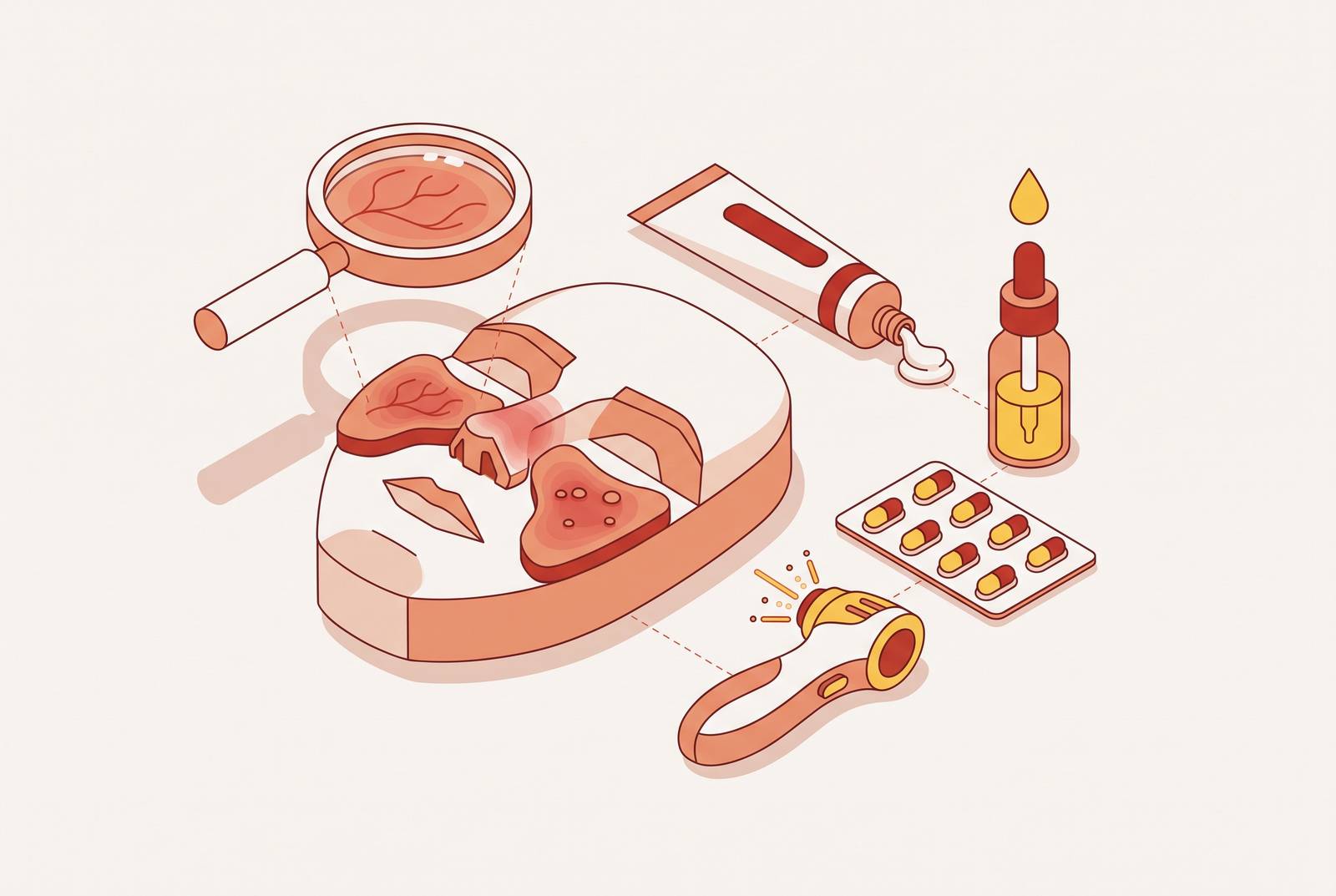
Subtype 1, erythematotelangiectatic rosacea (ETR), shows up as persistent redness and intermittent flushing across the nose and cheeks. It's usually the first sign anyone notices. Subtype 2, papulopustular rosacea, stacks papules and pustules on top of that redness and gets mistaken for acne constantly, except for one detail that separates the two: no comedones. No blackheads, no whiteheads. That absence is the clue clinicians actually rely on, and it's the reason acne treatments tend to make papulopustular rosacea worse instead of better.
Subtype 3, phymatous rosacea, involves thickening and fibrosis of the sebaceous glands, most visible as rhinophyma, the bulbous nose enlargement tied to advanced rosacea in men. It can also hit the cheeks, chin, and glabella. It tends to appear late in the disease course, though cases have turned up in people with no prior rosacea history. Subtype 4, ocular rosacea, brings tearing, dryness, a gritty feeling, itching, styes, and blepharitis. Somewhere between 50% and 75% of rosacea patients have some degree of eye involvement, a number that surprises anyone who still thinks of rosacea as a skin-only problem.
In 2017, the field moved toward phenotyping instead of subtype boxes. Rather than sorting a patient into one of four categories, phenotyping asks which specific features they actually have: redness, flushing, bumps, thickened skin, eye symptoms. That's because the four-subtype labels don't capture severity or overlap well, and most rosacea patients don't sit neatly in one box anyway. A review in the American Journal of Clinical Dermatology backed this phenotype-directed approach as the better match for how rosacea actually shows up in the exam room.
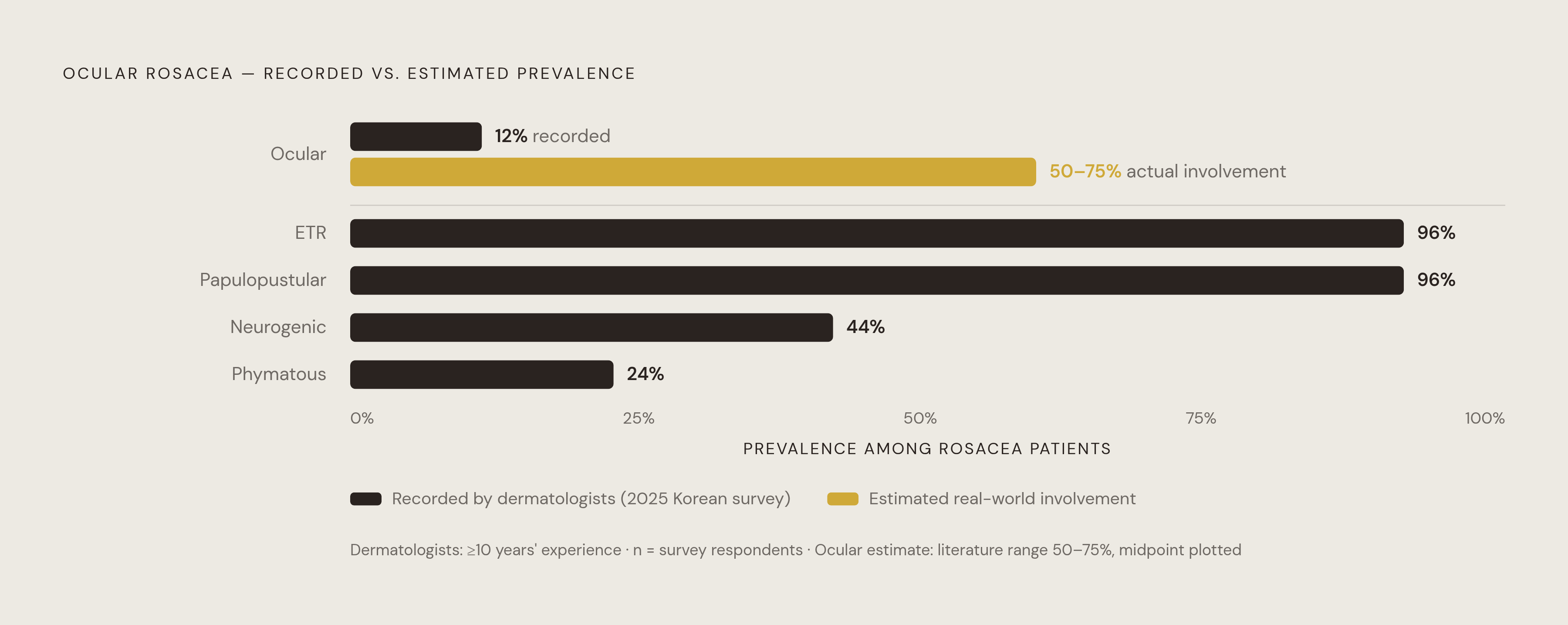
One phenotype the classic four subtypes miss: neurogenic rosacea, marked by burning and stinging out of proportion to what's visible on the skin, tied to nerve dysfunction rather than blood vessels alone. A 2025 survey of Korean dermatologists, most with over a decade of experience, found ETR and papulopustular were seen most often, both at 96%. Neurogenic came in at 44%, phymatous at 24%, and ocular at just 12%. That last number says less about how rare ocular involvement really is and more about how often it gets missed in practice, which is the theme running through most of the undertreatment problems in this disease.
What is happening in the skin: the biology beneath each subtype
Rosacea runs on a mix of immune overreaction, blood vessel and nerve dysfunction, oxidative stress, and a microbial imbalance on the skin's surface. None of these forces act alone. They feed each other, and pulling on one thread tends to tighten the others.
Start with the barrier. Barrier dysfunction occurs across the condition but hits hardest in ETR and papulopustular rosacea. When the barrier breaks down, water escapes through the skin faster than it should (transepidermal water loss, or TEWL), the stratum corneum holds less moisture, and pH shifts alkaline. That shift matters because it creates the exact conditions where bacteria that shouldn't be thriving start to overgrow. So the redness a patient sees is downstream of a chemistry problem, not just a vascular one.
On the immune side, a molecule called LL-37 gets switched on by two enzymes: MMP9 (a matrix metalloproteinase) and KLK5 (a kallikrein). Once LL-37 is overactive, it drags in inflammatory signals and immune cells. Elevated LL-37 alongside a buildup of CD4+ T-cells is one of the clearest fingerprints of active rosacea, and a receptor called TLR7 has been flagged as a key trigger in that cascade.
The skin's microbial residents play their own part. Demodex folliculorum, a mite that lives in hair follicles, along with Staphylococcus epidermidis, Bacillus oleronius, and Cutibacterium acnes, are the main players. Demodex and Bacillus oleronius activate a receptor called TLR2, which kicks inflammatory cytokines into gear. Skin and gut microbiota both help regulate inflammation, and their makeup differs between rosacea patients and everyone else. That points to gut dysbiosis disrupting the skin barrier from a distance.
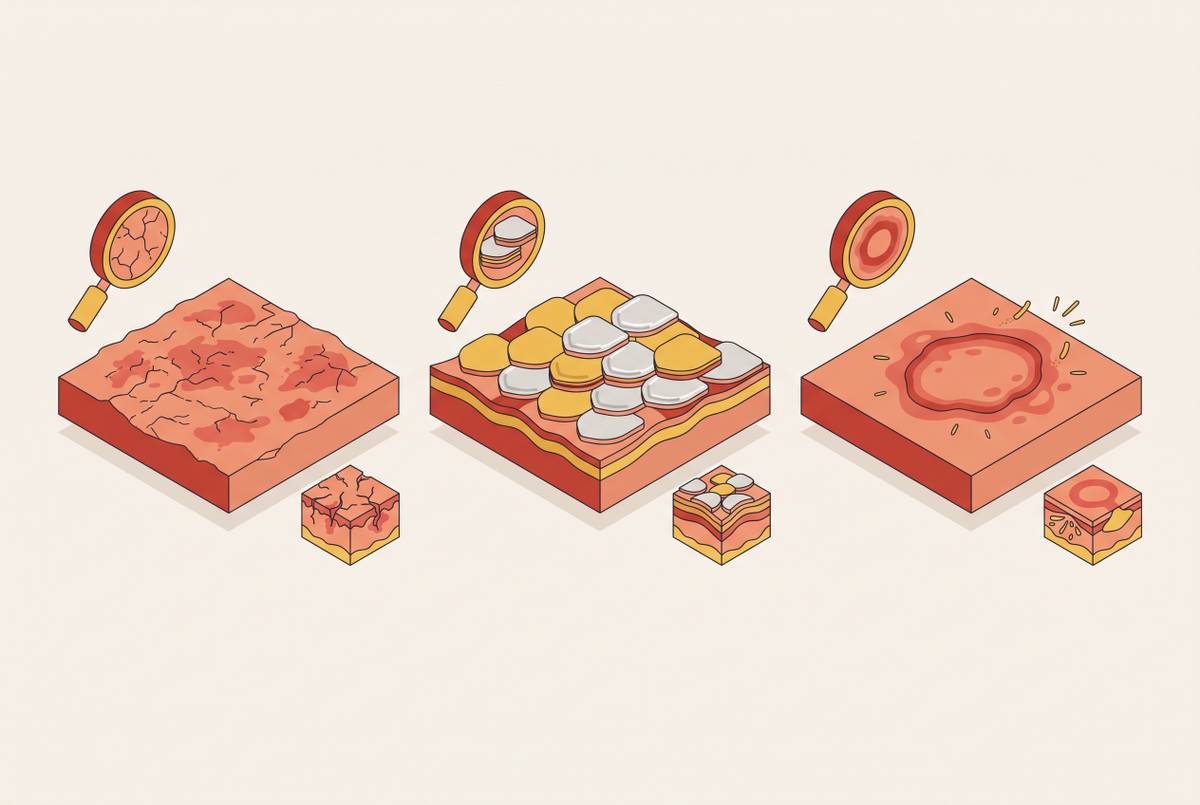
Under a microscope, each subtype tells its own structural story, and this is the strongest argument against treating rosacea as one condition. ETR shows sun-damaged collagen, dilated blood vessels, swelling, and immune cell clusters around vessels. Papulopustular rosacea shows neutrophils flooding hair follicles. Phymatous rosacea shows enlarged sebaceous glands, fibrosis, and stretched-out follicles. A rarer granulomatous form shows actual granuloma formation. Four different tissue pictures, one shared name. No single cream or pill was ever going to cover all four.
Triggers that cut across subtypes and identifying yours
Rosacea builds over years, with flares stacked on top of a baseline that's already primed to overreact. Triggers don't cause the disease. They flip on pathways it has already sensitized. Two people can eat the same spicy meal and only one of them flushes for the rest of the night.
A 2025 multicenter study covering 258 rosacea patients found 96% reported at least one aggravating factor across a range of environmental, dietary, and lifestyle triggers. Among the 28% who flagged food specifically, various dietary items were reported as triggers. Sun exposure, wind, extreme temperatures, certain skincare products, and intense exercise round out the list.
That pattern doesn't hit every subtype the same way, either. Heat, alcohol, and stress hit hardest for people with ETR and flushing, because those triggers act on blood vessels directly. Skincare ingredients matter more for papulopustular rosacea, where the barrier is already compromised and can't absorb much irritation. Sun exposure, though, sits close to universal across all four subtypes, so it's the one trigger nobody gets to skip managing, regardless of which subtype they're dealing with.
Tracking triggers is the one thing a patient can do before any prescription enters the picture. But trigger avoidance alone doesn't close the gap. A survey from the Turkish Society of Dermatology, covering 922 rosacea patients against 799 controls, found higher rates of other dermatological conditions in the rosacea group, and that gap widened with age and with how long someone had the condition. Rosacea's reach extends past the skin. A clinician needs to be in the loop for anything trigger-avoidance can't touch on its own.
Treating erythematotelangiectatic rosacea: targeting redness and flushing
ETR's core features, persistent central redness, intermittent flushing, and visible blood vessels (telangiectasia), call for a different toolkit than the other three subtypes.
On the topical side, brimonidine gel has strong backing for its effectiveness in managing rosacea-related erythema. Oxymetazoline 1% cream is FDA-approved for the same purpose, and a 2026 systematic review pooling 15 studies (537 patients plus 77 controls) confirmed it reduces redness too.
For persistent redness and visible vessels, intense pulsed light (IPL) and pulsed-dye laser (PDL) are the go-to procedural options. PDL showed up in that same 2026 review as delivering real clinical benefit.
Skincare for ETR starts with barrier repair, since TEWL and pH disruption make blood vessels more reactive, not less. Gentle, non-irritating formulas and daily broad-spectrum SPF are the baseline everything else sits on top of. They're the baseline everything else sits on top of. Retinoids, by contrast, have a shaky record for this specific subtype, and this is where a lot of well-meaning routines go wrong. One study of 55 people with inflammatory rosacea found 0.1% adapalene cut inflammatory lesions, with evidence for its benefit on redness or visible vessels remaining limited. Retinoids earn their place elsewhere in rosacea care. For ETR's redness and vessels specifically, the evidence supporting them is limited, and reaching for one here is a wasted step.
None of these vascular treatments touch the trigger sensitivity that causes the flushing. Redness-reducing drugs and lasers treat what's already visible, but trigger management and barrier support have to run alongside them, not sit on the shelf once the laser session ends.
Treating papulopustular rosacea: the acne lookalike that needs a different approach
The missing comedones aren't just a diagnostic footnote. Papulopustular rosacea gets mistaken for acne often enough that patients land on acne treatments, and the comedolytic, often-irritating ingredients built for acne make rosacea's already-fragile barrier worse, not better. Treating this subtype like teenage acne is close to the most common misstep in managing it, and it's an easy trap to fall into since the bumps genuinely look the same to an untrained eye.
Topical ivermectin and oral doxycycline are among the most effective options for papules and pustules, backed by strong evidence. Topical azelaic acid and topical metronidazole also carry strong support. The same 2026 systematic review referenced earlier (537 patients, 77 controls) found benefit across a wider list too: oxymetazoline, pulsed-dye laser, ivermectin, azelaic acid, dapsone, sulfur preparations, and metronidazole, each cutting erythema, inflammatory lesions, or overall severity to some degree.
Minocycline foam, marketed as ZILXI, is a tetracycline-class antibiotic FDA-approved specifically for inflammatory rosacea lesions in adults. And here's a finding that cuts against what most people assume about rosacea-safe ingredients: two Phase III trials testing once-daily benzoyl peroxide 5% cream against a vehicle control, across 733 adult patients in 2023, showed real efficacy, despite benzoyl peroxide's reputation as an acne ingredient too harsh for rosacea-prone skin. That result alone should put to rest the idea that anything labeled "for acne" is automatically off-limits here. The ingredient matters less than the concentration and formulation around it.
Further out, that same 2026 review points to tofacitinib and oral ivermectin showing promise for rosacea that hasn't responded to standard treatment, though both remain emerging options rather than settled standard of care. Demodex-targeted therapies and eradicating Helicobacter pylori, the bacteria behind stomach ulcers, were both tied to clinical improvement in that same review, which loops back to the microbial imbalance. Demodex-targeted therapies and eradicating Helicobacter pylori, the bacteria behind stomach ulcers, were both tied to clinical improvement in that same review, which loops back to the microbial imbalance described earlier as part of what actually drives the disease.
Among skincare ingredients, azelaic acid earns real respect here. It works as both an anti-inflammatory and a mild keratolytic that clears built-up dead skin cells, without the barrier disruption that comes with stronger actives. That combination makes it one of the more dependable first-line additions for papulopustular skin.
Treating phymatous and ocular rosacea: the two subtypes most often undertreated
Phymatous rosacea is a genuinely different problem, and no cream fixes it. Fibrosis and enlarged sebaceous glands are structural changes, and no topical anti-inflammatory reverses tissue that's already thickened and scarred. This is the one subtype where medication alone clearly falls short. Treating it like the other three with a stronger cream is a losing bet, and it wastes time a patient doesn't get back once fibrosis sets in.
Procedural treatment, laser resurfacing or surgical reshaping, is the primary way established rhinophyma gets addressed. Earlier in the disease course, systemic isotretinoin has been discussed in the literature as a way to potentially slow progression before fibrosis takes hold, so catching this subtype early carries real weight. The 2025 Korean survey found 24% of experienced dermatologists see phymatous cases regularly. That's less common than ETR or papulopustular, but far from rare. Men are disproportionately affected and tend toward the severe end, including full phyma formation. Cases have turned up in people with no documented rosacea history at all, so it isn't always the endpoint of a diagnosed disease. Sometimes it's the first sign anyone gets.
Ocular rosacea might be the most consequential undertreated subtype, simply because of how common it is. That 50% to 75% figure for eye involvement bears repeating, because the symptoms, tearing, dryness, a gritty feeling, itchiness, styes, blepharitis, get written off as allergies or too much screen time far too easily, and that misattribution delays treatment. The 2025 Korean survey found ocular rosacea was the least represented phenotype, appearing in just 12% of cases recorded by experienced dermatologists. That gap between reported frequency and actual prevalence points to underrecognition, not genuine rarity, and it's arguably the clearest example in this entire disease of a symptom hiding in plain sight.
Managing ocular rosacea usually calls for ophthalmology involvement once symptoms move past mild. Eyelid hygiene, lubricating eye drops, and sometimes the same topical or systemic agents used for skin rosacea help on the ocular side too.
What connects phymatous and ocular rosacea is delay. Both get recognized late, and both patients pay for it. That delay is the real clinical cost of treating rosacea as one disease instead of four, each with its own mechanism and its own timeline.
Skincare ingredients to use and avoid when you have rosacea
A product that soothes one rosacea subtype can do almost nothing, or actively backfire, for another. What follows maps onto the mechanisms already covered: barrier repair, microbial balance, and inflammation control. So the question to ask about any product isn't "is this good for rosacea," it's "which rosacea, and why."
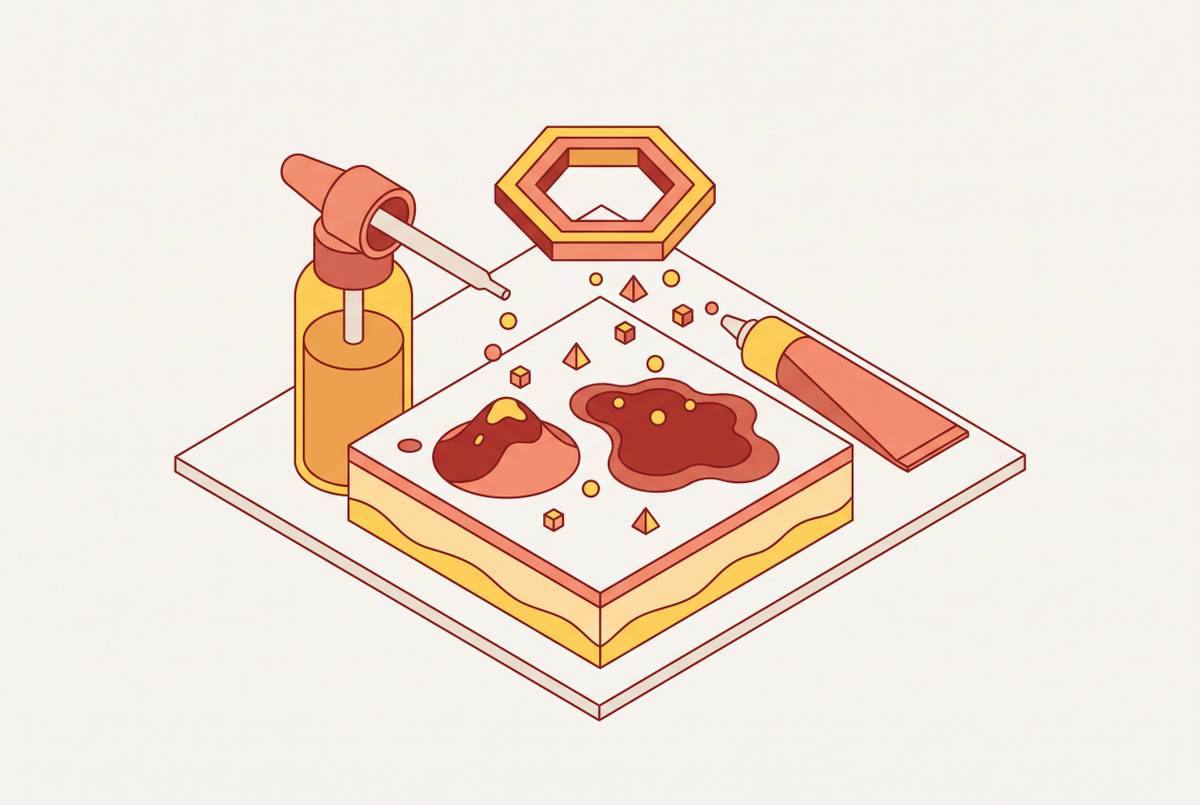
Azelaic acid stands out as one of the better-tolerated actives across subtypes, combining anti-inflammatory action with gentle exfoliation and minimal barrier disruption. Niacinamide runs a similar profile: it supports barrier function directly, which matters given how central TEWL and barrier compromise are to both ETR and papulopustular rosacea. Broad-spectrum sunscreen belongs in every rosacea routine, no exceptions, given how consistently sun exposure gets flagged as a trigger across all four subtypes.
On the avoid side, physical exfoliants, scrubs, brushes, anything abrasive, tend to aggravate skin that's already compromised rather than improve it. High-alcohol toners and fragrance are common irritants too, and they show up on ingredient labels even in products marketed as gentle. Comedolytic acne actives, built to unclog pores, are solving a problem this skin doesn't have. There are no comedones to clear, and stripping the barrier to chase them just adds injury to injury.
Retinoids sit in a gray zone, and treating them as a default rosacea ingredient is a mistake. They've shown some benefit for inflammatory lesions in papulopustular rosacea, but the evidence for redness and visible vessels in ETR stays thin and mixed. Expectations should stay modest, and use should stay closely watched, ideally with a dermatologist tracking whether it's helping the skin or wearing down the barrier further. Matching the ingredient to the mechanism, not the claim printed on the bottle, is what actually separates a routine that helps from one that quietly does damage.
Sources
- Dermoscopy of rosacea: A cross-sectional study comparing dark and light phototypes
- anndermatol.org
- Rosacea: New Concepts in Classification and Treatment | American Journal of Clinical Dermatology | Springer Nature Link
- The Latest Advances in Rosacea Treatment: A Systematic Review
- Recent advances in understanding and managing rosacea
- rosacea.org
- mdpi.com