Why You're Suddenly Getting More Skin Tags
Sudden clusters may signal insulin resistance, not just friction or weight gain.

A skin tag, medically called an acrochordon, is a small, soft growth that hangs off the skin by a thin stalk. They're common: something close to 46% of the general population has at least one, and over a lifetime, 50 to 60% of adults will develop one at some point. They show up where skin rubs against skin or against fabric, most often the neck, armpits, groin, eyelids, and the skin under the breasts. Underneath, a tag is just a small bundle of collagen and blood vessels caught inside thicker skin, formed when certain cells get a signal to grow faster than usual. They're benign, full stop, with only a rare exception noted later. But the question that actually matters isn't whether someone has skin tags. It is whether the rate at which new ones appear has changed. That shift in rate is the real signal, and it's the thread running through everything below.
Why "suddenly" is usually a perception event, not an overnight biological one
Almost nobody catches a skin tag on the day it forms. What actually happens is a collar catches on something, a necklace snags, or a photo shows three tags clustered together that somehow went unnoticed until now. That moment feels sudden. The biology underneath it usually isn't sudden; it builds gradually and only becomes visible when something like a collar, a necklace, or a photo reveals it.
So the real diagnostic question isn't "why did this happen overnight." It's whether the rate of formation actually increased, or whether the rate of noticing did. Working back through the last twelve months answers that more reliably than any test could. Did weight shift up or down? Is there a pregnancy or a recent postpartum stretch in the picture? Any hormonal transition, like perimenopause, or a new medication that changes how the body handles insulin? Is there a new source of friction, a heavier necklace, a different collar, a bra that fits differently than it did a year ago? And separately from all of that: has blood sugar been drifting upward quietly, with no symptoms attached?
That last one gets missed constantly, mostly because mechanical explanations feel too small to matter, and metabolic ones feel too slow to notice. If the increase turns out to be modest and nothing on that list applies, plain baseline biology, friction, genetics, age, is probably still the answer. But if something does apply, it usually points toward one of three broad drivers: friction and weight, insulin resistance, or a hormonal shift tied to a specific life stage. Each works differently, and each merits understanding on its own.
How friction and weight change produce more skin tags through two separate routes
Friction alone can do it. Repeated rubbing irritates the skin locally, which triggers inflammation, and that inflammation pushes skin cells to multiply faster than they otherwise would. No metabolic component required. It's a purely mechanical process, and it explains a large share of tags on its own.
Weight gain, though, works through two separate channels at the same time. The first is mechanical, and it's the more obvious one: more body mass means more skin folds, and more skin folds mean more skin rubbing against skin in spots that didn't have that problem before. Underarms, groin, the area beneath the breasts, inner thighs. These are exactly the zones where tags cluster, and that's not a coincidence.
The second channel runs deeper, and it's metabolic rather than mechanical, tied to how weight gain changes insulin activity in the body. That pathway matters more clinically than the friction one, because it's a signal about what's happening systemically, not just locally.
A necklace worn daily that's slightly heavier than the last one, a new uniform collar, clothing that fits differently after a weight change, and a job that adds a repetitive strap across the shoulder or waist are friction sources that get overlooked because they seem too ordinary to matter. None of these are dramatic. All of them add up over months. And loosening clothing, keeping skin folds dry, and skipping tight jewelry in prone spots can slow new tags from forming, though none of it will make existing ones disappear. That's a friction fix, not a cure.
The metabolic route is where things get more interesting, and more worth paying attention to.
The insulin resistance pathway: why metabolic health shows up on the skin
Skin doesn't grow tags at random. It responds to signals, and one of the strongest signals it can receive comes from inside the bloodstream, not from anything touching the skin's surface. When cells around the body become resistant to insulin, the pancreas compensates by pumping out more of it. That excess insulin activates IGF-1 receptors on fibroblasts and keratinocytes, the same cell types involved in friction-driven tag formation, now driven by a growth signal from within. Same cells, different trigger. Instead of rubbing setting off growth, a hormone circulating in the blood is doing it.
This isn't a loose theory. A 2020 NIH-published study measured IGF-1R and IGF-2R expression directly in skin-tag tissue and found it significantly higher than in controls (p < 0.01). That's the mechanism confirmed at the tissue level, not just inferred from patterns.
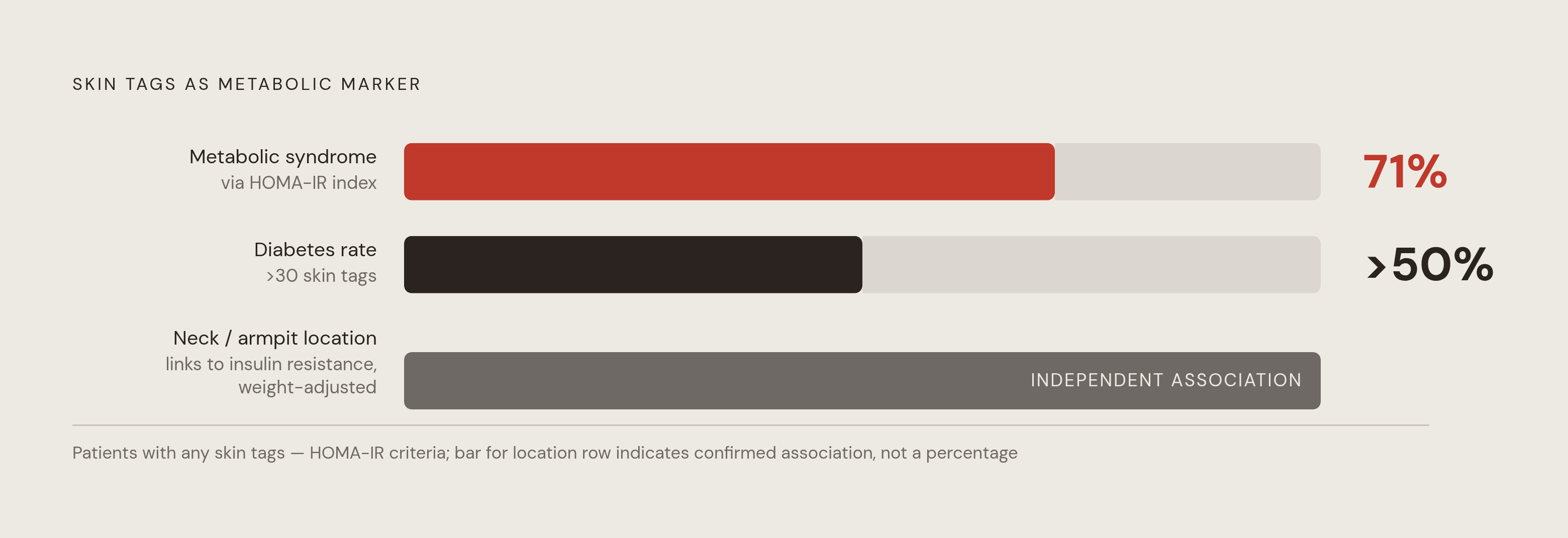
And the patterns back it up. A study using the HOMA-IR index, a standard measure of insulin resistance, found that 71% of patients with skin tags met the criteria for metabolic syndrome. Skin tag count, leptin levels, and HOMA-IR scores were all significantly higher in patients with metabolic syndrome than those without it, and tag count correlated positively with waist circumference. In a separate case-control study, patients who had more than 30 skin tags showed a diabetes rate above 50%. A 2023 meta-analysis confirmed the insulin resistance link broadly, and separately, neck and armpit tags specifically stayed linked to insulin resistance even after researchers adjusted for body weight. A larger systematic review from 2025, pulling together dozens of studies across thousands of participants, found a strongly elevated pooled odds ratio connecting metabolic syndrome to skin conditions overall. That's not one study finding a pattern. The same pattern appears across a body of research, from several angles, over more than a decade.
Type 2 diabetes shares this exact mechanism: the same hormonal process that eventually gets diagnosed as diabetes can show up on the skin years earlier, in a form most people write off as cosmetic.
One caveat deserves to sit front and center here, because it's the assumption that trips people up most. Chronically elevated insulin and metabolic syndrome are not conditions reserved for people carrying visible excess weight. Insulin resistance can build quietly in someone at a completely typical body weight, and if that person develops new skin tags, thinner build shouldn't be a reason to rule out a metabolic explanation. Body size is a clue, not a filter.
A companion sign is acanthosis nigricans, the darker, velvety patch of skin that tends to show up at the back of the neck or in the armpits. It frequently appears alongside skin tags, as in PCOS and insulin resistance generally. Seeing both together is a stronger prompt to check metabolic health than either one appearing alone.
Hormonal drivers: pregnancy, menopause, PCOS, and thyroid function
Insulin isn't the only hormonal lever that can push skin cells into overdrive. A handful of life stages and conditions activate that same growth machinery through different doors.
Pregnancy is the clearest example. New tags commonly show up in the second and third trimesters, driven by a surge in estrogen, progesterone, and human placental lactogen, all of which ramp up growth factor activity in the skin. Pregnancy also raises leptin, and leptin stimulates new blood vessel growth while triggering the same keratinocyte and fibroblast multiplication seen in the insulin pathway. Some tags that appear during pregnancy shrink or fall off once hormone levels settle back down afterward, but plenty stick around permanently.
Menopause works differently but lands in a similar place. As estrogen declines, androgen levels become relatively more dominant, and that imbalance can trigger new tag growth on its own. At the same time, skin is thinning and losing elasticity during this transition, which makes it more vulnerable to friction-driven proliferation in the first place. Two separate mechanisms compounding each other at once, not one canceling out the other.
PCOS deserves the closest look here, because it ties directly back to the insulin pathway just covered, while adding a second mechanism on top. PCOS affects an estimated 5 to 18% of women of childbearing age, and it drives skin tag formation through two overlapping routes: the same insulin resistance discussed above, plus elevated androgens, which independently promote tag growth on their own. Acanthosis nigricans and skin tags often appear together in PCOS, the same twin-sign pattern seen in insulin resistance generally. What makes PCOS tricky is that many women deal with each symptom on its own for years, treating the tags, the darker skin patches, the irregular cycles, and the excess hair growth as separate issues, without anyone connecting them back to one underlying hormonal condition.
Thyroid function belongs in this conversation too, if a step removed. Thyroid hormones regulate metabolism and cell growth throughout the body, skin included, and hypothyroidism in particular tends to travel alongside both insulin resistance and weight gain, two independent skin tag risk factors in their own right. Both an underactive and an overactive thyroid can play a role in tag development, which makes thyroid function worth ruling in or out when the picture doesn't fit cleanly elsewhere.
Reading the pattern: which tags, where, and their signals
Location tells a story on its own. Tags on the neck and in the armpits carry more metabolic weight than a stray tag somewhere else, since that link to insulin resistance holds up even after researchers control for body weight. A cluster confined to one high-friction spot, with an obvious new mechanical cause behind it, a new job, new clothing, a heavier bag strap, points toward friction as the likely explanation on its own. A wider crop appearing across several different areas at once, with no friction story to explain it, raises the odds that something systemic is driving it instead.
Timing matters just as much as location, arguably more. A few tags accumulating slowly across several years fits ordinary baseline biology fine, friction, genetics, and age doing what they normally do. A distinct new batch appearing over six to twelve months, especially concentrated on the neck or underarms, matches the pattern most associated with metabolic change, and it should be mentioned to a provider. A fast increase during pregnancy, on the other hand, is expected and benign, driven by hormones that will largely settle after delivery.
Certain combinations raise the stakes further. Elevated insulin is signaled when tags appear alongside acanthosis nigricans. Tags alongside increased thirst, frequent urination, or unexplained fatigue are worth raising in a diabetes screening conversation. Tags combined with irregular periods, excess hair growth, or new acne in a woman of childbearing age point toward PCOS and are worth a hormonal workup.
One rare pattern is a direct exception: a sudden burst of new growths that look like skin tags but turn out to be seborrheic keratoses is documented in dermatology literature as the Leser-Trélat sign, and it warrants evaluation. Any fast, unexplained jump in new skin growths is worth a dermatologist's eyes, if only to confirm the lesions are what they appear to be. Before acting on any of the patterns above, that confirmation step comes first.
What to do when a sudden increase is worth investigating
Start by confirming what's actually there. A true skin tag is soft, matches the surrounding skin color, hangs off a narrow stalk, and doesn't hurt. Something firm, dark, bleeding without being bumped, growing fast, or shaped irregularly doesn't fit that description, and it shouldn't be assumed to be a tag just because it's sitting among others that are. In the largest published series of lesions removed under the assumption they were ordinary skin tags, a small number turned out to be malignant on closer examination. Small odds, but real ones, and reason enough not to assume.
From there, a provider has a specific set of tests to ask about. Fasting glucose, hemoglobin A1c, and fasting insulin check for a metabolic driver directly. A HOMA-IR calculation, built from fasting glucose and insulin together, gives a more precise read on insulin sensitivity, and it's the same measure several of the studies above used to establish the skin tag connection in the first place. A lipid panel checking triglycerides and HDL often turns up abnormal in people with multiple tags, reinforcing a metabolic syndrome picture when one is present. A thyroid panel covering TSH, Free T3, and Free T4 makes sense if thyroid dysfunction seems plausible. And a hormonal evaluation belongs in the mix if PCOS or a menopausal transition fits the timeline.
Walking into that appointment with specifics helps more than walking in with a general concern. How many new tags, and over what stretch of time? Where exactly are they, since neck and underarm placement carries more metabolic weight than tags elsewhere? Any darker, velvety patches nearby? Any thirst, fatigue, frequent urination, or irregular cycles should be mentioned in the same breath. That level of detail helps a provider decide which test to run first instead of ordering everything at once.
On the lifestyle side, weight loss, where it's relevant, works through both mechanisms discussed earlier at the same time: it improves insulin sensitivity, which quiets the internal growth signal, and it reduces skin fold friction, which removes the mechanical trigger. Two separate levers, moving together. Managing blood sugar through diet, and medication where a provider recommends it, works on that same internal signal from a different angle. None of this erases tags that already exist. It slows the pace at which new ones form, which, if the last several sections have made anything clear, is really the question worth asking in the first place.
Sources
- Why is my skin tags increasing? | SiPhox Health
- What Causes Skin Tags? Risk Factors & Prevention
- Why Am I Getting Skin Tags All of a Sudden? Causes and Solutions
- The role of insulin-like growth factor in Acrochordon Etiopathology
- Skin tag
- A STUDY OF ANDROGEN AND ESTROGEN RECEPTORS α, β IN SKIN TAGS
- Open-access Association between skin tags and insulin ...