Asynchronous Dermatology Consultation Process Explained
Photos and medical history guide dermatologists' remote assessments without live appointments.
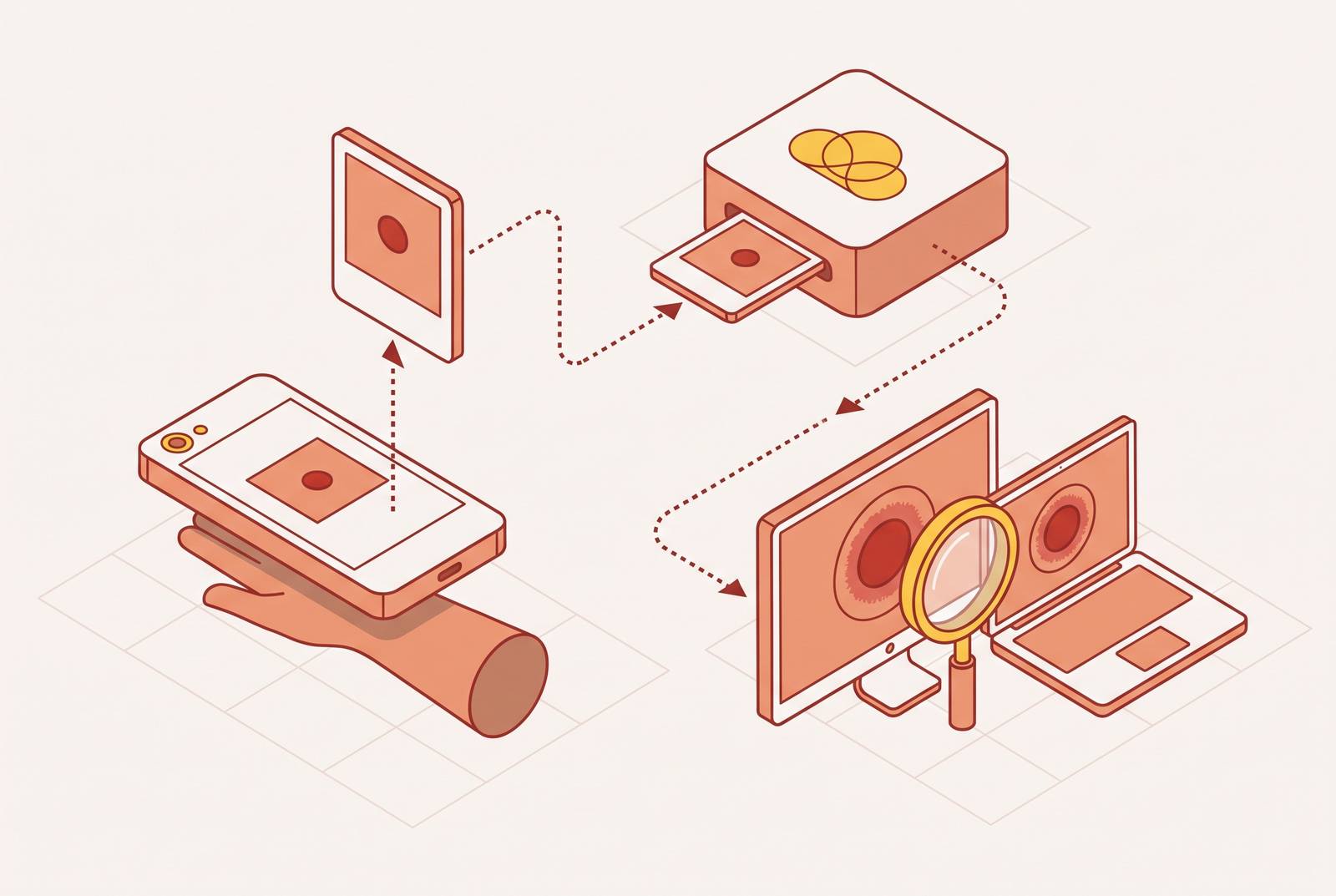
AI-assisted telehealth dermatology with clinician review uses submitted skin photographs and medical history to support a licensed clinician’s assessment. In an asynchronous consultation, that assessment happens without a live call and leads to a written care plan or referral. Understanding the process, especially the intake and image requirements, helps patients give the clinician the evidence needed for an accurate, useful assessment.
What asynchronous dermatology consultation actually is and how it differs from a video call
Asynchronous teledermatology is also called store-and-forward. The patient submits photographs and a medical history, and a dermatologist reviews them independently at a later time. There is no scheduled call to join. Unlike live video, this format does not require the patient and clinician to be available together or maintain a connection throughout an appointment. It is the most widely used teledermatology format, particularly for triage and routine skin evaluations. Because the clinician works from submitted materials alone, what the patient submits is the entire consultation.
The five stages of the consultation, in order
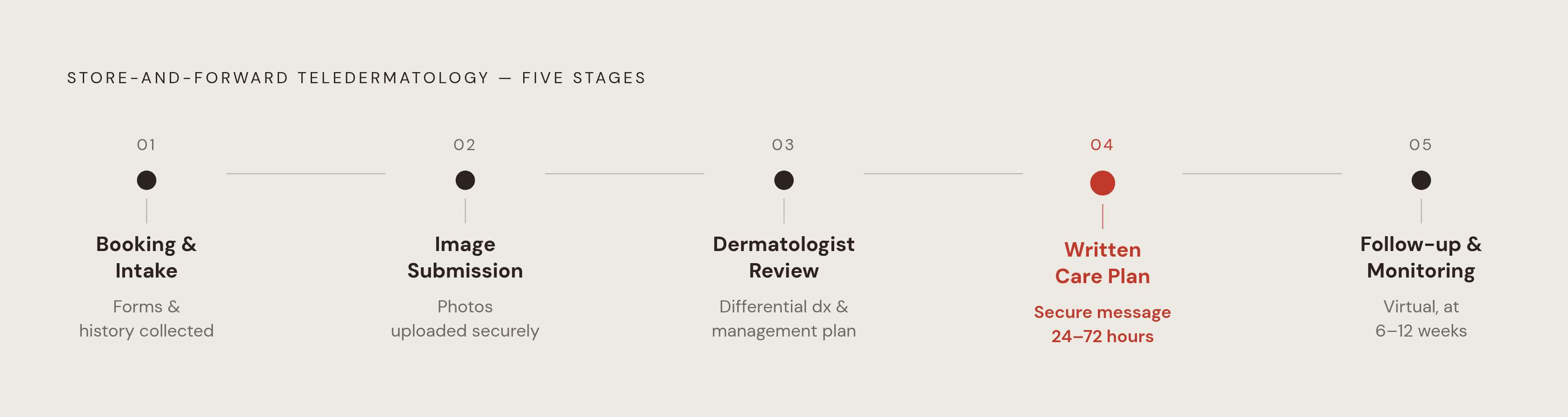
The process starts with booking and intake forms, then patients send in images before the review window opens. At the third stage, a board-certified dermatologist reviews the photographs and history to form a differential diagnosis and management plan. At the fourth stage, the patient gets that plan through a secure message, usually within 24–72 hours depending on the platform. The fifth stage is follow-up and monitoring, typically at 6–12 weeks and conducted virtually in most cases, so the clinician can adjust treatment based on the response.
What the intake form is actually asking and why thorough answers change the outcome
The intake form supplies the context that photographs cannot. A picture shows how a concern looks, but not how long it has been present, how it has changed, or which treatments have already been used. Typical questions cover skin history, duration and progression, current skincare products, prescription treatments, known sensitivities, and medications. The form also asks which concerns the patient wants addressed, helping the clinician understand the purpose of the consultation.
Patients should answer questions about medications as carefully as those about their skin. Oral contraceptives and hormonal treatments can affect the skin, while other drugs or health conditions can affect whether a prescription is right for the patient. Treatments including tretinoin, spironolactone, and certain antibiotics may interact with other drugs or be unsuitable in particular circumstances. The clinician needs that information before prescribing safely. To help them fill out the form accurately, patients should keep their current skincare products and prescription treatments within reach so they can give exact names.
Some diagnoses call for screening beyond the skin itself. The University of Pittsburgh Medical Center’s lichen planus retrospective study found that teledermatologists followed the hepatitis C virus screening standard of care in the large majority of cases.
How to submit images that a clinician can actually use
Photo quality is the main reason consultations stall or require resubmission. The Belgian pilot study found that only roughly 57.1% of dermatologists thought the photographs sent in gave them enough evidence to make the right decision. A photograph that looks clear to its owner may still leave a clinician unable to judge the skin reliably. Preparation is therefore a useful point of control. It can reduce avoidable delay before the assessment begins.
For patients preparing images, the practical approach starts with natural daylight and a plain background. Avoid flash, even in a dim room, because it can flatten skin texture and distort color. Artificial lighting and shadows are common reasons for resubmission. The aim is to show the skin clearly. Lighting needs to preserve the features the clinician is trying to assess.
Begin with a locator shot showing the affected area in context, including its distribution across the face or body. Then provide a close-up that captures texture, color, and surface quality. A dermoscopic image is needed only if the clinician specifically requests one. For monitoring over time, keep the angle and distance consistent so that changes in a rosacea flare or pigmented lesion are not confused with changes in framing. These images still need a full intake history, because good photographs allow the review to work as intended only when the clinician can interpret them in context.
What the clinician is doing during the review and what the written plan contains
During review, the dermatologist brings the photographs and history together to form a differential diagnosis. This means considering the possible explanations for what the patient has submitted, rather than treating every image as evidence of one certain answer. The clinician reasons much as they would in an in-person assessment, but without physical palpation. That distinction places a limit on certainty. For a complex or atypical presentation, the clinician may request more photographs or a live video call before issuing a plan.
The written plan records a confirmed or working diagnosis and sets out how the condition will be managed. It usually sets out which topical or oral treatments are recommended, if needed, along with product protocols, lifestyle advice such as sun protection, and when to have a follow-up. It is more than a product recommendation. A working diagnosis also tells the patient that the assessment may need to be refined as further information or a treatment response becomes available. Most platforms send the plan within 24–48 hours, which falls within the wider window described earlier that depends on the platform.
Remote prescribing covers many of the same treatments available in an exam room, including topical retinoids, topical and oral antibiotics, azelaic acid, benzoyl peroxide, and hormonal treatments such as spironolactone. Isotretinoin is a major exception because it remains governed by the iPLEDGE REMS program. Some patients will receive no prescription for these medicines because the management plan depends on how the clinician assesses the case sent in.
When a case routes to in-person care instead of or after the remote consultation
An in-person referral lets the clinician answer a question about the patient’s care that the photographs and history leave open. The Belgian study found that a meaningful minority of patients, 21%, needed an additional in-person consultation after the remote one. The reason may be the need to feel firmness or texture, assess a wound, biopsy a suspicious lesion, or examine a rapidly changing presentation.
Incomplete evidence can lead to a different kind of escalation. Poor images or insufficient intake information may prompt a resubmission request, while an in-person visit may be needed if the evidence cannot support a safe remote plan. The distinction is between missing information and information that requires physical examination. Neither is a judgment on the patient’s effort.
The UPMC study and its alopecia companion study found that the strong majority of cases were managed entirely through teledermatology. Platforms and VA programs nevertheless include routes to in-person care when the remote assessment is insufficient. Referral is part of the care pathway. Asynchronous dermatology can be the right first step for everyday concerns without being a permanent substitute for an examination when one is clinically necessary.
How do AI and a real dermatologist work together during an online review?
AI can help with image pre-screening, pattern detection, and triage before or while a clinician reviews the case. In the clinician-led model, a board-certified dermatologist remains responsible for diagnosis and treatment decisions, including whether a prescription is appropriate. An AI-assisted intake therefore does not mean that a computer is making the patient’s diagnosis.
Pattern recognition is only one part of assessment. AI can perform well on common conditions in controlled settings, but performance can degrade on early-stage presentations and on patients with darker skin tones. Atypical cases also require more than matching an image to a familiar pattern. Clinicians integrate the history with clinical, anatomopathological, and microbiological information where relevant. AI cannot perform that synthesis in the same way.
For patients asking which service is “best,” the available evidence supports comparing services by their workflows. Image analysis, licensed clinician review, and physician approval of prescriptions are separate functions. One does not establish the presence of another. A service described as AI-assisted is not, by that description alone, evidence that a dermatologist assesses every case. In this model, the clinician makes the decision, including whether the patient needs more than remote care.
Which conditions benefit most from this format and which genuinely require an in-person visit first
Asynchronous dermatology is well suited to acne, rosacea, atopic dermatitis or eczema, psoriasis, non-scarring alopecia, pigmentation concerns, and photoaging. These are common, visually distinct concerns for which clinicians can often issue treatment plans remotely. A condition’s name can help show when this format is likely to work, but photographs and history may give the clinician enough evidence for some presentations and too little for others. Even with a familiar diagnosis, the clinician still needs to check for changes.
Routine follow-ups for stable eczema or rosacea allow a clinician to review progress and adjust treatment without a shared appointment time. Comparable photographs make those reviews more useful. In-person appointments are better for flare-ups that need physical assessment, while remote follow-up can work when the clinician can still assess the case through visual review. The choice depends on what the next assessment needs to establish.
By contrast, suspicious pigmented lesions under active evaluation, post-procedure wound checks, and conditions in which texture or firmness is diagnostically critical are better handled in person first. Teledermatology can then support follow-up once a baseline is established. Feng et al.’s 2018 JAMA Dermatology study found that over two-thirds of U.S. counties had no practicing dermatologists as of 2013. Asynchronous care extends specialist access to rural, underserved, elderly, disabled, and caregiver populations who face substantial barriers to attending an appointment.
How cost compares to in-person dermatology and what the written care plan is worth in practical terms
Asynchronous consultations usually cost a fraction of what an in-person dermatology visit costs without insurance, though the notes give no single price that applies to all services. For patients who would otherwise go without care, a lower-cost consultation with a real clinician can make specialist assessment reachable. Scheduling efficiency supports that access as well. Reduced no-show rates and fewer empty appointment slots can shift clinician time toward active cases.
The document received at the end also has value beyond the initial exchange. A written plan records the diagnosis, treatment approach, and follow-up expectations in a form the patient can revisit. It is a starting point for adjustable care. Reviews at 6–12 weeks allow the clinician to assess how the skin responds and change the plan where needed.
The UPMC study found that asynchronous patients were less likely to have follow-up than patients seen in person, showing a gap in care after the first assessment. Receiving a plan is not the same as using it. Patients who understand their condition and the reasoning behind treatment are more likely to follow the plan, especially when it explains what is prescribed, why, and what to watch for. The practical value of asynchronous care grows when patients understand both how to supply the evidence for an assessment and how to use the plan that follows.
Sources
- Store‐and‐Forward Tele‐Dermatology Pilot Study in Belgium: Patients and Physicians Satisfaction Study With Process Evaluation - Heselmans - 2025 - International Journal of Clinical Practice - Wiley Online Library
- Managing rosacea using asynchronous consumer to physician teledermatology as compared to in-person visits: A retrospective study
- Asynchronous Teledermatology Reduces Wait Times and Maintains High Adherence to Standard Care for Lichen Planus: A Retrospective Study
- Using the RE-AIM framework to assess national teledermatology expansion
- Asynchronous Teledermatology for Non-Scarring Alopecia: A Retrospective Study
- Store-and-Forward Teledermatology for Assessing Skin Cancer in 2023: Literature Review