Prescription Acne Treatment Through a Licensed Clinician Without a Clinic Visit
Remote assessment by a licensed clinician can treat mild-to-moderate acne without waiting weeks.

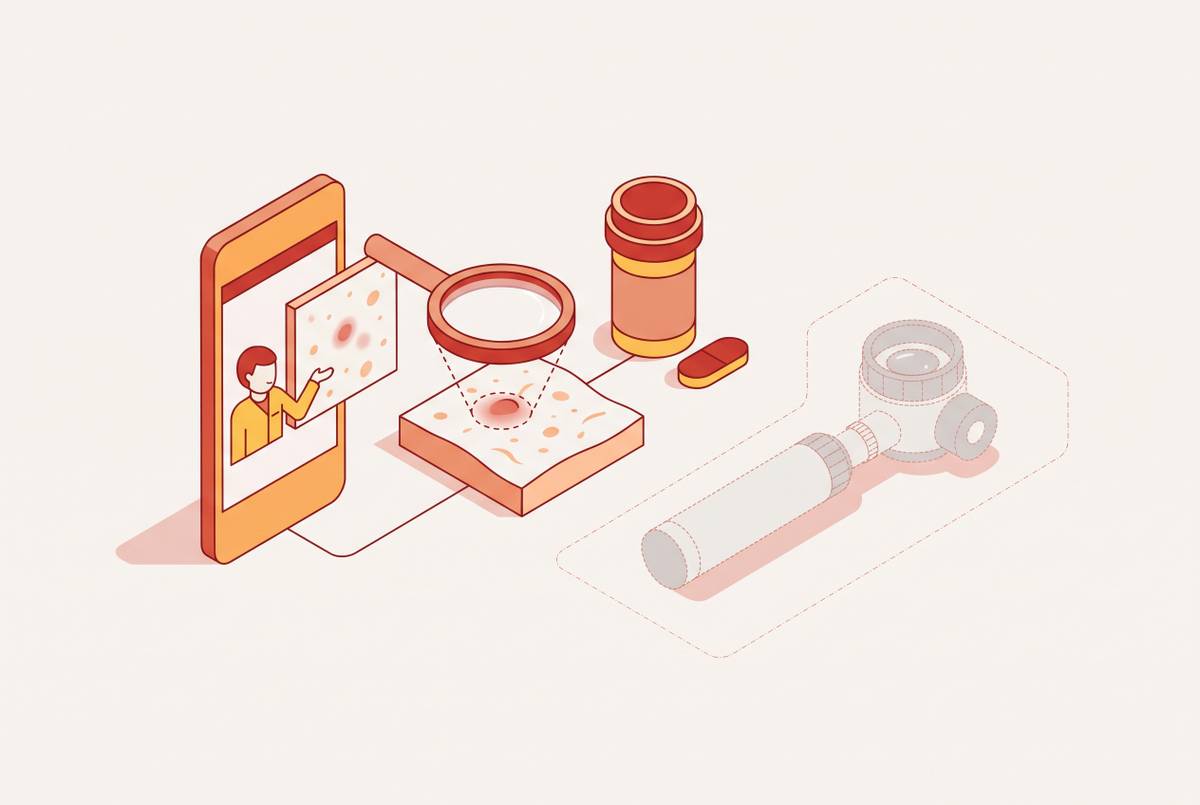
Prescription acne treatment online is a well-established way to receive care without a clinic visit. A licensed clinician can assess photos and medical history, prescribe treatment for mild-to-moderate acne, and send the prescription to a pharmacy. The strongest pathway includes individual clinical review and a route to in-person care when photographs or remote prescribing cannot meet the patient’s needs.
Why acne accumulates real harm while patients wait for a dermatologist appointment
An appointment can stay weeks away while acne keeps changing. New inflamed spots come up, older ones leave dark marks, and the patient still has no plan for prescription treatment. The waiting is not clinically neutral. Inflammation can build week by week and raise the risk of post-inflammatory hyperpigmentation and permanent scarring. Even treatment that works later cannot undo all the damage done during the wait.
The emotional burden develops in parallel with the skin changes. Reduced self-esteem and anxiety are part of acne’s psychosocial harm even before the disease becomes severe. That makes the delay especially frustrating for a condition that is highly treatable with first-line medicines studied for decades. Treatment exists, but access can remain out of reach.
Dermatologists are concentrated in urban centers, some rural counties have none, and the specialist pipeline has not kept pace with patient volume. For patients caught in that mismatch, the realistic choice may be remote assessment now or continued waiting.
Why acne is one of the conditions most suited to remote clinical assessment
What does a clinician need to recognize acne? Much of the answer is visible on the skin’s surface. Comedones, papules, pustules, and nodules provide the pattern used to classify acne, and well-lit photographs can show those features. For straightforward presentations, classification does not require a biopsy, palpation, or a real-time examination. The remaining context, including hormonal history, previous treatments, current products, and medications, comes from the patient’s history.
That makes acne unusually suited to image-based care, but suitability is not a promise that every remote assessment will be sufficient. A 2022 study found that Global Acne Grading System scores fell by 87.94% in patients who received care through teledermatology. That finding demonstrates treatment benefit. Studies comparing remote and in-person assessments find moderate-to-good agreement for common skin conditions, with clinicians reaching the same conclusion in most cases.
University of Pittsburgh Medical Center’s published work on asynchronous care for rosacea and its 2025 study on non-scarring alopecia also support remote management of many common skin presentations without in-person follow-up. Those findings help support remote care, though they do not prove that it works for acne. The boundary remains condition-specific. A potentially cancerous lesion needing biopsy, a full-body skin exam, or a genital presentation calls for a different assessment pathway.
How can you get a prescription for acne through a telehealth app?
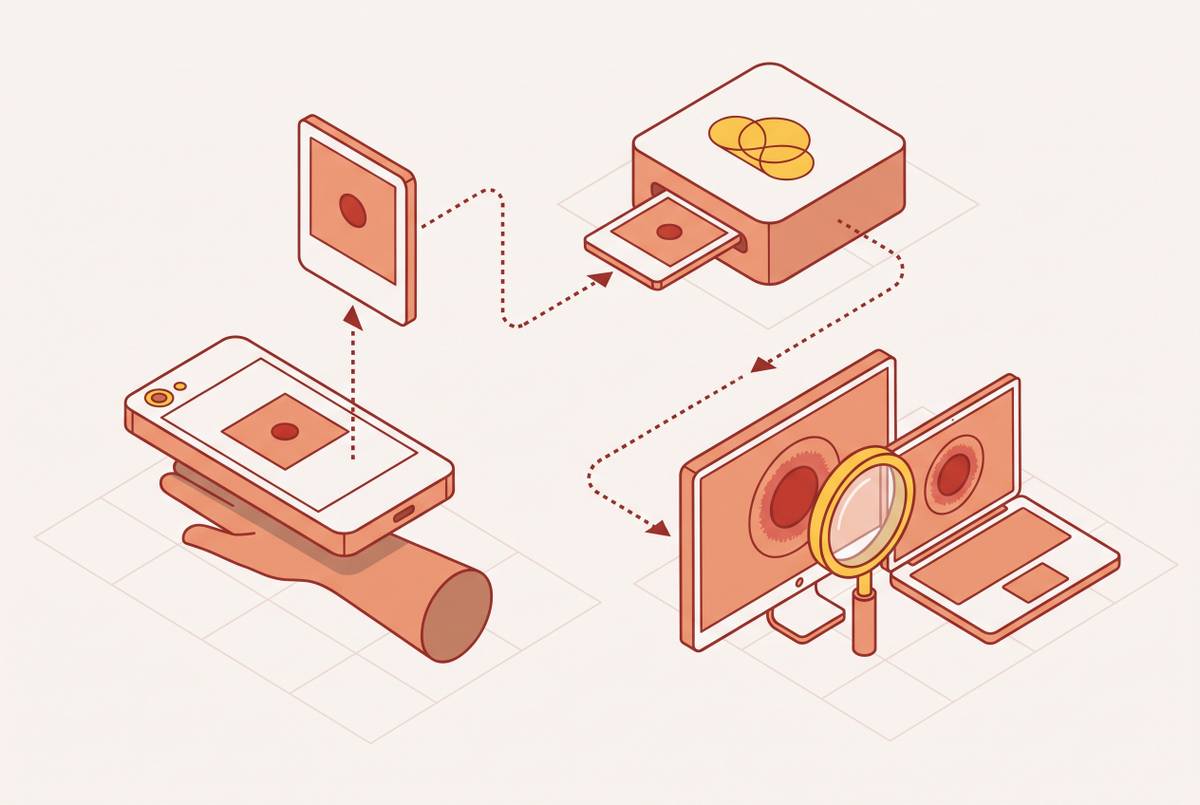
Most remote acne services use a store-and-forward process. The patient submits photographs and a structured medical history, and a licensed clinician reviews them later. Neither party needs to be online together. Some services also offer live video or hybrid care, in which asynchronous intake leads to video when a case needs more discussion.
The process begins with questions about current medications, birth control status, allergies, previous acne treatments, and relevant hormonal or medical history. Photographs then give the clinician a view of the skin from multiple angles, including affected and unaffected areas. For the patient, photo preparation is worth attention. Natural light is preferable to bathroom lighting, the camera should be steady, and the images should be close enough to show lesion texture. Studies that compare photographs sent by patients with those sent by clinicians find that the quality varies more in patient images, which affects how sure a clinician can be of an assessment.
The completed intake goes to a board-certified dermatologist, primary care physician, nurse practitioner, or physician assistant, depending on the service. The American Academy of Dermatology advises appropriate licensure where the patient receives virtual services, in accordance with state law, with some cross-state store-and-forward and emergency exceptions. Where a patient is therefore affects which services can accept them. Reviewers’ qualifications also vary, a distinction that becomes more important in complicated cases or when oral medicines are being considered.
If treatment is appropriate, the clinician sends an electronic prescription to the patient’s chosen pharmacy. Most services also provide a written plan explaining use, expected side effects, and follow-up. Standard generics such as tretinoin, clindamycin, and doxycycline are widely stocked, while some services use compounding pharmacies for combination formulations.
What a clinician is actually assessing and deciding during a remote acne review
A remote review is not simply approval of a photograph. The clinician grades severity, distinguishes comedonal acne from inflammatory or nodular/cystic disease, and checks whether a proposed medicine is safe for that patient. One teledermatology study found that dermatologists changed or modified treatment in 96.4% of cases. Significant distress or early scarring can also justify escalation sooner than lesion count alone would suggest.
The safety questions directly affect that selection. Pregnancy status affects the suitability of retinoids and some antibiotics, hormonal history informs consideration of spironolactone, and current medicines raise possible interactions. Previous antibiotic use also informs resistance risk.
Treatment then matches the medicine to acne’s different drivers. A retinoid addresses follicular hyperkeratinization and inflammation, benzoyl peroxide kills bacteria and reduces antibiotic resistance risk, and a topical antibiotic targets inflammatory lesions. The AAD’s 2024 guidelines strongly recommend multimodal topical treatment for mild-to-moderate acne, and those agents can be prescribed after remote assessment.
Oral treatment may be appropriate when topicals are not the right match. Spironolactone is frequently used for hormonal acne patterns in adult women, with suitability assessed through health history. For moderate-to-severe inflammatory acne, a clinician may consider oral antibiotics. Doxycycline is preferred in guideline-aligned practice because Cutibacterium acnes remains highly susceptible to it, while resistance to erythromycin and clarithromycin has become common. To choose among these options, a clinician needs more than a photograph.
The one treatment remote prescribing cannot deliver, and why that boundary is the right one
Oral isotretinoin is the key limit to a wholly remote acne pathway. The AAD strongly recommends it for severe acne, acne causing scarring or significant psychosocial burden, and acne that has not responded to standard oral or topical treatment. It is not merely a last resort. For these patients, it is the right escalation in care instead of another round of treatment that is less suited to their needs.
That escalation requires more than an ordinary online prescription. Isotretinoin is governed by the iPLEDGE REMS program, with enrollment, monthly monitoring visits, and pregnancy testing for patients who can become pregnant. A service that uses photos and questionnaires cannot do all the monitoring that is needed. Some services combine virtual consultations and follow-up with an in-person initial evaluation and lab monitoring.
If the remote clinician spots a need for isotretinoin early, the review has helped the patient get on a path to the right treatment. The same principle applies to findings that may require biopsy, full-body examination, genital examination, or palpation. After two rounds of telehealth-prescribed treatment without improvement, an in-person assessment can also add information that photographs cannot provide. The right response is a different pathway.
What the AI layer in some platforms actually does — and what licensed clinician oversight still decides
Some remote acne platforms use AI to help organize and assess the incoming information. Tools can recognize image patterns, suggest a severity grade, and flag cases that may need escalation before a licensed clinician makes the prescribing decision. That division of work is important. Strong performance in research image classification does not, by itself, establish that a tool can choose an appropriate treatment for an individual patient.
The concern changes when AI moves from assistance to autonomous prescribing after an initial stage of clinician review. AAD president Murad Alam, MD, stated that the staged approach “increases the risk that reviewers defer to AI output instead of applying independent clinical judgment,” and that AI “should not be used to independently diagnose or treat dermatologic conditions.” Accurate image classification and independent clinical scrutiny of the prescribing decision both matter.
A topical-only autonomous system also has a narrower treatment range than a clinician who can consider oral antibiotics, spironolactone, or referral for isotretinoin. Access to a prescription is not necessarily access to the right treatment. For patients comparing services, the useful question is whether a licensed clinician reviews their specific case and approves each prescription before it is issued. Review limited to an initial set of cases, followed by retrospective oversight, is a different model from individual clinical review.
How remote acne care compares on cost for patients paying out of pocket
Virtual consultations cost 60–80% less than traditional clinic visits, while the national average for a telehealth acne visit is roughly $50–$150, including a first-line generic topical or antibiotic. Cash-pay primary care visits run roughly $110–$330. Urgent care costs roughly $160–$270 and has limited dermatology scope. These figures describe care settings with different service scopes.
The emergency room is a particularly poor fit for routine acne. An uninsured visit costs roughly $1,500–$3,000, but the more basic problem is that acne is not an emergency-appropriate presentation. By contrast, first-line acne management does not require office procedures such as extractions or culture swabs. A remote consultation can therefore deliver a standard mild-to-moderate regimen without leaving out a procedure that the treatment requires.
Medication may cost less than the consultation. Common generics, including adapalene, tretinoin, doxycycline, and clindamycin, are often inexpensive through discount programs. Many platforms also accept HSA and FSA funds, reducing effective out-of-pocket expense for patients with those accounts. Severe acne has different cost dynamics, however, because an isotretinoin pathway includes monitoring and an in-person component. The basic telehealth price is not a complete budget for that care.
Who the remote prescribing pathway genuinely serves well, and who it does not
Remote prescribing is a reasonable first step for most people with mild-to-moderate comedonal, papular, or pustular acne who have not tried prescription treatment. It also serves patients whose existing regimen works and needs renewal. Adult women with hormonal acne patterns may be candidates when they can provide the history needed to assess spironolactone. Long local waits strengthen the practical case. In those cases, remote care lets patients get a clinician’s advice when an office appointment may be weeks or months away.
The fit is weaker when acne is severe, nodular-cystic, actively scarring, or unresponsive to two or more treatment courses. Those patients need consideration of isotretinoin and a pathway that includes its monitoring requirements. Rosacea, perioral dermatitis, folliculitis, or concerning lesions may lead the reviewer to recommend an in-person evaluation. Poor photographs also limit remote care, even when the symptoms seem straightforward.
For patients choosing a service, individual licensed review is the central criterion, followed by the clinician’s treatment range and ability to redirect care. A service limited to topicals cannot offer the same choices as one that can also consider oral antibiotics and spironolactone. After unsuccessful over-the-counter treatment, a message-based consultation with a clinician is a better starting point than another unsupported trial. The informed patient can ask who will make the decision, which treatments that person can consider, and what happens if remote care is insufficient. Those answers make it possible to judge the pathway by the care it provides.