Which Online Dermatology Services Run Your Photos Through AI Before a Clinician Reviews Them
Most online dermatology services don't tell patients whether AI screens their photos first.

AI-assisted telehealth dermatology can mean AI screening followed by optional clinician review, or a clinical pathway where AI determines which cases need human review. ScanSkinAI offers the first model, while DERM operates in regulated clinical pathways. Clinician-first services instead send photos straight to a provider, so the key question is whether a clinician reviews every case, only selected cases, or only when the patient pays extra.
Why patients submitting skin photos online rarely know what happens to them next
After submitting a photo of a suspicious mole, a patient may expect the next step to be a clinician looking at it. The upload screen rarely explains all the steps that follow. Store-and-forward teledermatology, now the dominant model for online dermatology, has split into workflows that can look identical from outside. One sends photos straight to a clinician, while another runs them through AI first, sometimes without any human review. That difference changes what the assessment means, how reliable it may be for the patient’s skin tone, and which regulatory protections apply.
What store-and-forward teledermatology is, and why AI entered it
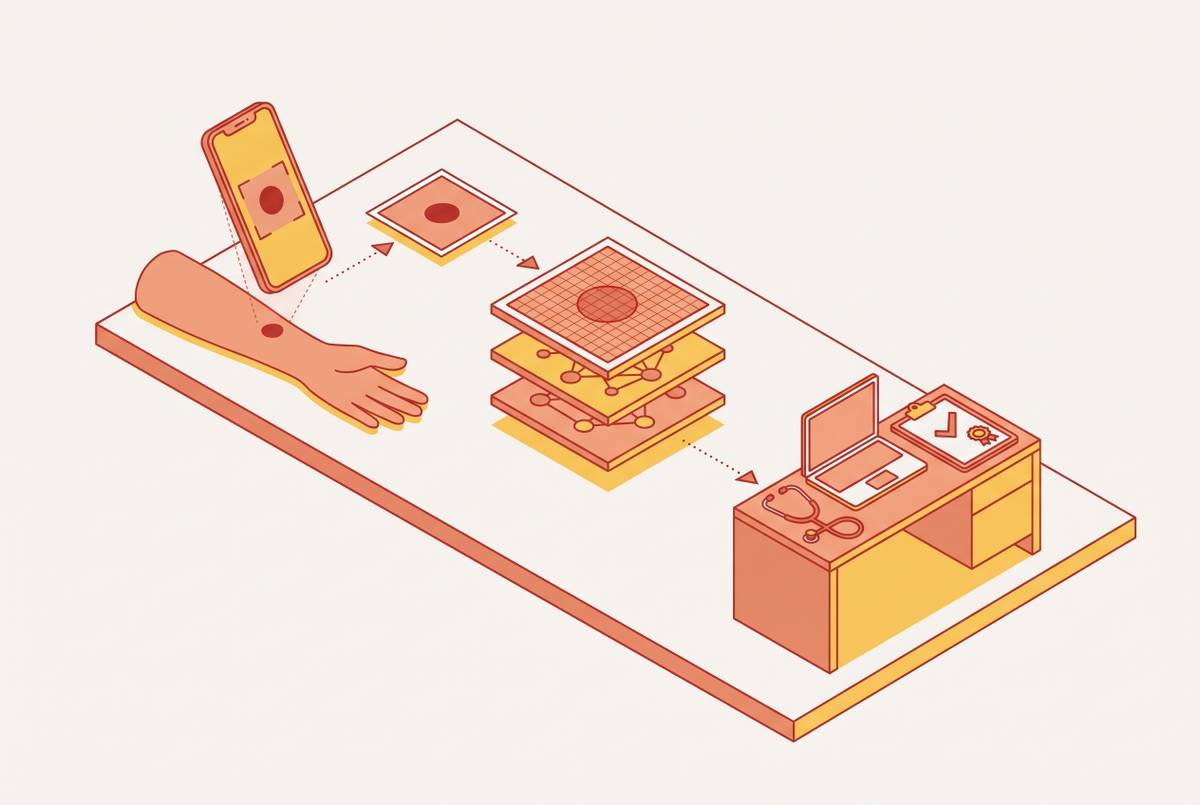
Store-and-forward means that the patient submits photos and a structured medical history, then receives a response without a live appointment. The clinician reviews the submission at another time. Both AI-first and clinician-first services build on this asynchronous model, which separates collecting information from assessing it. In an AI-augmented pathway, intake and image submission may lead to AI triage, clinician assessment, a treatment plan, and follow-up. But that sequence does not show whether every patient reaches a clinician.
AI entered this process partly to help with the number of cases. Average waits for in-person dermatology are measured in weeks, while AI-assisted triage can shorten the route to assessment to days. Dermatology is also unusually suited to computer vision because a photo contains much of the information needed for an initial assessment. Image models can therefore help sort cases before a clinician takes part. Sorting is not the same as diagnosing, though, and the distinction becomes clearer when the individual steps are visible.
Which telehealth dermatology tools analyze photos with AI before clinician review?
ScanSkinAI, developed by Ivy AI Solutions Limited, illustrates the consumer AI-first workflow. Its pipeline begins within seconds of an upload. The system checks focus, lighting, and resolution and rejects blurry or dim images before it goes on. An object detector then isolates the lesion so that the model evaluates the spot. The model scores the cropped image against the condition categories it was trained on, then ranks them in a list with confidence scores. Finally, the leading categories are mapped to a next action, including self-care, a pharmacy, a GP appointment, or specialist referral.
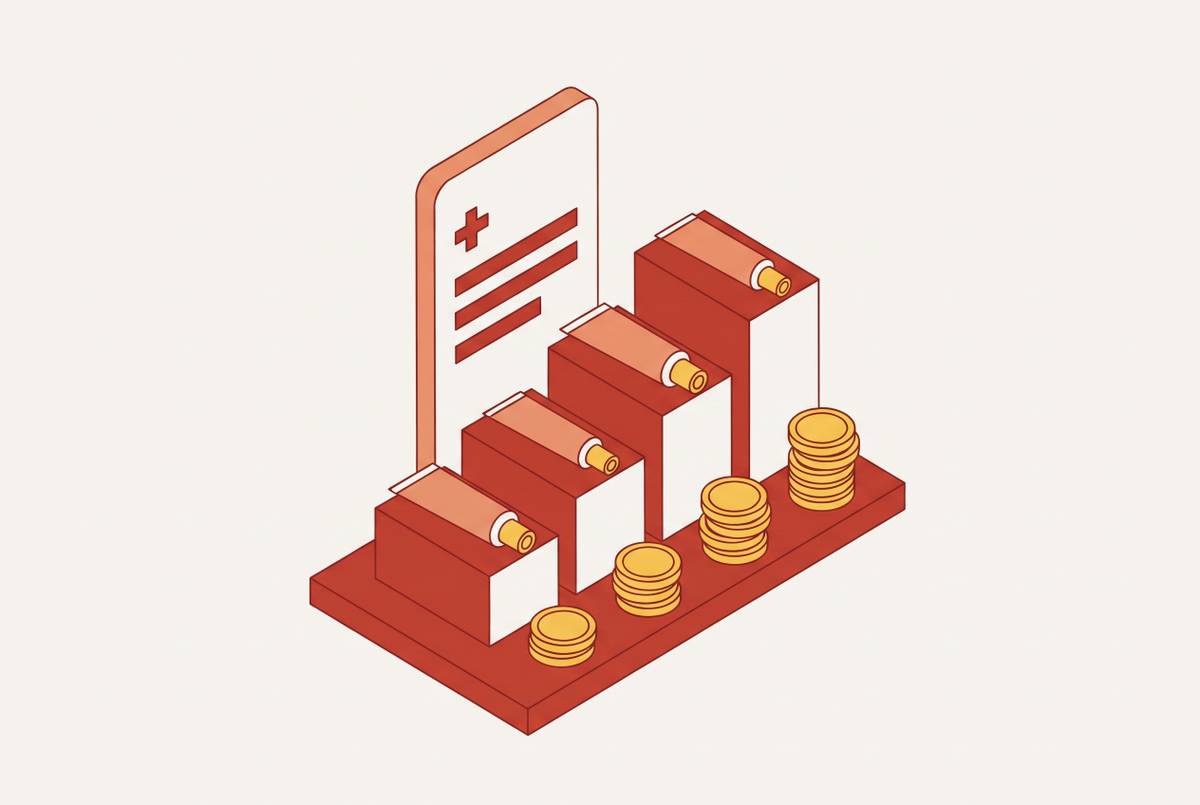
The patient gets that AI result before any human assessment they choose to have. Clinician review is a separate paid step. ScanSkinAI offers a written opinion from a qualified clinician for US$19.99 within its standard turnaround, with expedited review available for a higher fee.
DERM, from Skin Analytics, uses AI first in a different setting. Patients enter through a primary-care referral into a teledermatology service, where images are uploaded for lesion analysis and triage. DERM can redirect benign-triaged cases toward non-urgent pathways without mandatory clinician review of every case, subject to the conditions governing its use. This is a regulated clinical pathway rather than a consumer result with a paid review option. The shared label “AI-first” therefore describes the order of assessment across services with differing levels of oversight.
How clinician-first workflows handle the same photo differently
In a clinician-first workflow, the photos enter a provider queue without algorithmic pre-screening. A board-certified dermatologist or another qualified clinician reviews them first. The service still uses images and structured history, but a licensed professional uses medical judgment to give the first opinion. Human review is what the service provides as standard, with no need to buy it after an automated result. A response may arrive within hours or a day or two.
Some services also use a hybrid arrangement. AI is available, but the clinician decides whether to consult its suggestions rather than receiving every case through an AI filter. Clinician-first workflows usually cost more per case and take longer than automated tools. In return, the first assessment the patient receives has the accountability and legal status of a licensed clinician’s opinion, without requiring a later handoff from software to professional care.
What AI can and cannot determine from a skin photo
AI is best at spotting patterns in the categories it has seen in its training data. Convolutional neural networks and vision transformers learn those patterns from large sets of images that have been labeled. They can then score new images against what they have learned. This is a narrower task than assessing every possible cause of a skin change. Strong classification performance does not by itself establish that an app can provide a complete clinical assessment.
Salinas et al.’s 2024 systematic review and meta-analysis in NPJ Digital Medicine found higher overall sensitivity and specificity for AI algorithms than for clinicians overall in skin cancer classification. The researchers, from Pontificia Universidad Católica de Chile and Memorial Sloan Kettering, also examined differences between clinician groups. Those differences are important to interpreting the result. AI outperformed general clinicians and non-expert dermatologists, while performing comparably to expert dermatologists. The evidence supports substantial capability on standardized image sets.
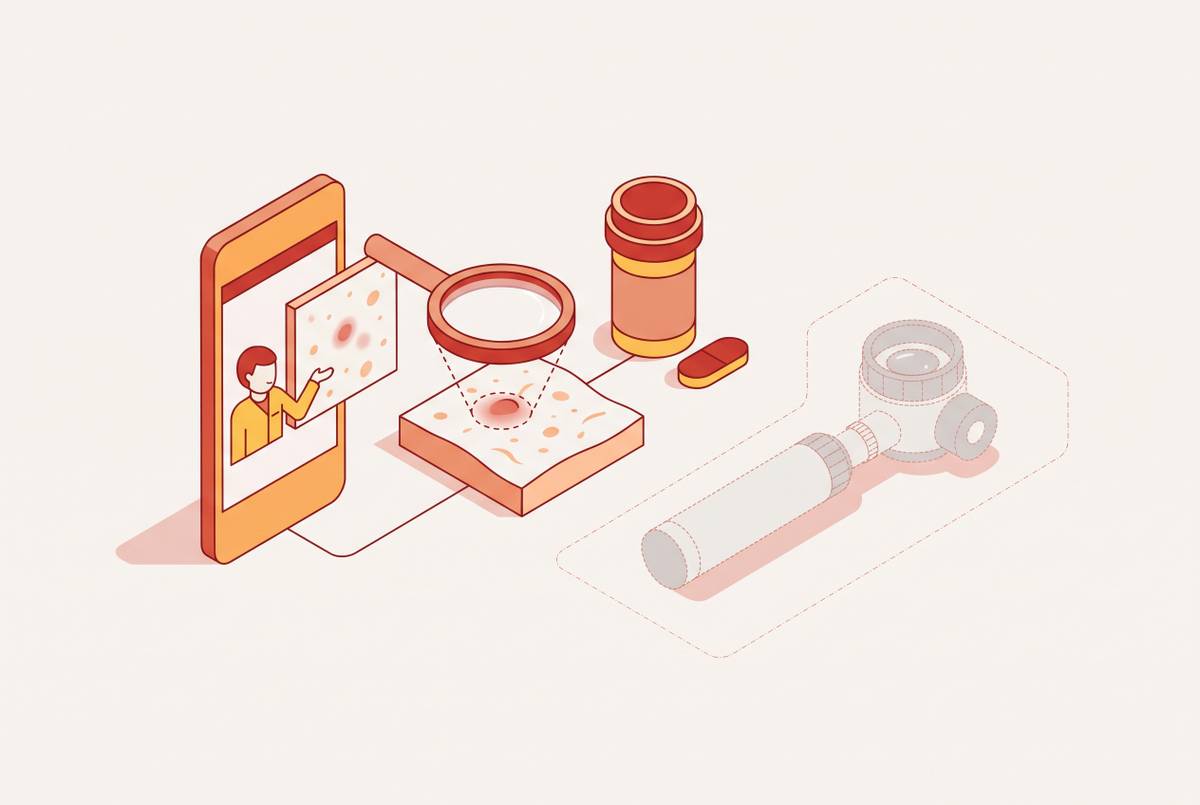
A photo still leaves important information out. It cannot provide palpation findings such as firmness or depth, or odor cues relevant to some infections and inflammatory conditions. Photo analysis alone cannot order a biopsy or provide the separate examination and interpretation that dermoscopy or biopsy requires. Clinical context also depends on patients filling out the intake correctly with their history, other conditions, and how they responded to past treatment. To give either workflow a photo it can use, patients can send a sharp photo taken in natural daylight, approximately 10–15 cm from the skin, with locked focus.
Where AI-first tools perform less reliably — and why skin tone is the central issue
The most consequential documented performance gap is across skin tones. AI tools trained mainly on lighter skin consistently make less accurate diagnoses for darker skin tones, including Fitzpatrick types IV–VI. The imbalance begins in the training material. Only a small fraction of the images in The Lesion Image Database, a widely used reference set, show Black or African American skin, and many dermatology training sets have a similar imbalance. A model’s broad performance claims can therefore obscure differences in whom it serves reliably.
The Diverse Dermatology Images dataset evaluations found lower AUC scores for Fitzpatrick types V–VI than for types I–II in tools including DeepDerm and ModelDerm. AUC measures how well a model distinguishes between categories. A 2025 evaluation of ChatGPT-4o using biopsy-confirmed dermatologic images also found significantly lower sensitivity, specificity, and accuracy for melanoma in darker skin tones, defined there as FSTs III–VI, than in FSTs I–II. These findings concern specific tools and evaluations.
A negative AI result does not rule out malignancy. For patients with darker skin, the documented performance gap makes false reassurance a particular concern in a population already facing dermatology access barriers. NICE’s conditional recommendation for DERM requires further evidence on cancer and non-cancer lesion detection in Fitzpatrick skin types 5 and 6 compared with teledermatology alone. That question remains unresolved.
The regulatory gap between consumer AI tools and cleared medical devices
Regulatory status distinguishes tools that otherwise make similar promises. A 2024 JAMA Dermatology analysis identified dozens of downloadable dermatology AI applications, none FDA-cleared, with only a small number disclosing their regulatory status. Under US frameworks, AI risk-triage functions are likely to fall within Software as a Medical Device. Yet consumer skin apps have not pursued that pathway at scale. Being available to download is not the same as being cleared for a clinical function.
DERM sits in a different regulatory category. NICE made a conditional recommendation for NHS use in May 2025, and the device has a Class III CE marking under the European Medical Device Regulation. The British Association of Dermatologists describes NICE’s recommended use as conditional and semi-autonomous, with mandatory dermatologist second-reads for patients with black and brown skin tones. Those safeguards qualify the description of autonomous triage. NICE also requires continued evidence collection rather than treating the recommendation as an unconditional endpoint.
Other tools have different intended uses and regulatory positions. SkinVision holds a Class IIa CE marking, while its US FDA pathway is supported by a pivotal trial and clearance remains pending in the supplied evidence. ScanSkinAI is registered as a UKCA Class I medical device and is positioned solely as a wellbeing and educational screening tool. These labels are not interchangeable endorsements. Patients need to know which function a regulatory status covers, in which market, and whether the tool is intended to diagnose or only to screen.
How the clinician’s role changes depending on where they enter the workflow
The clinician’s entry point changes the work they do. In a clinician-first service, they form the initial assessment from the submitted information, and their professional license backs the recommendation from the start. With optional review after AI screening, they instead become an interpreter and validator of an existing output. They may see what the AI flagged without necessarily seeing its confidence levels. Confirming or overriding a suggested diagnosis is a different task from forming an opinion without that suggestion.
AI Labs Group S.L.’s clinical trial registrations in 2026, NCT07428941 and NCT07428954, describe doctors providing diagnoses with and without AI assistance. In the assisted workflow, doctors see the AI’s top five suggested diagnoses and confidence levels. The presentation itself is part of the comparison. These registrations make the distinction between independent assessment and AI-informed review concrete, with no outcome established by the registrations.
In autonomous triage, the clinician may not review an individual benign-triaged case at all. Depending on DERM’s confidence threshold, a case may proceed to a clinician or be discharged, subject to required second-reads. Clinical involvement then sits partly at the level of system design and audit. The concern is false reassurance if an incorrect low-risk result ends the urgent pathway without individual review. “Clinician involved” is therefore less informative than knowing which decisions the clinician actually makes.
How to identify which workflow a service uses before submitting photos
Patients can turn these distinctions into three questions before uploading anything. First, is there an instant result? An assessment that comes back in under a minute points to automated processing rather than a full human review, while a wait of hours or a day or two with no instant result suggests a clinician-first queue. The service’s published description should explain what produced the result.
Second, is clinician review included or does it cost extra? When a service gives an AI result for its base price and charges extra for human review, the AI result is what it mainly provides. A service promising a dermatologist’s response, with AI described as optional support, puts the clinician first. For someone seeking both AI and a real dermatologist, the reviewer’s qualification and whether review is guaranteed are more useful criteria than the phrase “AI-assisted.” The examples here leave open which service requires a physician to approve every prescription after AI screening, so patients need to confirm that requirement.
Third, what does the tool say about its regulatory status and intended use? “Wellbeing,” “educational,” and “screening” describe a different purpose from diagnosis, and a marking alone does not explain which functions it covers. Patients with darker skin tones should place more weight on clinician review after an AI-first result and mention their skin tone when asking for review or an in-person appointment. Teledermatology cannot replace an examination that requires palpation, dermoscopy, or biopsy. But for most routine skin questions, a message-based consultation with a licensed clinician can be a useful first step, especially when the alternative is no professional input at all.
Sources
- Evaluating an Artificial Intelligence Tool to Help Primary Care Doctors Diagnose Skin Conditions.
- Using Artificial Intelligence to Help Doctors Identify Different Skin Conditions and Improve Patient Care
- A systematic review and meta-analysis of artificial intelligence versus clinicians for skin cancer diagnosis