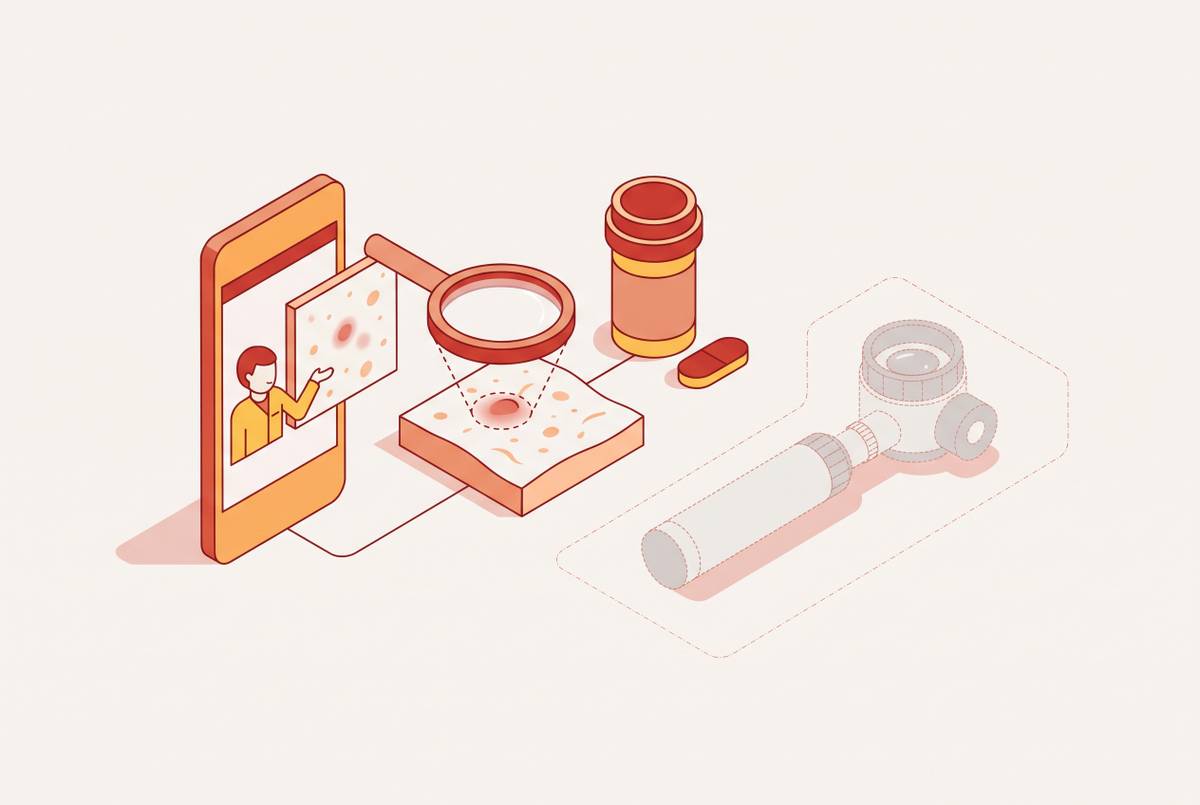
What Patients Should Actually Expect When an App Uses AI and a Real Clinician to Evaluate Your Skin
AI flags possible patterns, but a licensed clinician makes the actual diagnosis and care decision.
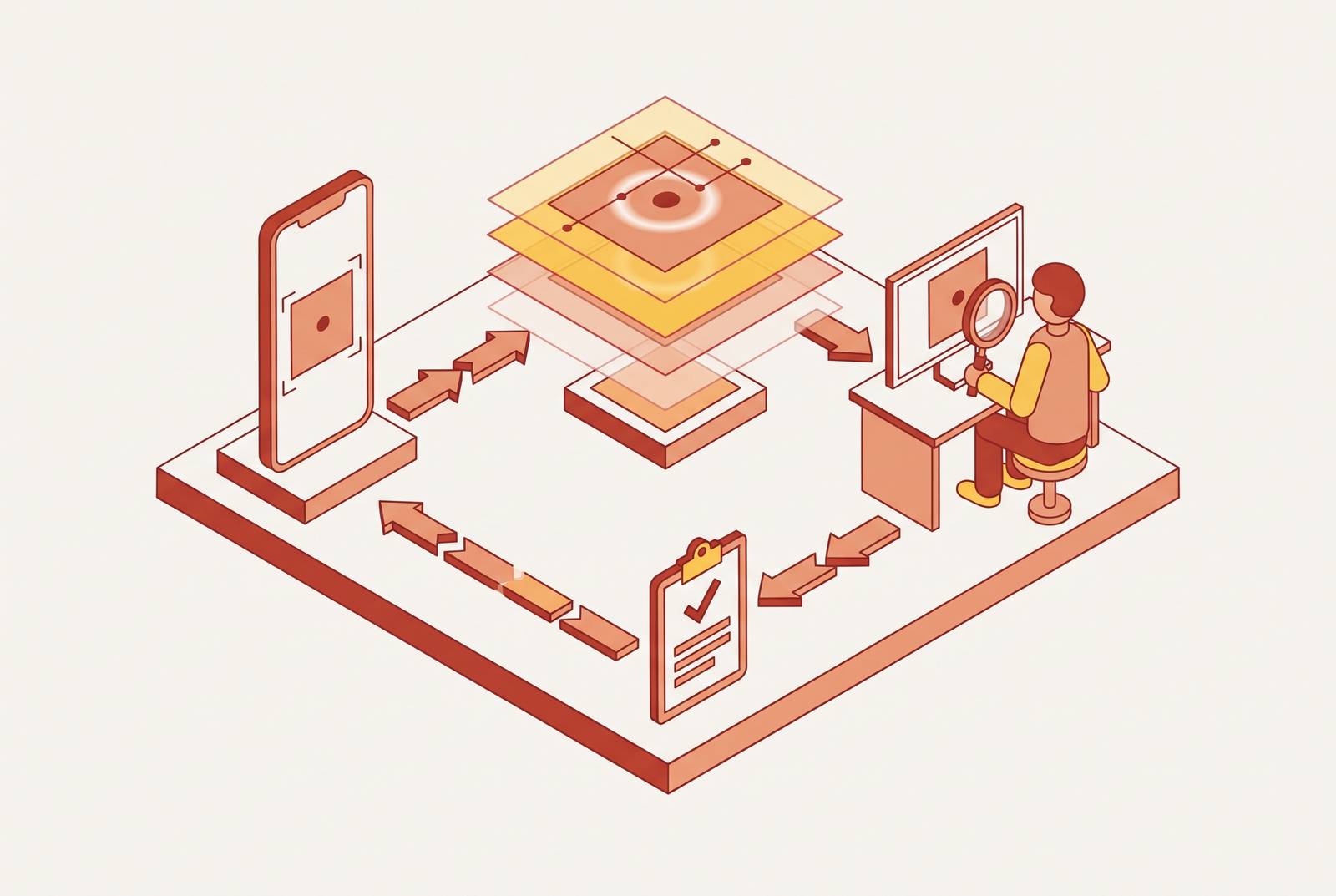
AI-assisted telehealth dermatology with clinician review uses a three-step process, namely photo submission, AI-assisted triage, and evaluation by a licensed clinician. The AI helps sort urgency and flag possible patterns, while the clinician interprets the images and history to decide on care. For patients, the key distinction is that AI supports a medical evaluation rather than supplying a diagnosis that a clinician simply approves.
Why skin evaluation by photo is clinically sound — and where it stops working
Dermatology is well suited to photo-based care because much of its diagnostic information is visible. Common conditions including acne, rosacea, eczema, and contact dermatitis have well-documented appearances in photographs. For the right condition, an image gives a clinician useful clinical evidence without requiring the patient and clinician to be in the same room. That is a genuine basis for care. It does not, however, make every skin problem a good candidate for remote evaluation.
What can a photograph leave out? Age, biological sex, the affected body site, the symptom timeline, and product history all help a clinician interpret what is visible. A photograph records appearance, but it does not explain when a rash began or what touched the skin before it appeared. Those details belong in the medical assessment. They are why a questionnaire is part of diagnosis.
Some missing information cannot be supplied in writing. A condition that requires palpation, meaning examination by touch, dermoscopy, or biopsy is beyond what an ordinary photo submission can safely resolve. Suspicious moles, lesions with irregular borders, and rashes accompanied by fever or rapid spread require in-person assessment. This is the boundary of the medium itself. AI assistance does not remove that boundary, which is one reason the process needs a clinician who can recognize when remote care must stop.
What asynchronous, store-and-forward care actually means for a patient submitting photos
Asynchronous telehealth means that the patient and clinician do not have to participate at the same time. The patient submits photographs and a symptom history when convenient, and a clinician reviews that information later without a real-time appointment. “Store-and-forward” is another name for this arrangement.
For the patient, this changes the rhythm of an appointment. Instead of explaining a concern while a clinician watches on video, the patient gathers the visual and written information before the review begins. The clinician then works from that submission independently. It is not an instant exchange of questions. Nor does the term “asynchronous” promise a particular response time, so the format alone does not tell a patient how soon an answer will arrive.
Skin findings can be captured and reviewed with the same clinical intent as an in-person examination when the condition is suitable for photo-based assessment. The important qualification is “when the condition is suitable.” Without a live exchange, the initial submission has to communicate both what the skin looks like and what has been happening to it. That makes the first step more consequential than uploading a picture and waiting for a label.
Step one: photo submission and what makes a usable image
Photo quality is a clinical variable because both layers of review depend on what the image reveals. AI performance drops with blurry, poorly lit, or low-resolution photographs, and a clinician also has less information when an image obscures the affected area. Neither reviewer receives the skin itself. They receive a representation of it, and the detail preserved in that representation shapes what can be assessed.
Use consistent, natural lighting, with the lesion in frame and in focus. Multiple angles help when texture or the border is important, while filters and heavy processing should be avoided. Changing how the skin looks makes the picture less useful for judging the condition, even if it looks cleaner.
The written history needs as much care as the photographs. Useful details include when the rash appeared, what makes it better or worse, which products have touched the skin, and whether dietary, hormonal, or stress-related triggers preceded it. These details provide context that a photograph cannot contain. Recording a possible trigger gives the reviewer something to assess against the visible pattern.
What happens if the submission is not enough? When image quality or patient information is insufficient for remote evaluation, teledermatologists redirect the patient to in-person care. The purpose of submission is to support a defensible assessment, including a decision that the condition needs a different kind of examination.
Step two: what the AI layer does with that submission — and what it cannot do alone
The AI layer helps triage cases by urgency, flags visual patterns for the clinician to look at, and narrows the differential before a human reviews the case. A differential is the set of possible explanations for a finding. The clinician still has to judge whether the suggested possibilities fit the person’s history and images.
Nina Ivanovic and colleagues’ 2026 meta-analysis found that AI did as well as or better than specialist dermatologists in 71% of direct comparisons in controlled settings. The same analysis identified unresolved challenges in real-world evidence and algorithmic equity. Those findings belong together. Doing well under controlled conditions shows that AI could help with care, but it does not show that every smartphone submission will be judged as accurately.
Why does a high accuracy score leave room for concern? An overall score brings together results from many cases, but a patient needs a sound decision about their own problem. Image quality, the population represented in training data, and the setting in which the system is used can affect that decision. Accuracy measures also depend on choices about which kinds of error are acceptable. Patients usually cannot see those choices in a headline number that looks reassuring.
Pattern recognition and clinical responsibility are different functions. An AI suggestion can focus a clinician’s attention, but poor input or an inappropriate suggestion still needs to be recognized. A system that performs well on average still needs oversight that can question its output.
Step three: licensed clinician review and what it adds that AI cannot supply
The licensed clinician examines the photographs, questionnaire, medical history, and AI-flagged patterns together. That review can override a suggestion, extend the range of possible explanations, or redirect the patient to in-person care. It is an active assessment of the evidence.
This is where a visual pattern becomes part of a care decision. The same review that considers a possible condition also considers whether the submission supports remote treatment at all. A care plan requires judgment about the whole picture, including information the image does not show. The human layer therefore adds more than another pattern check. It connects the findings to an individual patient’s circumstances and the appropriate next step.
The U.S. Department of Veterans Affairs launched a direct-to-patient teledermatology clinical trial, NCT05128006, to test teledermatology and computer-assisted diagnosis as ways to help veterans get dermatology care. The trial is a government-scale test of this model, rather than evidence that any particular consumer app is the best option. Its scope is important to keep clear. A clinical investigation of the approach does not establish the performance of every service that advertises AI-assisted skin care.
The Centers for Medicare & Medicaid Services have also issued guidance stating that algorithms cannot be the sole basis for adverse coverage decisions in Medicare Advantage. Coverage determinations must account for each patient’s circumstances rather than rely on population-level algorithmic outputs alone. That guidance applies specifically to coverage decisions. The distinction prevents an overly broad legal claim. Its relevant principle is that an individual decision cannot be reduced to what an algorithm predicts about a population.
Where the AI-plus-clinician model performs less reliably — and who is most affected
Dermatology AI does not perform uniformly across all skin tones. Studies have found lower diagnostic accuracy for darker skin tones, Fitzpatrick IV–VI, than for lighter skin tones. For certain benign lesions in Black patients, specificity was near zero at a standard sensitivity threshold. In plain terms, those benign lesions were poorly distinguished from concerning findings under that testing condition.
Large dermatology image repositories contain disproportionately more lighter skin tones, creating a gap in the evidence available to the model that makes models trained on them generalize less reliably to people who were not adequately represented, a reason to look closely at how an AI-assisted service handles uncertainty.
The setting also changes performance. Accuracy is lower in community care and smartphone environments than in specialist clinical settings, so results from carefully controlled evaluations cannot simply be transferred to everyday use. The camera and platform are part of that difference. A patient’s phone photograph may differ from the kind of input on which a model did best.
Clinician review is especially important under these conditions, but its presence alone does not erase bias. If AI flags or misses patterns differently by skin tone and the clinician is not alert to that possibility, review may not correct the problem. Patients have a legitimate basis for asking about a service’s AI training and validation populations. That question belongs with the other parts of an evaluation that patients can help make more informative.
What a patient can do to improve the quality of their own evaluation
Treat the submission as the first part of the clinical assessment. Provide sharp, well-lit photographs from multiple angles when useful, and give the symptom history enough detail to explain timing, triggers, product use, and progression. Those inputs serve both the AI and the clinician.
After review, the patient needs to understand the care being proposed. A complete plan should name the problem that led to the appointment and give the agreed-upon care plan, details about any newly prescribed medications, and the next steps. Each element answers a different practical question. If any is missing, follow up before starting treatment.
A clearly photographed rash may be approachable through asynchronous care, but fever, rapid spread, or suspected cellulitis over a joint changes that assessment. In those cases, seek an in-person examination. A responsible service will recognize that a readable image is not enough to make remote care appropriate.
For patients with darker skin tones, asking what datasets the AI was trained and validated on is a reasonable part of evaluating the service. The same applies to asking how clinician oversight addresses known performance gaps. These are questions about the basis for care. Understanding the process gives patients a concrete role at each stage, from supplying useful evidence to recognizing an incomplete plan or the need for an in-person visit.
Sources
- The Evolving Role of Artificial Intelligence in Dermatology: A Meta-Analysis of Diagnostic Performance, Clinical Applications, and Implementation Challenges (2003–2025) - PMC
- Equity and Generalizability of Artificial Intelligence for Skin-Lesion Diagnosis Using Clinical, Dermoscopic, and Smartphone Images: A Systematic Review and Meta-Analysis
- The Use of Artificial Intelligence for Skin Disease Diagnosis in Primary Care Settings: A Systematic Review
- A systematic review and meta-analysis of artificial intelligence versus clinicians for skin cancer diagnosis
- DigitalCommons@PCOM - Research Day: The effectiveness of teledermatology and artificial intelligence across diverse skin tones: a systematic review
- JMIR Dermatology - Diagnostic Accuracy, Implementation Barriers, and Equity Implications of Teledermatology in Rural Skin Cancer: Scoping Review
- Teledermatology Diagnostic Accuracy: A Randomized Cohort Study Comparing Three Image Acquisition Techniques
- Enhanced Dermatology Image Quality Assessment via Cross-Domain Training