Perimenopause Skin Changes and Evidence-Based Interventions
Hormonal shifts demand targeted treatments, not just stronger anti-aging products.
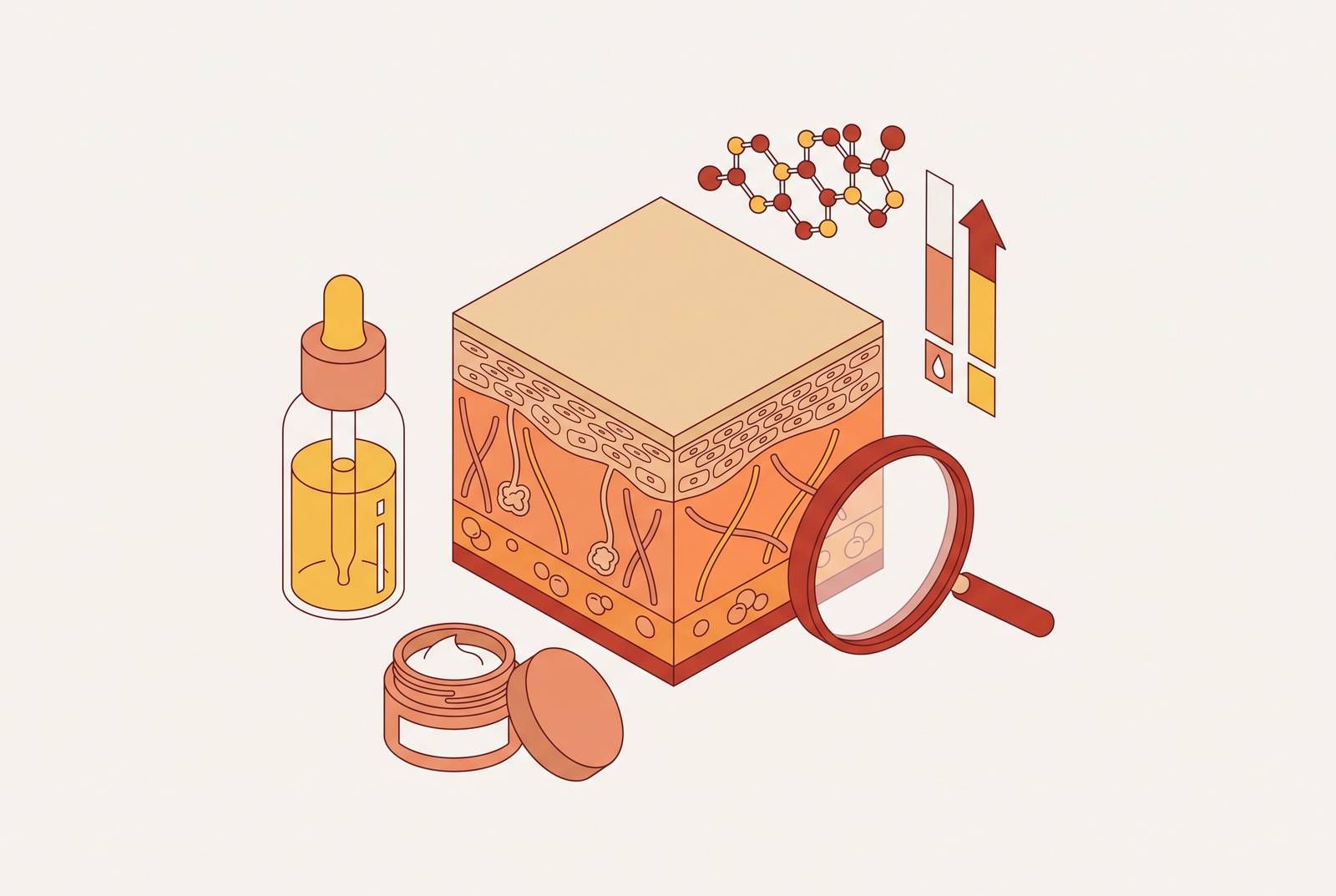
Perimenopause skin changes call for more than a stronger anti-aging routine. Hormonal shifts affect collagen, the skin barrier and inflammation in different ways, so treatments help most when they target the cause.
Why perimenopause skin changes are not simply accelerated aging
The mirror moment can be confusing for a woman who knows her products well. A familiar moisturizer no longer seems enough, an acid suddenly stings, and breakouts appear on skin that also feels dry. The formula may not have changed, but the skin it suited has. During perimenopause, hormonal fluctuation changes how skin behaves, rather than simply making ordinary aging happen faster.
Skin is an endocrine organ, with estrogen receptors on fibroblasts, keratinocytes and sebaceous glands. Hormonal changes therefore act directly on the cells that give skin its structure, keep its barrier working and make oil. Estrogen, progesterone and testosterone decline across the transition, with separate and additive effects, but estrogen does not fall smoothly. It swings up and down, sometimes above premenopausal levels, before falling overall.
That uneven pattern helps explain why dryness, oiliness and sensitivity can arrive together. It also makes timing important when interpreting claims about collagen loss. Menopause is the point when twelve months in a row have passed without a period, while perimenopause is the transition leading up to it. The widely cited findings on rapid collagen loss describe what happens in the postmenopausal window and do not give a fixed amount that every woman loses during perimenopause.
How estrogen loss collapses the dermis from three directions at once
Estrogen supports the genes that encode type I and type III procollagen in dermal fibroblasts. These collagen types provide tensile strength, so reduced estrogen signaling means less support for the skin’s load-bearing framework. This is the first direction of loss, namely reduced synthesis.
At the same time, estrogen loss removes a brake on collagen breakdown, allowing existing structure to degrade more readily. It also impairs the signaling that maintains and repairs the extracellular matrix, the supporting material around skin cells. Less collagen is made, more is broken down and repair works less well.
Women can lose a substantial proportion of dermal collagen in the first five years after menopause, with further decline afterward. This loss tracks hormonal age rather than birthdays alone, making an earlier transition relevant to cumulative change. Elastin, which gives skin its rebound, also declines in early postmenopause. Together, these changes can produce wrinkles, thinning, a softer jawline and reduced cheek and under-eye volume.
Why perimenopausal dryness is a lipid problem, not a water problem
Dryness requires a different explanation because it involves two layers. Deep in the dermis, declining hyaluronic acid reduces a component of the skin’s water-holding support. At the surface, the stratum corneum loses some of the lipids that keep water from escaping. A product that helps one layer does not necessarily correct the other.
Estrogen supports ceramide production in keratinocytes, and ceramides help form the surface’s waterproof seal. Lower production weakens that seal and raises transepidermal water loss, or TEWL. In plain terms, more water escapes through the skin than before. Adding a hydrating serum without addressing this lipid deficit is like adding water to a leaky vessel.
Changes in sebaceous gland activity can further reduce the surface lipid layer. As that protection weakens, skin becomes more prone to sensitivity and irritation from acids, fragrances or alcohol-based formulas it once tolerated. Topical hyaluronic acid can help at the surface, but its molecular size limits its reach and it cannot replace depleted dermal hyaluronic acid.
How hormonal fluctuation triggers acne, rosacea, and heightened oxidative stress as separate downstream effects
Breakouts on dry skin may seem contradictory, but relative hormone activity matters as much as absolute levels. Estrogen normally moderates androgen effects on sebaceous glands. When that moderation recedes, existing androgens become relatively more influential without blood androgen levels necessarily rising. This is androgen unmasking, which helps explain why a routine built for teenage oiliness may be a poor fit.
Sleep disruption can amplify this pattern. Fluctuating estrogen can disturb REM sleep, while higher cortisol can increase inflammation, oil production and sensitivity. This cascade can contribute to adult-onset jawline breakouts even in women without an acne history. Rosacea follows a separate route, because estrogen’s anti-inflammatory effects and support for blood vessel stability diminish, increasing flushing and persistent redness.
Oxidative stress adds another burden, although it is not solely a hormonal effect. Mitochondrial function in dermal fibroblasts declines with age, reducing collagen and hyaluronic acid synthesis while generating more reactive oxygen species, or ROS. This creates a feedback loop that adds to structural deterioration. The same face may therefore need help with its barrier, sebum regulation and anti-inflammatory care, more than one ingredient can do alone.
What the evidence supports for restoring collagen and structural volume
Treatment begins with determining whether an intervention replaces hormonal support or stimulates collagen through another pathway. Hormone replacement therapy, or HRT, can preserve collagen, improve elasticity and hydration, and slow dermal thinning when started in the early postmenopausal window, but clinical guidelines do not support its use solely for skin symptoms. Dr. Jenna Peart, MD, FAAD, makes that distinction explicit. Skin benefits are relevant to a discussion already taking place about symptoms such as hot flashes.
Topical estrogen for facial skin has less consistent evidence. Some studies find thicker skin and more collagen, while others, especially in sun-damaged skin, find no improvement or more collagenase activity. Dr. Peart does not routinely recommend topical estrogen creams for facial aging and points to stronger data for topical retinoids and peptides. A treatment may seem to fit the hormonal mechanism, but that alone does not show that it helps.
Prescription tretinoin has the strongest topical evidence for collagen. It increases procollagen synthesis and inhibits MMP-1, an enzyme involved in collagen degradation, addressing both reduced production and increased breakdown. It can improve wrinkling, uneven pigmentation and texture in postmenopausal skin. However, a weakened barrier calls for lower starting concentrations and choosing cream or lotion formulations over gels to reduce irritation.
Over-the-counter retinol works through the same pathway but must first turn into retinoic acid in skin, so it is usually less potent. It is a reasonable starting point, while signal peptides such as Matrixyl and GHK-Cu offer generally well-tolerated stimulation through pathways independent of estrogen. Injectable poly-L-lactic acid and hyaluronic acid fillers address dermal volume beyond the reach of topicals, while carbon dioxide laser resurfacing stimulates dermal remodeling.
What the evidence supports for repairing the barrier and managing dryness
For surface dryness, the practical starting point is replacing missing lipids. Ceramide-containing moisturizers directly replenish lipids reduced by estrogen loss in the stratum corneum. Applying moisturizer right after cleansing, while skin is still slightly damp, helps keep water in before it escapes.
Topical hyaluronic acid remains useful as a humectant that draws water to the surface. Its limitation is depth. It cannot refill the dermal deficit, which calls for systemic intervention or injectable hyaluronic acid.
Niacinamide is useful where concerns overlap because it supports the barrier, regulates sebum, reduces inflammation and fades hyperpigmentation. It is also generally well tolerated in mature, sensitive skin. Cleanser choice matters for the same reason, since stripping away remaining surface lipids worsens an existing deficit. Switching from foaming cleansers to cream or oil-based cleansers is a practical, low-cost adjustment that supports the work of the moisturizer.
What the evidence supports for managing acne, rosacea, and oxidative damage in perimenopausal skin
For acne, the aim is to manage oil and follicular blockage without further damaging the barrier. Niacinamide fits that need by regulating sebum and reducing inflammation. Retinoids also help normalize the way cells shed within follicles while addressing collagen loss, making them useful when both concerns are present. They still need gradual introduction, whereas high-concentration glycolic acid and physical scrubs can worsen barrier damage and reactive inflammation.
For rosacea, the emphasis shifts toward controlling redness and inflammation. Azelaic acid is evidence-supported and generally well tolerated by sensitive skin, while botanical extracts and niacinamide offer other topical options. During active flares, exfoliants are best avoided, as are fragrances and alcohol-based formulas that trigger reactivity.
Topical phytoestrogen-isoflavone products are a lower-evidence adjunct for dryness and roughness, with insufficient evidence to establish their use for restoring structural collagen. They may be an option for people who cannot or prefer not to use prescription topical estradiol, but the evidence is weaker than for estradiol or retinoids. How well someone sleeps, the antioxidants in their diet and not smoking also affect skin through the inflammatory and oxidative pathways already described. These factors can help with care, but treatment still needs to target the cause.
For oxidative damage, vitamin C in the form of L-ascorbic acid supports collagen synthesis, neutralizes ROS and helps brighten hyperpigmentation. Its antioxidant protection against UV does not replace sunscreen. Daily broad-spectrum SPF protects against UV-driven collagen breakdown that compounds the effects of estrogen loss.
When topical skincare reaches its limits and what to do next
Moisturizers improve the epidermal surface but cannot replace deep dermal hyaluronic acid. Retinoids and peptides can stimulate collagen, yet they cannot restore lost facial volume.
Clinical assessment becomes useful when prescription tretinoin, prescription azelaic acid or HRT is being considered. It allows treatment to be matched to the concern and introduced with the compromised barrier in mind. Fillers and carbon dioxide laser resurfacing require in-person assessment.
New or changing lesions need a physical examination, and severe or persistent itching that interferes with daily life or sleep warrants dermatology contact. Wounds that heal very slowly or are infected need medical care beyond what cosmetic care can do. Acne or rosacea that does not improve with steady use of over-the-counter care that suits the barrier is another reason to seek help.
How to access clinical guidance on perimenopausal skin without an in-person dermatology wait
For chronic, non-urgent concerns, asynchronous teledermatology is a way to get care without waiting for an office appointment first. In this store-and-forward model, a patient sends photographs and a written account of their symptoms for a board-certified clinician to look over. The clinician can then provide a care plan or prescription with a short turnaround. This can help rural and underserved patients get care when they face long waits to see a specialist.
A 2025 University of Pittsburgh Medical Center retrospective study found that clinicians made a definitive remote diagnosis in 91.3% of asynchronous teledermatology cases involving non-scarring alopecia. That finding is from cases of hair loss, so it does not show that the same diagnostic rate holds for perimenopausal facial skin. It does show what this model can achieve for a chronic condition. For perimenopausal skin, practical uses include prescribing an appropriate starting concentration of tretinoin and adjusting care as symptoms evolve.
AI-assisted, clinician-supervised asynchronous care can support this approach, but the clinical judgment belongs to the clinician. Suspicious lesions, conditions that need biopsy, and acute or emergency cases still need to be assessed in person. A remote consultation cannot provide palpation, dermoscopy or a physical examination of a new or changing lesion. Within those limits, message-based care offers a more directed next step than continued self-diagnosis and product swapping.
Describing dryness, breakouts, flushing and volume loss as distinct concerns gives a clinician a clearer picture than saying that skin suddenly looks older. The goal is to recognize what has changed and ask for care that addresses the cause.
Sources
- The innovation of estrogen-based medical skincare
- Round Table Discussion: Aesthetic Treatment Considerations for the Perimenopausal & Menopausal Patient - Fabi - 2026 - Journal of Cosmetic Dermatology - Wiley Online Library
- Round Table Discussion: Aesthetic Treatment Considerations for the Perimenopausal & Menopausal Patient
- Natural strategies to optimize estrogen levels in aging women: mini review
- Managing Menopausal Skin Changes: A Narrative Review of Skin Quality Changes, Their Aesthetic Impact, and the Actual Role of Hormone Replacement Therapy in Improvement - PMC