Getting Birth Control Online Without an In-Person Visit
Telehealth platforms can prescribe most hormonal birth control after reviewing your health history.
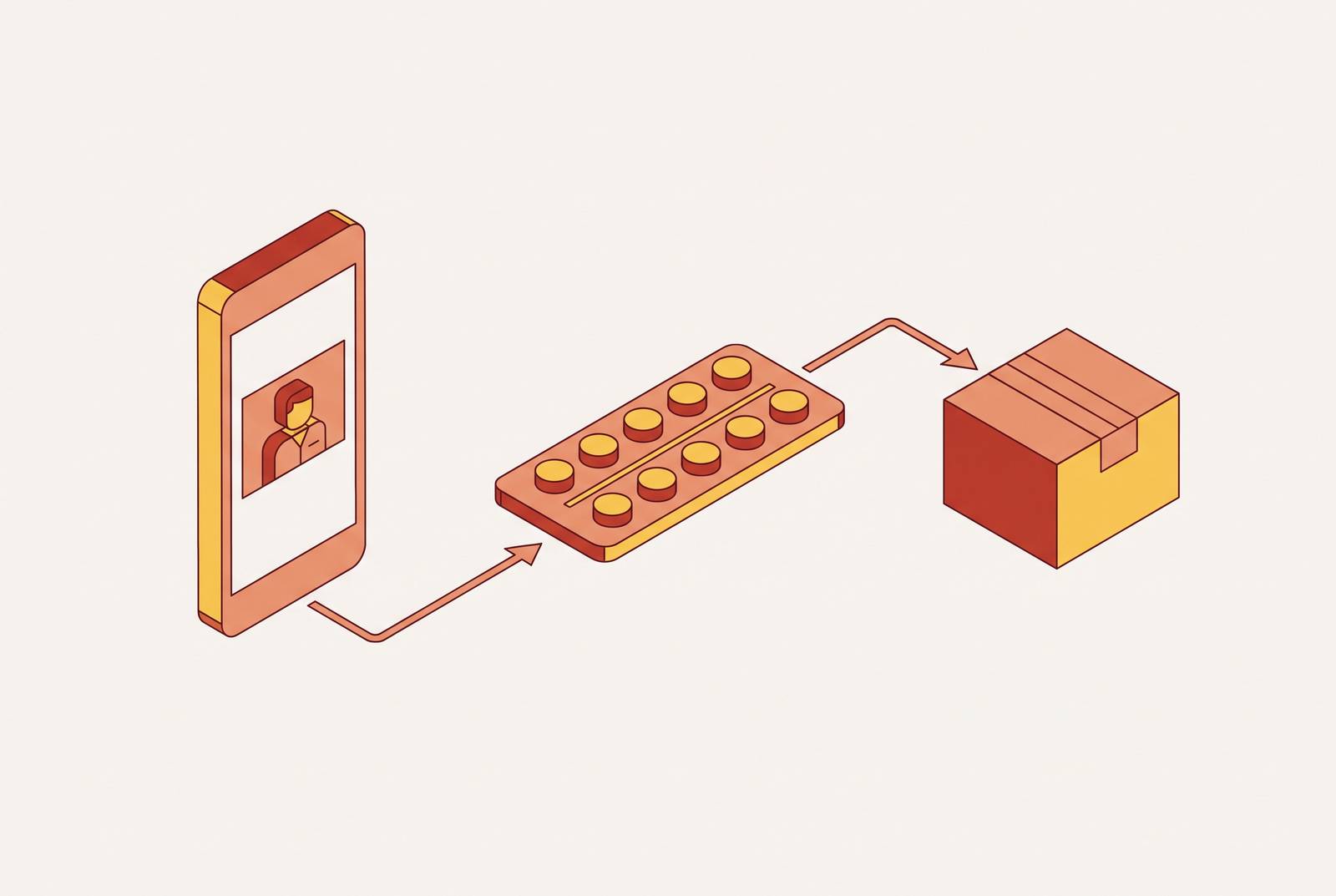
You can get birth control online without an in-person visit for most hormonal methods if a clinician checks your health history and finds that the method is right for you. The key is knowing what can happen remotely and what still needs hands-on care.
Why getting birth control without an in-person visit is now the norm, not the exception
Most hormonal contraceptive methods do not require an in-person exam before prescribing. The CDC U.S. Selected Practice Recommendations for Contraceptive Use (2024) and ACOG state that healthy adults do not need a pelvic exam or Pap smear to start or continue combined oral contraceptives. That distinction matters because an exam and a prescription have often been treated as parts of the same appointment. The clinical guidelines separate them, allowing prescribing to happen without an exam that is not required for that purpose.
The legal framework also allows this approach. Hormonal contraceptives, including pills, patches, rings, and the shot, are not controlled substances, so the Ryan Haight Act's in-person requirement does not apply to them. State telehealth law governs their prescribing instead. Under these rules, platforms usually provide a prescription the same day, while a patient may wait weeks to months for a routine gynecology appointment. A clinician still needs to review the request before it is approved, but the patient may not have to wait for an appointment slot.
That difference addresses a real gap in care. A meaningful share of women seeking contraception encounter barriers when they need a prescription or refill. Telehealth was developed to help people get care when these barriers stand in the way, with less need for an office visit.
Which birth control methods a telehealth provider can and cannot prescribe
Many hormonal methods can be prescribed online, though the choices vary from one platform to another. Combination pills include formulations such as Sprintec, Junel, Yaz, Loestrin, and Apri. Progestin-only pills include norethindrone 0.35mg, an option for patients who cannot use estrogen. Contraceptive rings and patches are also available through telehealth, including Xulane, which is replaced weekly. A provider can discuss and recommend non-hormonal options such as condoms and diaphragms as well.
The important boundary is between prescribing a method and physically providing it. Depo-Provera can be prescribed online, but administration still requires a clinic or pharmacy visit for the injection itself. IUDs and the arm implant require an in-person insertion procedure. Their initial consultation and follow-up monitoring can happen virtually within this procedural boundary.
Plan B One-Step contains levonorgestrel 1.5mg and is available over the counter without a prescription, so no telehealth visit is needed. Ella contains ulipristal acetate 30mg and requires a prescription, which can be obtained through telehealth. It is effective up to 5 days after unprotected sex.
What actually happens during an online birth control consultation, step by step
The process starts with a health intake questionnaire. It asks about medical history, current medications, blood pressure if known, contraceptive preferences, and conditions that might make a method unsafe. This is not simply registration paperwork. It forms the clinical record that the provider uses to assess the request. The consultation begins with that information, even when no live conversation takes place.
Next, a licensed clinician reviews the intake. Some platforms review the intake without the patient and clinician needing to be online together, while others offer video or messaging follow-up. The provider may ask more questions before approving a prescription. AI-powered clinical decision support tools may organize the information from the intake and triage it, but a licensed clinician checks what the tools produce and signs every prescription. Approval after clinician review often takes less than 24 hours.
After approval, the prescription goes to a partner pharmacy or the patient's preferred local pharmacy. Many platforms can also send the medication by mail, often in discreet packaging. Most can prescribe a 3- to 12-month supply, although prescription approval and medication delivery are separate stages.
Care can then continue through the same service. Refill requests, side-effect questions, and method switches can typically be handled without a new full intake. Where platforms use AI-assisted follow-up, its role is to summarize patient-reported changes for clinician review.
The medical screening that happens remotely — and the one check patients need to handle themselves
Safe prescribing requires the provider to obtain the information needed for this prescribing decision. For healthy adults in this well-defined setting, remote screening can do that. The clinician reviews medical and reproductive health history, medications and supplements for possible interactions, smoking status, age, and family history of clots. That review helps identify patients for whom estrogen is appropriate.
Combined hormonal contraceptives have contraindications that must be ruled out. These include current or previous DVT/PE with a higher risk for recurrence when the patient is not on anticoagulants, migraines with aura, and severe hypertension. Severe hypertension means systolic ≥160 mmHg or diastolic ≥100 mmHg. If estrogen is unsuitable, a progestin-only option such as norethindrone 0.35mg may be appropriate instead.
Blood pressure is the measurement patients need to supply when the provider cannot take it. The CDC U.S. Selected Practice Recommendations (2024) state that it should be measured before starting combined hormonal contraceptives and allow patients to report a reading from another setting. Most pharmacies offer free readings at in-store kiosks, home cuffs are widely available, and a reading from a recent clinic visit is acceptable. The UCSF Beyond the Pill telehealth protocol (September 2025) allows a 12-month supply when there is no history of hypertension in the last 3–5 years, with a blood pressure report requested within 3 months of initiation.
A responsible provider recommends safer alternatives when screening identifies a contraindication. If an exam or lab work is needed, the provider refers the patient for in-person care.
What birth control costs through telehealth versus a clinic visit, with and without insurance
For an uninsured patient paying cash in 2026, a telehealth refill is generally substantially less expensive than an in-person primary care visit. There is no single price because platform fees and pharmacy prices vary. Comparing options with a discount card can meaningfully reduce out-of-pocket expense. An office visit may also bring added charges if a pelvic exam or Pap smear is included, even though neither is required for oral contraceptive initiation or refill under current guidelines. The emergency room is never the appropriate setting for a birth control refill.
Insurance changes the comparison but does not make every brand or consultation free. The Affordable Care Act requires most non-grandfathered insurance plans to cover at least one FDA-approved contraceptive in each category without cost-sharing, including pills, patches, and rings. Some brands may still need prior authorization or involve cost-sharing, though this is usually not the case for generics. Many telehealth platforms check the patient's insurance and handle claims themselves. The consultation itself may be covered as preventive care, but that depends on coverage.
Medicaid covers birth control across the country with no copay, and Title X family planning clinics offer contraceptives for free or at a lower cost based on how much the patient earns. Funding for Title X has faced cuts, so patients should check what is available near them. GoodRx coupons can significantly reduce generic pill costs at participating pharmacies. HSA and FSA accounts can pay for birth control through legitimate telehealth providers, and some platforms offer discounts for quarterly or annual prepayment.
The regulatory landscape for telehealth prescribing and the one near-term risk patients should know about
Standard hormonal birth control is not affected by the near-term uncertainty often called the “telemedicine cliff”. Estradiol and progesterone are not on the DEA's controlled-substances list. The Ryan Haight Act's in-person requirement therefore does not apply to them. State telehealth law governs hormonal contraceptive prescribing, and state-level access has expanded substantially since the pandemic.
The cliff concerns a different category of medication. The Ryan Haight Online Pharmacy Consumer Protection Act of 2008 generally requires at least one in-person evaluation before controlled substances in Schedule II–V can be prescribed remotely, with certain exceptions. A temporary rule from DEA and HHS (90 FR 61301) set that requirement aside through December 31, 2026, for prescriptions given after an audio-video visit that meets the rule's terms. If neither a fifth extension nor a final rule is in place when those flexibilities expire, the in-person requirement returns for controlled substances. That uncertainty matters for some adjacent reproductive medications, but not standard oral contraceptives, patches, rings, or the shot.
Amazon One Medical's current terms identify Arkansas, Delaware, Indiana, Mississippi, and West Virginia as states that may require an audio-video visit for a first consultation even for non-controlled substances. A small number of states restrict asynchronous-only prescribing. Patients should therefore check with their chosen platform about their state's rules to find out whether a questionnaire alone will be enough.
Where access gaps persist even with telehealth available
An online visit saves a trip, but it may not be private. The rules on age vary by state, and many services let minors get birth control in confidence. Yet a partner or parent listening to a consultation may make honest disclosure difficult. Intimate partner violence screening may even be counterproductive or unsafe when someone else is present. A confidential service and a private place to use it are not necessarily the same thing.
Patients who need an IUD or implant face a different gap. These methods may be the best clinical option for someone who wants the most effective available method or cannot reliably take a daily pill. Telehealth can support the consultation and follow-up, but the patient still needs a clinic for insertion. For uninsured patients, Title X clinics can provide a route to free or reduced-cost care, subject to local availability.
Coverage and geography also shape who can use a service. Amazon One Medical's current terms identify service availability limits in Alaska, Hawaii, Kansas, New Mexico, and Vermont. Where a service is available and how it checks insurance vary by platform, so patients should check that the service takes their plan before they start. Message-based consultations reduce the demands of a live video visit but do not eliminate the need for internet access or a smartphone. Rural patients who gain the most from avoiding travel may also have the least reliable connectivity.
How to choose a telehealth platform for birth control and what questions to ask before you start
Choosing a platform comes down to five factors, namely clinician oversight, method availability, cost, state access and consultation format, and privacy with ongoing care. Start by asking whether a licensed clinician reviews every intake and approves every prescription. AI can help organize information, but it is not a substitute for that review. The useful distinction is not whether a service uses AI, but whether the clinician retains responsibility for care.
Next, confirm that the platform prescribes the method or formulation you want. Some services offer fewer than all 40+ combination pill formulations or only some of the patch and ring options. If you are unsure which method fits, look for genuine clinical guidance. Ask what happens if screening reveals a contraindication, including whether the provider offers an alternative or refers you for further care.
Before committing, ask for the total cost of the visit and the specific medication. Confirm whether the platform accepts your insurance and processes claims directly or expects you to pay and seek reimbursement. Ask whether the consultation is covered as preventive care, and confirm HSA or FSA acceptance if relevant. A message-based consultation with a licensed clinician can be an affordable option without the full cost of video. That choice still needs to fit both your state's rules and your preferred way of communicating.
Finally, ask whether you can message the provider about side effects, request refills, and switch methods without repeating a full intake. Periodic check-ins and a way to report health changes matter beyond the first prescription. Look for clear commitments to HIPAA compliance and end-to-end privacy, and avoid platforms that do not affirm both.