Recurrent BV Causes and Long-Term Management
Antibiotics clear symptoms but leave the biofilm intact, allowing BV to return predictably.
The pattern is familiar to a lot of women: symptoms clear up after a round of antibiotics, relief lasts a few weeks, and then the discharge, odor, or irritation comes back. That cycle isn't bad luck, and it isn't a sign that someone did something wrong. Recurrent bacterial vaginosis is the predictable result of several biological mechanisms working at once, and a standard antibiotic course was never built to address all of them. Antibiotics remain the only officially approved treatment for BV, and they do what they're approved to do: they clear the infection in the short term. What they don't reliably do is prevent it from coming back, and for a large share of women, it does come back.
Clinicians define recurrent BV as three or more episodes within twelve months. That number matters beyond the chart: it tells a patient that something structural is driving the pattern, not just one unlucky exposure or one course of pills that didn't quite work. The stakes go past discomfort, too. BV carries a higher risk of preterm birth, a higher risk of sexually transmitted infections including HIV, and a higher risk of pelvic inflammatory disease. Recurrence is a reproductive health question, not simply a quality-of-life one. The rest of this piece walks through why antibiotics alone fall short, and what the biology actually looks like underneath the symptoms.
Biofilm Formation and Antibiotic Resistance in Standard Treatment
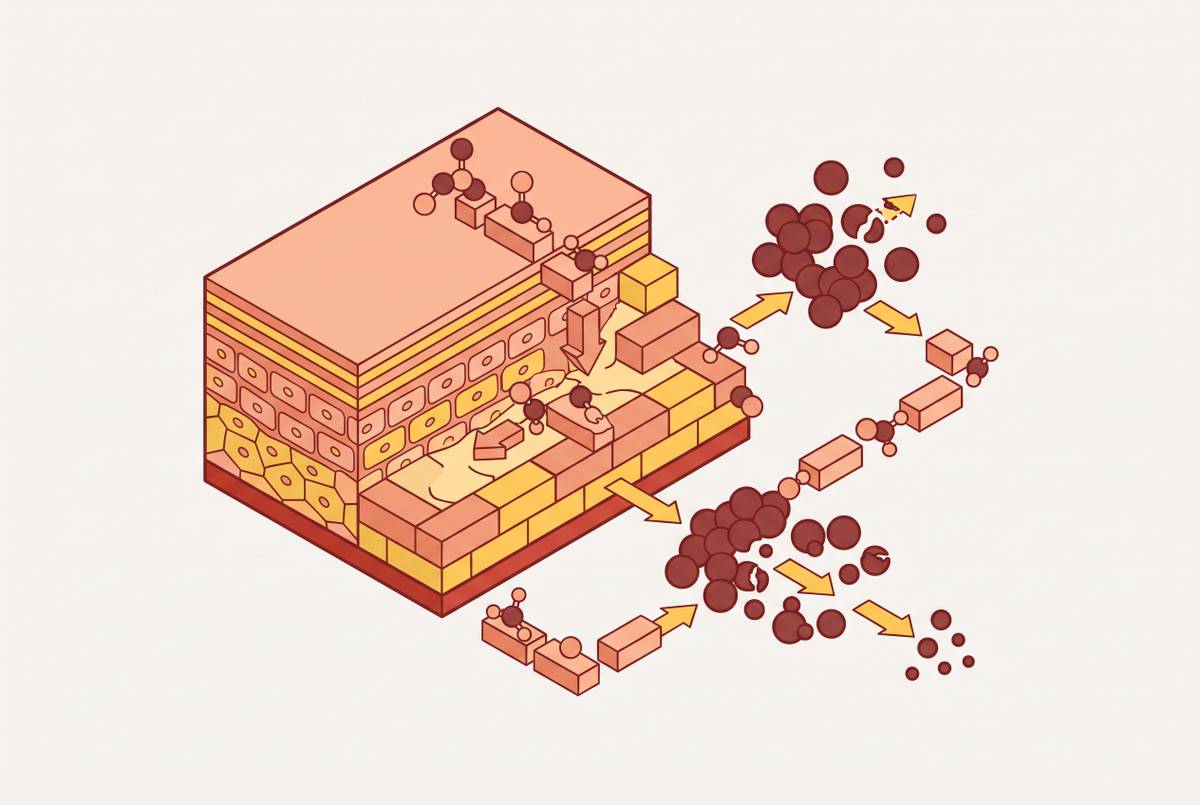
Picture the bacteria behind BV not as loose cells floating around but as a city built on the vaginal lining, with walls and a water supply. That's close to what actually happens. Instead of a simple overgrowth of one bad bacterium, BV involves a structured, multi-species layer of bacteria, called a biofilm, that forms directly on vaginal epithelial cells. The healthy vagina is normally run by Lactobacillus species. In BV, that balance shifts toward a mixed community of anaerobic bacteria, including Gardnerella, Atopobium vaginae, Megasphaera, Prevotella, and Sneathia. That shift, more than any single germ, is what defines the condition.
Gardnerella species appear to kick off construction of the biofilm, and once it's built, it shelters the other anaerobic bacteria living inside it. That shelter is the problem for antibiotics. Bacteria tucked inside a biofilm are physically protected from drug penetration, the same way a fortress wall blocks an approaching army. Metronidazole, the most commonly prescribed antibiotic for BV, can actually be broken down or trapped by bacteria within the biofilm before it ever reaches its target. And resistance isn't rare: most Gardnerella vaginalis strains tested in lab studies turned out to be resistant to metronidazole, though most stayed sensitive to clindamycin, the other first-line option.
There's a second layer working against the drugs, one that doesn't even require the biofilm's physical shield. Vaginal epithelial cells and bacterial cells living alongside each other carry enzymes that can break down antibiotics, plus transporter proteins that pump drugs and toxins back out of the cell before they can act. Treatment can fail for reasons that have nothing to do with resistance in the textbook sense. Putting the two layers together shows that a course of antibiotics can knock back symptoms while leaving the biofilm scaffold standing, ready to rebuild.
Why the vaginal microbiome does not simply restore itself after antibiotics
Clearing the harmful bacteria is only half the job, and it might be the easier half. The other half is restoring the Lactobacillus population that's supposed to run the vagina, and that part frequently doesn't happen on its own. After a course of antibiotics, protective strains like L. crispatus often fail to recolonize the vagina. The infection may be gone, but the healthy ecosystem that's supposed to replace it never shows up.
This matters more than it might sound like at first. L. crispatus doesn't just sit there as a placeholder. It produces lactic acid and other compounds that keep vaginal pH low, and that acidity is what keeps the anaerobic bacteria associated with BV from taking hold again. Without L. crispatus dominance, the vaginal environment sits open, waiting for the same bacteria, or new ones, to move back in. That absence is a vacancy that something tends to fill.
Part of the reason recolonization fails may be the treatment itself. The same antibiotic exposure that clears the dysbiosis also disrupts the broader microbial dynamics in the vagina, making it harder for a healthy community to reestablish itself afterward. That helps explain a pattern many patients recognize: things improve, then weeks or months later, with no obvious new exposure, symptoms return anyway. Nothing about the patient's behavior changed. Recolonization, not eradication, was the missing piece, and any treatment plan that stops at killing bacteria without rebuilding the Lactobacillus population treats half the problem.
Sexual transmission as a hidden driver of the recurrence cycle
A third mechanism operates almost independently of the first two, and it has nothing to do with whether the antibiotic worked or whether Lactobacillus came back. BV-associated bacteria can pass between sexual partners, resetting the vaginal microbiome toward dysbiosis no matter how well a given treatment round went, which points to a route of exposure that clinical practice has been slow to formally address.
A review in Current Opinion in Infectious Diseases lays out the accumulating evidence for this kind of transmission between sexual partners, and the authors describe it as a real shift in how BV's underlying biology is understood. One practical signal supports the pattern: patients with a history of sexually transmitted infections, candidiasis, or both, who have recently finished a course of antibiotics, show up with recurrent BV at notably higher rates. That's consistent with re-exposure driving at least some of the recurrence.
The strongest direct evidence comes from the StepUp trial, published in the New England Journal of Medicine. Treating male sexual partners with oral metronidazole along with topical clindamycin, at the same time the patient was treated, cut BV recurrence substantially compared with treating the patient alone. Recurrence rates stayed meaningful even with partner treatment, so this approach reduces risk without eliminating it, and its effectiveness outside heterosexual, monogamous couples hasn't been established yet. Clinical guidance is still catching up to the research. In November 2025, the California Department of Public Health recommended that clinicians consider offering concurrent partner therapy for male partners of cisgender women with confirmed recurrent BV in ongoing monogamous relationships. The suggested regimen pairs oral metronidazole twice daily for several days with topical clindamycin cream applied to penile skin twice daily over the same stretch.
The Cascade from Recurrent BV to Recurrent Yeast Infections
Patients managing recurrent BV often find themselves also managing recurrent yeast infections, and the two tend to get treated as unrelated nuisances that happen to show up around the same time. The connection runs deeper than coincidence. Recurrent BV can directly trigger recurrent vulvovaginal candidiasis through immune suppression, not simply as a side effect of the antibiotics used to treat it. Research in Microorganisms, from Sobel and Vempati, argues that in some populations, recurrent BV is actually the main driver behind recurrent yeast infections, not a bystander condition running in parallel.
The mechanism centers on the immune system. BV dysbiosis creates a proinflammatory environment in the vagina, and that inflammation compromises the body's normal defenses while also weakening its tolerance for yeast. That sets up conditions for a yeast infection independent of whatever antibiotics were used along the way. There's a second consequence that makes the cycle harder to escape: repeated antimicrobial exposure, including patients self-treating with oral fluconazole, appears to contribute to fluconazole resistance in C. albicans. Over time, in patients with frequent BV episodes, the standard yeast infection treatment may simply stop working as well as it once did.
Most people living through this don't connect the dots between the two conditions. They just experience a vagina that never seems to settle down. Understanding the mechanism changes the approach: treating BV more durably, rather than chasing each flare as a standalone event, should reduce yeast recurrence as a downstream effect. That reframing matters for anyone who feels like they're stuck fighting two separate battles when it may really be one.
Modifiable risk factors that patients and clinicians can act on
Everything described so far explains why recurrence happens. Some of the contributing factors are within reach to change, and a conversation about them with a clinician is a reasonable starting point for anyone trying to break the cycle. Contraceptive method turns out to be one of the more significant variables. The copper IUD carries the highest risk among common options: the prevalence of BV-associated bacteria rises substantially in the six months after it's placed. Hormonal methods behave differently. Hormonal IUDs and similar options show no notable increase in BV-associated bacteria over that same stretch, and some, including combined oral contraceptives and depot medroxyprogesterone acetate (DMPA), are linked to an overall decrease in BV-associated dysbiosis. Both are associated with a more stable, Lactobacillus-dominated vaginal microbiome. None of this means a copper IUD is the wrong choice for a given patient. Contraceptive decisions involve plenty of considerations beyond BV risk, and anyone currently using a copper IUD who's dealing with recurrent BV should bring the pattern to a clinician as one input into a shared decision, not treat it as a reason to switch methods unilaterally.
Smoking is another factor with real evidence behind it. Quitting is associated with a reduced risk of BV, which gives patients who smoke one more concrete reason, among many, to consider cessation. None of these factors guarantee an outcome on their own, and none of them should be read as something a patient failed to manage. They're levers, not verdicts, and identifying which ones apply to a specific patient is a practical way to start narrowing down what's driving a particular case of recurrence.
Evidence on Breaking the Recurrence Cycle Long-Term
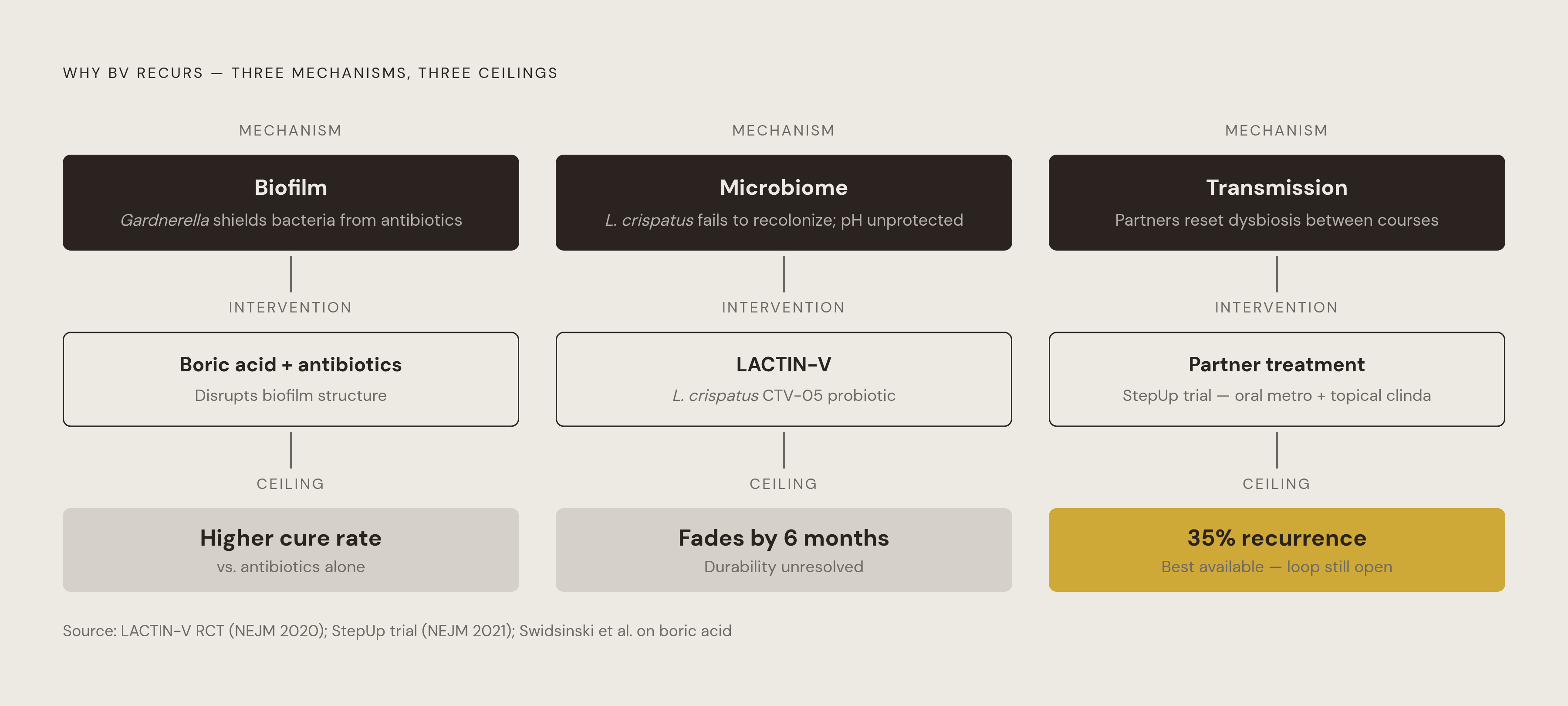
Given how many separate mechanisms contribute to recurrence, it follows that no single treatment addresses all of them at once. The current evidence points toward layering strategies, each aimed at a different piece of the problem: breaking down the biofilm, restoring the Lactobacillus population, and, where relevant, treating the partner.
On the biofilm side, boric acid used alongside antibiotic therapy has shown a notably higher six-month cure rate for recurrent BV compared with antibiotics alone. One maintenance protocol under study combines a seven-day course of metronidazole, followed by several weeks of intravaginal boric acid, followed by metronidazole gel twice weekly for four to six months. The logic tracks directly back to the biofilm mechanism described earlier: boric acid disrupts the biofilm's structure, which makes the bacteria inside it more vulnerable to antibiotics that previously couldn't reach them.
On the recolonization side, a live biotherapeutic product called LACTIN-V, built from L. crispatus CTV-05, is designed to restore exactly the species that so often fails to come back on its own after antibiotic treatment. Administered after a course of metronidazole, it produced a meaningfully lower BV recurrence rate at a follow-up timepoint compared with placebo, medRxiv preprint data from the LACTIN-V follow-up study show. The limitation is durability. By six months, recurrence rates in the LACTIN-V group had risen, and only about half of participants maintained colonization. The approach targets the right mechanism. Whether it holds up over the long run is still being worked out.
On the partner side, the California Department of Public Health's November 2025 recommendation gives clinicians a concrete option: concurrent partner therapy for male partners, using oral metronidazole twice daily for several days alongside topical clindamycin cream applied to penile skin on the same schedule. Even here, the recurrence numbers reveal the ceiling on what one intervention can do. Recurrence sat at 35% even with partner treatment in place, which tells a fuller story: partner treatment is a meaningful part of a plan, not a cure by itself. Taken together, the three strategies, aimed at the biofilm, the microbiome, and the transmission cycle, make long-term management look less like a single prescription and more like a coordinated plan built around the specific mechanisms keeping a given patient's recurrence going.
Sources
- Frontiers
- Advances in treating bacterial vaginosis: recognizing sexual transmission and pipeline of therapies - PMC
- Bacterial Vaginosis and Vulvovaginal Candidiasis Pathophysiologic Interrelationship
- The Role of Antimicrobial Resistance in Refractory and Recurrent Bacterial Vaginosis and Current Recommendations for Treatment
- Patient characteristics and factors contributing to recurrence of bacterial vaginosis presented in primary care
- Guidance: Partner Treatment to Prevent Recurrent Bacterial Vaginosis - Clinical Guidelines Program
- Donation strain engraftment demonstrates feasibility of vaginal microbiota transplantation to prevent recurrent bacterial vaginosis
- November 12, 2025