Clindamycin Topical Use for Acne Alone vs Combined
Clindamycin monotherapy targets bacteria alone while leaving three other acne mechanisms untreated.

Acne vulgaris comes from four processes working together, not one bacterial infection that a single drug can clear out. The Texas HHSC Therapeutic Class Review, updated January 2025, lays out the pathogenic basis that guides treatment decisions: androgen-driven stimulation of the sebaceous glands, disruption of the normal bacterial balance inside the hair follicle, and immune responses that produce inflammation. Follicular hyperkeratinization, the process by which dead skin cells clog the pore, completes the picture with four moving parts: clogged follicles, excess oil production fueled by androgens, overgrowth of the bacterium Cutibacterium acnes, and inflammation that runs through several separate biological pathways at once.
Clindamycin works on exactly one of those four. It binds irreversibly to the 50S ribosomal subunit inside C. acnes and stops the bacterium from making the proteins it needs to multiply. A 2024 review in the Journal of Dermatological Treatment confirms that this mechanism cuts bacterial proliferation and brings some anti-inflammatory benefit along with it. But the drug has no effect on sebum output, and it does nothing to unclog a follicle that's already plugged with dead skin cells.
That mismatch has a structural consequence: even when clindamycin does what it's supposed to do, the skin keeps producing excess oil and keeps shedding cells into clogged pores. Those two untouched processes rebuild the exact environment C. acnes needs to come back. Treating the bacteria without addressing the conditions that let them thrive is a temporary fix on a problem that keeps resetting itself. Understanding acne as four interacting mechanisms, rather than a single infection to knock out, shapes what a patient and a clinician should actually expect from any single drug. Platforms that pair AI-guided symptom intake with licensed clinician review, Nolla among them, help patients see which of the four mechanisms are actually driving their case before they settle on a plan.
What monotherapy achieves on its own
Because clindamycin only reaches the bacterial and inflammatory side of acne, its results as a standalone treatment run meaningfully behind what combination regimens achieve. That gap appears most clearly in lesion counts, and it differs depending on which kind of lesion you're looking at.
Comedones, the non-inflammatory lesions caused by clogged, oil-filled follicles, don't respond to clindamycin. The drug has no mechanism that reaches follicular plugging, so a patient on clindamycin alone keeps a steady supply of developing comedones even in weeks when visible inflammation looks calmer. Inflamed lesions may shrink for a while, but the pipeline that produces the next round of breakouts keeps running underneath.
For a patient living through this, partial treatment rarely registers as partial. It registers as failure. Acne that persists or comes back after weeks on a topical antibiotic reads as "this drug isn't working," and the natural response is to stay on it longer, switch to a higher strength, or add another round of the same antibiotic. That response feels reasonable. It's also precisely the pattern that creates the next problem: prolonged, extended antibiotic exposure is the exact condition that lets resistant bacteria get a foothold.
How clindamycin monotherapy accelerates antibiotic resistance
Monotherapy's costs go beyond lackluster results. Used alone, clindamycin measurably selects for resistant strains of C. acnes, and that selection pressure is something combination therapy demonstrably blocks. This turns the monotherapy-versus-combination choice into a stewardship question, not just a question of which approach clears skin faster.
Laboratory studies make the contrast concrete. Under clindamycin used alone, resistant C. acnes strains emerged. Under clindamycin combined with benzoyl peroxide, no resistant strains were detected. The reason traces back to how benzoyl peroxide kills bacteria. It isn't an antibiotic. It works through an oxidative mechanism, essentially a chemical kill rather than a biological one that targets a specific protein or receptor bacteria can mutate around. Because resistance only develops when bacteria survive repeated exposure to a mechanism they can adapt to, an oxidative kill doesn't give them that opening. Pairing it with clindamycin cuts the overall bacterial load through a second, independent channel, and that combination lowers the selective pressure that clindamycin alone would otherwise put on the bacterial population.
The Texas HHSC review, updated January 2025, confirms this is the accepted standard: topical antibiotics are typically combined with benzoyl peroxide specifically because the pairing improves efficacy, reaches more of the pathogenic process, and reduces the development of antibiotic resistance.
Time adds another layer of pressure. Current stewardship guidance caps topical antibiotic use at 3 to 4 months, usually described as 12 to 16 weeks, and discourages repeated or extended courses beyond that window. With a hard ceiling on how long any antibiotic course can run, each course needs to do as much work as possible while it lasts. Combination therapy is how that gets done within the time allowed.
Some practitioners lean toward monotherapy to avoid side effects, since adding benzoyl peroxide to a topical antibiotic can bring more dryness and irritation than the antibiotic alone. That's a reasonable concern, but it doesn't force a choice between comfort and stewardship. Lower concentrations of benzoyl peroxide preserve the resistance-blocking effect while staying tolerable for most patients, so the tradeoff practitioners often assume they're making usually isn't necessary. When patients see partial results or a return of acne on clindamycin alone, they tend to conclude the drug failed rather than recognizing that the approach was incomplete from the start, a distinction that generally takes a clinical conversation to sort out. A quick telehealth consultation can identify why a monotherapy course underperformed and move a patient toward a combination regimen without several more months of trial and error.
What current clinical guidelines recommend
The case against monotherapy is the documented standard inside dermatology. The American Academy of Dermatology's updated 2024 acne guidelines, the first update to the AAD's acne guidance since 2016, explicitly discourage topical antibiotic monotherapy, clindamycin included, and set combination therapy as the default approach for inflammatory acne.
Topical retinoids get named as cornerstone first-line treatments across a wide range of acne severity, whether used alone or folded into a combination regimen. Retinoids reach the hyperkeratinization pillar, the clogged-follicle mechanism that clindamycin has no effect on, which is part of why they show up so often as the combination partner of choice.
The guidelines treat the choice of combination partner, benzoyl peroxide, a retinoid, or both, as something that depends on the type and severity of a patient's acne, not as a matter of personal preference. That framing shifts combination therapy from a preferred option clinicians might reach for to a structural requirement of evidence-based care.
None of this writes clindamycin out of the picture. James Q. Del Rosso, who co-authored the 2024 comprehensive review of clindamycin, is direct about this: years of clinical trial data show clindamycin continues to contribute meaningfully to combination outcomes. The clinical question is what to combine clindamycin with.
The three combination options and their evidence
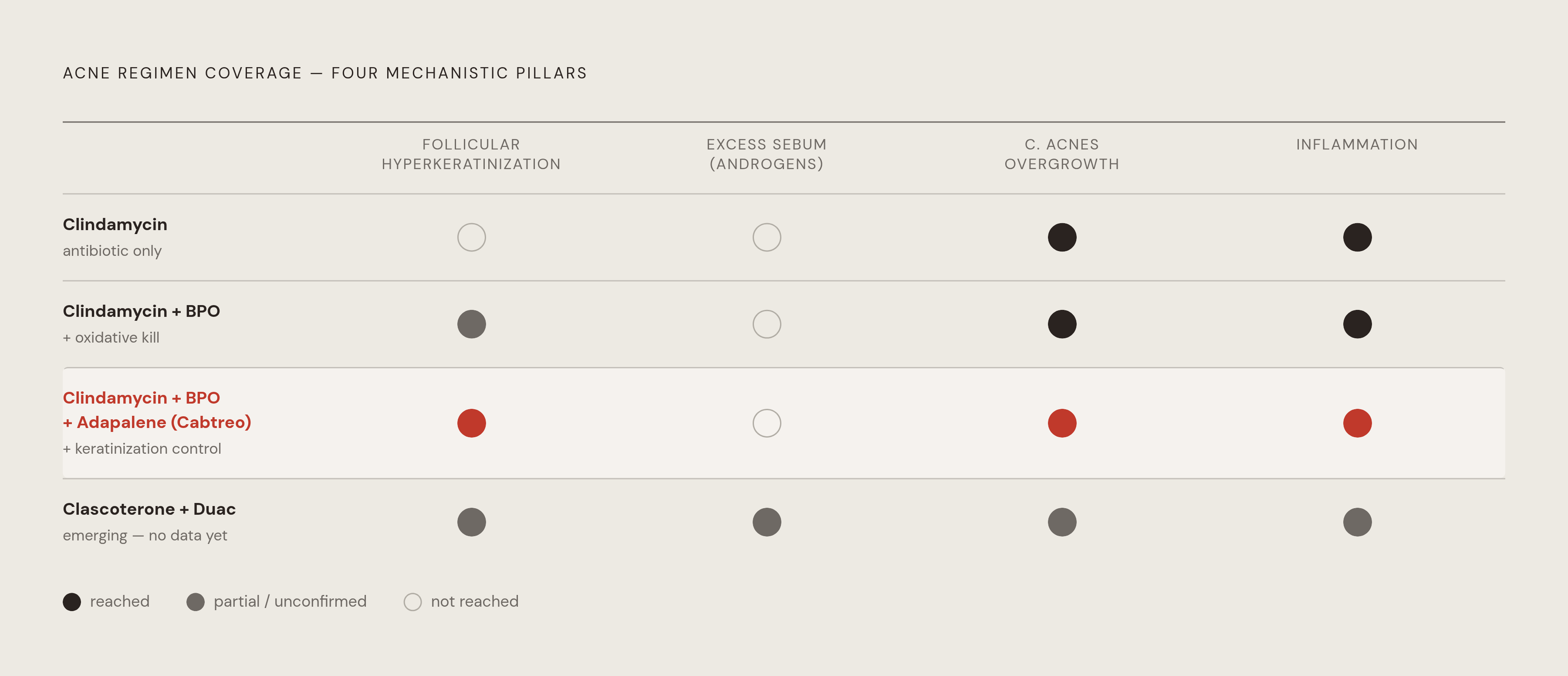
Combination regimens aren't interchangeable. The evidence sorts them into three tiers, clindamycin paired with benzoyl peroxide, clindamycin paired with a retinoid, and a triple combination of all three, and what separates them is how many of the four acne pillars each one reaches and how well each one holds off resistance.
The clindamycin-plus-benzoyl-peroxide pairing is the foundational combination. Clindamycin handles the bacterial and inflammatory side, while benzoyl peroxide adds its oxidative kill, blocks the resistance that clindamycin alone would invite, and brings mild comedolytic activity on top. The Texas HHSC review backs this as the standard pairing, citing better efficacy, broader coverage of the disease process, and reduced resistance development. Benzoyl peroxide comes in a range of strengths, and higher concentrations bring more irritation without a matching gain in results, so lower strengths suit most patients just as well. Onexton, the branded clindamycin/benzoyl peroxide combination, is now available as a generic.
Clindamycin paired with a retinoid reaches further into the disease process. A 2025 CSDerm review lays out the logic: this pairing is preferred because it covers multiple mechanisms that monotherapy can't touch on its own. Retinoids work by activating retinoic acid receptors, RARα, RARβ, and RARγ, which changes gene expression governing how skin cells grow and shed. That's the mechanism that reaches follicular hyperkeratinization and sebum-driven comedone formation, two processes clindamycin has no access to. The tradeoff is that this pairing leaves resistance control dependent on strict adherence to the 8 to 12 week course limit, since benzoyl peroxide's second kill mechanism isn't part of the regimen.
The triple combination, clindamycin phosphate, benzoyl peroxide, and adapalene, sold as Cabtreo by Bausch Health (Ortho Dermatologics), reaches all three mechanisms at once: antibacterial and anti-inflammatory action from clindamycin, oxidative kill and resistance suppression from benzoyl peroxide, and keratinization control from adapalene. It earns the strongest position among the three because it's the only one that covers bacterial load, resistance suppression, and follicular plugging in a single regimen.
One more pairing, still preliminary, tested clascoterone 1% cream combined with Duac Gel, a benzoyl peroxide/clindamycin product, for acne, in a completed study registered on ClinicalTrials.gov (NCT06336629). Clascoterone works as an androgen receptor antagonist that targets the sebum-production pillar directly, the one mechanism none of the three established combinations above reach. If the data eventually support it, a clascoterone-based regimen could be the first to address all four pillars in one treatment. Results from that study aren't available yet, so it belongs on the radar for future practice.
Why combination regimens require consistent use
Combination therapy's edge over monotherapy only holds if the regimen gets used consistently for two to three months straight. That's a real demand to place on a daily routine, and adherence in practice is uneven. The same obstacles that cause someone to skip applications, mix products incorrectly, or quit early often kept them from getting on the right regimen to begin with.
Guidance recommends changing the treatment plan if a patient shows no response within 12 weeks. Three months is roughly the window where a clinician needs to distinguish a regimen that genuinely isn't working from a regimen that's being used inconsistently. Catching that distinction early matters because the fix for each one differs: one calls for a new medication, the other calls for better instructions on how to use the one already prescribed.
Patients who understand why they're using multiple products at once, one targeting bacteria and inflammation, another targeting clogged follicles or oil production, tend to stick with the full regimen and flag problems sooner. Diet and hormones play into this too. High glycemic index foods, dairy, and androgen-driven oil production all interact with how well a given regimen performs, and a patient who can describe those patterns during an intake or consultation gives a clinician better information for picking the right combination partner from the start.
Much of what looks like a patient compliance problem actually traces back to a communication gap at the point of prescribing. A patient handed three products with no explanation of what each one does tends to simplify down to whichever one is most familiar or least irritating, dropping the rest without realizing what that costs them. Because antibiotic stewardship now caps topical antibiotic courses at 3 to 4 months, getting the most out of that window matters from the first prescription, not the second attempt after a failed one. That argues for building a combination regimen from the outset rather than starting with monotherapy and discovering its limits through trial and error. Fast-track dermatology services that connect patients directly to licensed clinicians can help make that first prescription evidence-based.
Sources
- Topical clindamycin for acne vulgaris
- Created Date: 11/13/2024 Acne Agents, Topical Revised Date: 11/13/2024
- A Study Assessing the Efficacy and Safety of Combined Use of Clascoterone 1% Cream and Duac Gel (Benzoyl Peroxide/Clindamycin) for the Treatment of Acne
- Clinical approaches in vogue for combination therapies for acne and post-inflammatory hyperpigmentation
- Combination Effects of Clindamycin and Benzoyl Peroxide Against Cutibacterium acnes - PubMed
- Guidelines of care for the management of acne vulgaris - ScienceDirect
- Combination Effects of Clindamycin and Benzoyl Peroxide Against Cutibacterium acnes - PMC